Trump’s war secretary Hegseth and Pacific Command chief Paparo may ‘soon visit China’
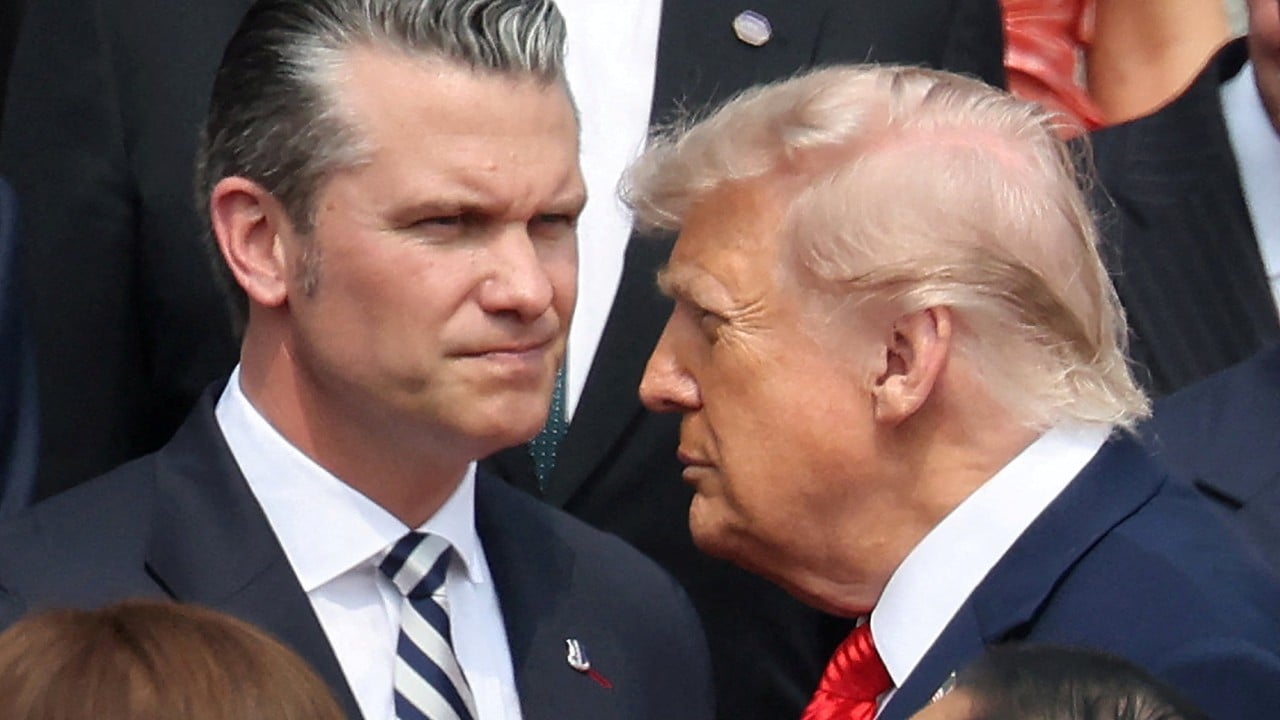
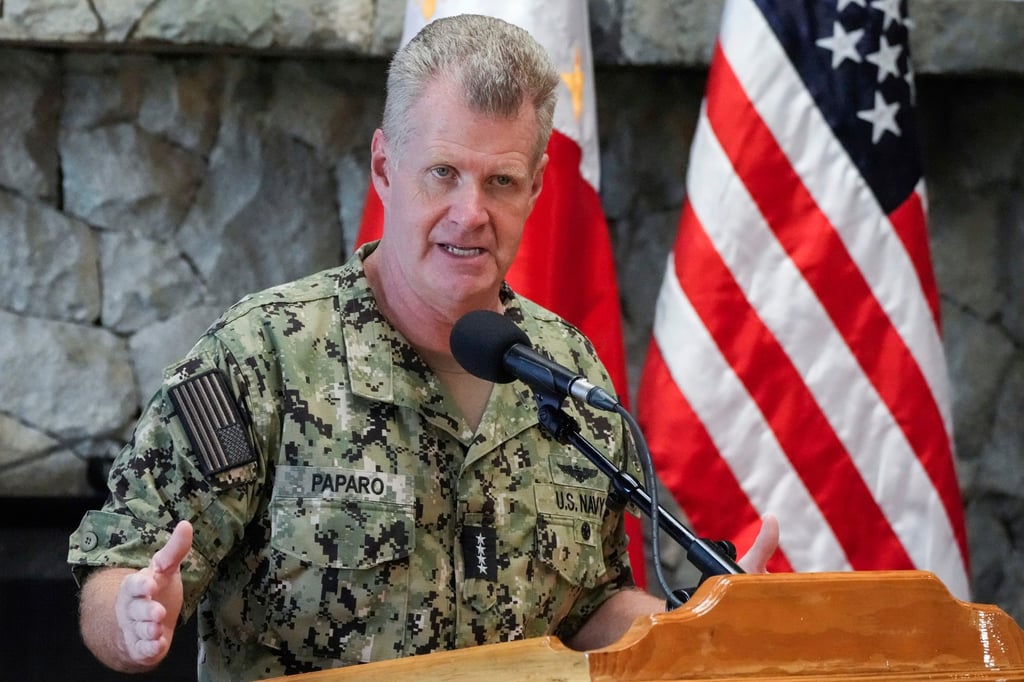
Pentagon chief Pete Hegseth and US Pacific Command head Admiral Samuel Paparo may visit China “soon”, according to a veteran China hand.
Stephen Orlins, president of the non-profit organisation National Committee on United States-China Relations (NCUSCR), disclosed the potential visit during a video address at a conference on Friday in Sanya, in southern China’s Hainan province. More than 400 Chinese officials, foreign diplomats and legal experts have gathered in the South China Sea resort city for the Global Maritime Cooperation and Ocean Governance event closing on Sunday.
Orlins said the prospective visit by Hegseth and Paparo would be critical to regularising military-to-military communication between Beijing and Washington.
The former US diplomat also warned that the South China Sea – rather than Taiwan – had become the flashpoint most likely to trigger an accidental military clash between the two powers.
09:58
Will Batanes become the next South China Sea flashpoint?
“So here’s what I would ask of both governments: first, regularise military-to-military contact at every level, so mistakes don’t happen, and when they do, we are able to have immediate discussions on how to de-escalate,” Orlins, who has led NCUSCR since 2005, said.
“I understand that Secretary of War Hegseth and Admiral Paparo may soon visit China. This is very useful to establish that contact.”
The two sides have been in talks in recent months for a potential China visit by the US defence secretary, possibly before year’s end, the South China Morning Post has learned.
Sources earlier told the SCMP that military-to-military communication was increasing, and that Washington had for months been preparing for separate visits to China by Hegseth and Elbridge Colby, the undersecretary of defence.
Reciprocal visits by Hegseth and Chinese Defence Minister Dong Jun had also been discussed since Xi Jinping and Donald Trump met in Washington in September, the sources said.
It is unclear whether those plans have changed after this week’s midterm elections that saw major Republican losses.
If confirmed, Paparo’s visit will also be the first trip to China by a US Pacific command chief since 2015.
Headquartered in Hawaii, the US Pacific Command, reverting to its original name from Indo-Pacific Command in June, oversees American military operations across the Asia-Pacific. This places its commander on the front lines of potential confrontations with the People’s Liberation Army in flashpoints like the Taiwan Strait and the South China Sea.
Paparo, who assumed the post in May 2024, has advocated a sharp deterrence posture towards Beijing. He previously outlined a so-called hellscape strategy, proposing to deploy thousands of autonomous aerial, surface and underwater drones to deter the PLA and to buy time for the US and its allies to respond in the event of a cross-strait war.
SCMP Plus is a new premium news platform that gives you an
all-inclusive edge to stay ahead on China news.
To access our exclusive content you’ll need to subscribe.
Already a subscriber?
LOG IN
In response to queries from the SCMP, the Pentagon and US Pacific Command said they had no announcements to make at this time.
Meanwhile, the prospect of a visit by Hegseth has been thrown into doubt as he faces mounting calls to resign or risk impeachment proceedings. Those demands have intensified following the Republican Party’s midterm drubbing – driven largely by public outrage over the ongoing war in Iran and the resulting spike in fuel prices.
02:53
US midterm elections: What the results mean for mainland China, Taiwan and foreign policy
Thomas Massie, an outgoing Republican House representative, has called for a vote to impeach Hegseth next week when the chamber reconvenes.
“There is one contingency in which I won’t reintroduce the articles of impeachment: Hegseth resigns,” Massie wrote on social media on Tuesday.
Hegseth has remained defiant, saying that he would “not back down” against a “lame duck” Congress and the calls for his impeachment “will not work.”
“Didn’t work against President Trump, and it won’t work with me. You can rest assured of that,” Hegseth said in a video post on Thursday.
Zhu Feng, dean of Nanjing University’s School of International Studies, said the potential visit could be a “positive step” towards constructive strategic stability, a new framework in ties agreed upon by Trump and Chinese President Xi Jinping in Beijing in May.
He noted that a visit by Paparo could also be part of the efforts to strengthen “working-level communications” between the two militaries.
High on the agenda, Zhu said, could be “urgent talks on the South China Sea, the Yellow Sea, and the East China Sea to prevent accidental friction”.
“The third area could be artificial intelligence, which is shaping new forms of military warfare, and the two sides must step up communication here as well to avert unpredictable crises.”
Sourabh Gupta, resident senior fellow at the Institute for China-America Studies, said the possibility of the visit was an “unmistakable plus” for the US-China political relationship.
“That a defence secretary would visit Beijing twice in a calendar year is remarkable in itself,” he said, in a reference to Hegseth being part of the US delegation during Trump’s state visit to Beijing in May.
“Such meetings do establish an important floor of stability for ties.”
According to Gupta, the two sides are making only “marginal and grinding progress on the trade and investment front”, which means that “the foreign-defence-national security side of things must pick up the slack”.
“It is my impression that the Chinese side has determinedly stepped up the level of engagement and problem-solving on military-to-military challenges,” he noted.
While economic ties remain strained by reciprocal tariffs, export controls and sanctions, military engagement has shown signs of a thaw, with both sides keeping communication lines open and pledging to preserve peace and deepen mutual understanding.
Gupta said although progress in restoring military ties and communication channels had been slow, the frequent military talks at multiple levels in the past few months were an “unambiguously positive sign”.
“Slow but steady is good enough, given the depth of geostrategic competition between the two sides in the Asia-Pacific theatre.”
US and Chinese defence officials held a two-day meeting of the newly created Crisis Communications and Prevention Working Group in Washington on Monday, the first such exchange in six years.
A Pentagon readout released on Tuesday said the two sides agreed on the importance of “advancing practical communication measures” to reduce risks in the US-China relationship.
The officials also discussed “additional channels” for “effective” crisis management and ways to communicate “expediently and effectively”.
The Pentagon said the November 2-3 meeting was attended by Cynthia “Xanthi” Carras, principal director for China, Taiwan and Mongolia at the Office of the US Undersecretary of War for Policy, and Senior Colonel Wang Wei, deputy director of the Americas and Oceania Affairs Bureau at the PLA Office of International Military Cooperation.
02:22
US defence chief Hegseth says Trump seeks ‘peace through strength’ in Shangri-La speech
Command-level talks also resumed in August after a two-year hiatus, with Chinese General Yang Zhibin, commander of the Eastern Theatre Command overseeing the Taiwan Strait and the East China Sea, meeting Paparo in Canada.
“The two leaders discussed the importance of maintaining open lines of communication between senior US and Chinese military leaders to reduce the risk of miscalculation and promote safe and professional conduct between forces,” the US Pacific Command said in a statement.
In July, a senior Pentagon official attended a reception at the Chinese embassy in Washington to mark the 99th anniversary of the PLA, becoming the first senior US defence official in more than five years to attend such an event and deliver remarks.
“Under the leadership of Secretary [Pete] Hegseth, we are actively repairing a once broken military-to-military channel and making clear, steady progress,” Alvaro Smith, deputy assistant defence secretary for China, Taiwan and Mongolia, said in his address.
“This is how two powerful militaries should engage, and over the last year and a half, we [have] made this a reality.”
KioskNews shows a cleaned-up reading view extracted from the publisher’s page — the original always lives on their site, not ours.