‘You can taste the land’: the Somerset farmer bringing wildflowers back to cheddar
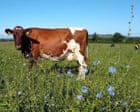
In the rolling hills of Somerset, hundreds of thousands of cows placidly munch lush green grass to produce milk for cheddar.
But six fields stand out. Rather than uniform grass, they have technicolour wildflowers sprouting across the meadows. Farmer Tom Calver said that to allow the flowers to grow he has to keep fewer cows and leave some fields ungrazed as they mature.
“Other farmers thought we were nuts for doing this,” said Calver, who runs the Westcombe dairy in the eponymous hamlet in Somerset.
He is pioneering emerging research that suggests that when cows are fed in an organic way, their microbiome is healthier and more complex than when they are given modern feed. It is thought that feeding cattle a wide range of plants creates a healthier gut microbiome still.
“We have actually lost milk production in what we’re doing,” Calver said, but added the cheese tasted better than ever as it is “meadow flavoured”.
Cheddar has been made in the county for over 850 years, and cows once grazed more varied pasture, much like Calver’s black-and-white herd do now.
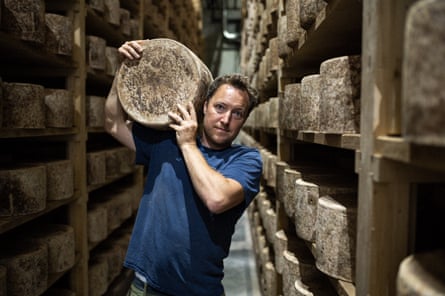
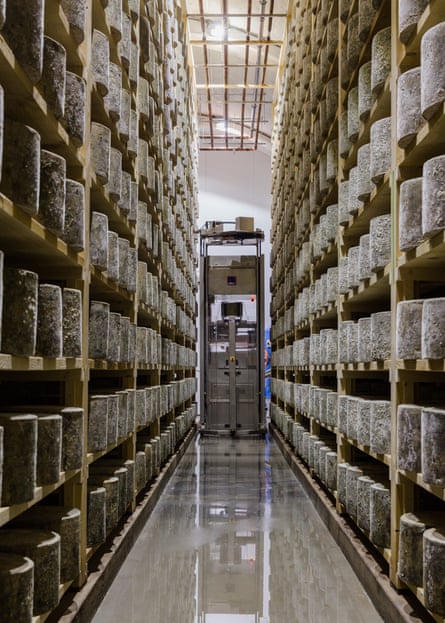
Calver believes his Westcombe cheddar, which is raw and unpasteurised, has a much more complex taste than the average supermarket block and this is because of its microbiome.
“If you look at the diversity of what cows have been eating before, we were growing lots of maize and Italian rye grasses,” Calver said.
“Now, actually, the cows are out into 19 different species of plants in our paddocks. What’s living on those plants is a huge, diverse range of microbiome, and I think you’ve probably heard a lot about how the microbiome is actually helping our guts and minds and everything else like that. It also actually has a massive input in the flavour profile.”
Calver, a trained chef, said he didn’t understand why cheese couldn’t have a “terroir” – a taste of the land where it was created, just like wine does. “You talk to viticulturists, winemakers, and they talk about terroir, and I think that’s amazing. It’s what we can actually use to improve diversity in our landscapes and in the flavour of our foods.”
The drawback is that his way of farming is “much more expensive”.
But Calver believes it’s worth it. He said that growing wildflowers rather than just maize and grass has boosted nature on his farm, and he also prefers the taste of the cheese now: “You can actually like taste the land. You can taste everything around it.”
Calver said it had been hard to market the cheddar as it tasted different every time due to the diversity of the plants the cows are fed.
“One of the things that we are very bad at, I think, is wanting to have the same thing every single day. When you’re working with nature and you’re actually trying to farm in that particular way, you have to embrace diversity, even of the actual flavour profiles that you’re actually creating as well, which makes it very difficult for a retailer to actually market that. It is quite a challenge.”
Growing deep-rooted wildflowers in the meadows helped the farm during this year’s drought, too. “We’ve got lots of chicory that’s actually going down and accessing water from subsoil and actually bringing that up. So we’ve done rather well.”
Farmers trying to graze their cattle on parched fields looked at Calver’s comparatively greener land with envy. “I think there’s been a lot of other farmers locally who have been, hopefully, maybe inspired by taking a slightly different approach,” he said.
KioskNews shows a cleaned-up reading view extracted from the publisher’s page — the original always lives on their site, not ours.