Raymond J. de Souza: Elon Musk’s unglorious moment
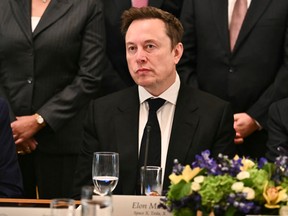
Even for the world’s premiere celebrity entrepreneur, Elon Musk is having something of a moment.
Sign In or Create an Account
He was on the cover The Economist’s special summer issue over the headline, “Should you be afraid of Elon Musk?”
When U.S. President Donald Trump invited the would-be, perhaps-already-are, gods of artificial intelligence to the White House, Musk was seated directly at the president’s side. The convened tech titans signed a “morally binding” declaration to use, more or less, AI for good things, not bad.
To have Trump preside over the making of moral commitments showed something of a sense of humour. To rely on the moral commitments of the same people who have devoted impressive ingenuity and massive marketing into products that intentionally seek to addict their customers, including children, is less funny.

Columnist Jesse Kline keeps you up to date with what’s happening in Israel and the effects of antisemitism on life here in Canada. Friday mornings.
By signing up you consent to receive the above newsletter from Postmedia Network Inc.
A welcome email is on its way. If you don't see it, please check your junk folder.
The next issue of Channel Israel will soon be in your inbox.
We encountered an issue signing you up. Please try again
Days had barely passed before Musk was appointed by Defence Secretary Pete Hegseth to a three-person panel to advise on autonomous weapons. Perhaps the moral commitment to use AI for good includes permitting AI agents to choose and destroy targets — to kill on their own.
Then Musk offered his views on Canadian Confederation, namely that there should be much less of it. Quebec, Alberta and Saskatchewan were advised to separate. That would leave an odd-looking Canada, but perhaps then Ontario would separate from it, too.
Musk, it should be noted, knows something about Ontario, having lived in Kingston for two years. A decade or so ago, Queen’s University was rather more bullish on promoting its quondam student than it is now. I learned recently from an old alumni magazine that Musk and I arrived on campus together in September 1989 as undergraduates. We apparently lived in the same residence, Victoria Hall. It was a big residence, more than 800 students. I don’t recall ever meeting him. In any case, after two years Musk was off to the Ivy League.
He may continue to pay attention to Canada, as a good number of the 14 children he has fathered with several women are Canadian citizens. Their names alone — X Æ A-Xii, Techno Mechanicus, Seldon Lycurgus — suggest grounds for questioning his non-engineering, non-entrepreneurial judgment.
There is much to admire in the visionary engineer and daring entrepreneur. It is well established that he sees what other do not, and makes happen what others cannot. The adjective “unique” is rarely employed accurately; Musk may well be just that.
At least he managed to convince his board of directors that he is exactly such, unique in that he is utterly irreplaceable. For him, they crafted a trillion-dollar compensation package, making him unique in that regard, too — the world’s only trillionaire. His worth is so great that it now measures half of the annual deficit of the American federal government.
Which is relevant, in that before signing on to Trump’s moral pact, and advising the Pentagon, Musk did a few months of government service last year at the Department of Government Efficiency (DOGE). He promised to find some $2 trillion in savings; after a few months his service wrapped up with estimates that DOGE achieved something on the order of $60 billion to $160 billion in savings. Not nothing — the Pentagon may need that much just to rebuild the military bases it lost during the Iran war.
There is much debate over what DOGE achieved, and Trump administration claims are worth whatever credibility the Trump administration has. What is not in dispute is that Musk and DOGE had one singular so-called success: the shuttering of the United States Agency for International Development (USAID).
USAID was the principal federal agency for overseas aid, humanitarian assistance and global development programs. It was the main co-ordinating agency for the President’s Emergency Plan for AIDS Relief (PEPFAR), the flagship 2003 program credited with saving millions of lives from HIV/AIDS, mostly in Africa.
When Musk cast his careful eye over the vast array of American government programs, he thought it best to start by cutting programs for the poor, the sick and the suffering. Indeed, some of the poorest, sickest and most suffering people on the planet.
DOGE shut down USAID and merged its programs into the State Department, significantly cutting USAID grants, including for PEPFAR. Thousands of experts in providing practical assistance to the poorest parts of the globe were let go. How many preventable deaths were not prevented is hard to measure, but the scale is sobering, measured in hundreds of thousands, if not millions.
No doubt there was some waste at USAID. But more than, say, at the Pentagon, or the panoply of federal agricultural subsidies to farmers, or the payments to Big Pharma? Musk’s moral judgment was to start first with the most vulnerable and move on from there. Actually, there was no moving on, as Musk lost interest and DOGE was wound down.
The most powerful government in the world enabled the richest man in the world to cut aid to the poorest people in the world.
Afraid of Elon Musk? No need. Rather, be afraid of what Musk betrays of our moment, when the powerful and the rich combine forces to further immiserate the weak and the poor.
National Post
Join the Conversation
This website uses cookies to personalize your content (including ads), and allows us to analyze our traffic. Read more about cookies here. By continuing to use our site, you agree to our Terms of Use and Privacy Policy.
KioskNews shows a cleaned-up reading view extracted from the publisher’s page — the original always lives on their site, not ours.