Van Eyck: The Portraits review – a jewel box of phenomenal death-defeating paintings
The stubble is tiny yet silver-sharp on the chin of an unknown old man whom Jan van Eyck painted in oils 600 years ago: so long after both are dead you can still see this bloke needs a shave. The hairs on top of his head are just as miraculously caught, varying individually in paleness and lankness. You feast your eyes on the sagging skin of his throat with its overhangs and shady gulleys like a rock formation. He is a wonder, a freak of nature and yet a perfectly ordinary person. So are we all banal and marvellous, mundane and impossible, suggests Van Eyck.
The National Gallery has created a jewel box of a show bringing together all Van Eyck’s portraits as we define them – a painting of a person for its own sake. Yet portraitist was a long way from being his only job. Van Eyck painted stupendous religious works, including the Ghent Altarpiece that he collaborated on with his brother Hubert. These too have portraits in them, of real people in uncanny proximity to supernatural beings. You could argue this show cheats by cutting out that medieval context of prayer and faith. It’s also a great way for the gallery to show off that it owns three of his greatest portraits. Yet the result makes you see the utterly strange way he collects his slightly miniaturised people like flies in amber.
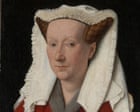
This artist who worked in Flanders at the end of the middle ages paints like an alien who has hidden his flying saucer in a barn outside Bruges and gone into town to observe the humans. Every detail of earthly life seems new to him. A woman with a big, blunt face looks at us from under the gold-ribboned horns of her fashionable hennin headdress. Van Eyck records the shine, moisture and green-greyness of her eyes but she remains a mystery to him. She is his wife.
If it seems fanciful to see Van Eyck as an alien, stories about him in the Renaissance were nearly as extreme. Vasari believed he was some kind of alchemist who chanced not on gold but the new medium of oil painting. It’s a powerful fable for there is something occult about a painter who can create gold by a trick of the brush. In Van Eyck’s portrait of Jan de Leeuw, a Bruges goldsmith, your eyes are hypnotised by his tiny ring like a real nugget of gold magically inserted into the illusory space of the painting.
The modern artist Willem de Kooning said oil painting was invented to depict human flesh – he was probably thinking of Titian’s lush nudes. Van Eyck reveals the mystery of flesh just by painting a face. No one before looked at the world the way he does. He didn’t invent oil painting but he was the first fully to exploit its multiplicity of slowly built-up layers to create a mirror-like image of reality. Van Eyck is surely looking at himself in a mirror, gazing with piercing, even merciless eyes in his portrait of a man with his head wrapped in crimson cloth. We see the laughter lines in his gold-tinted skin, the pink flush in his cheeks, the beginnings of age or ill health, for Van Eyck would die at around 50. I think it’s timid not to call it a self-portrait.
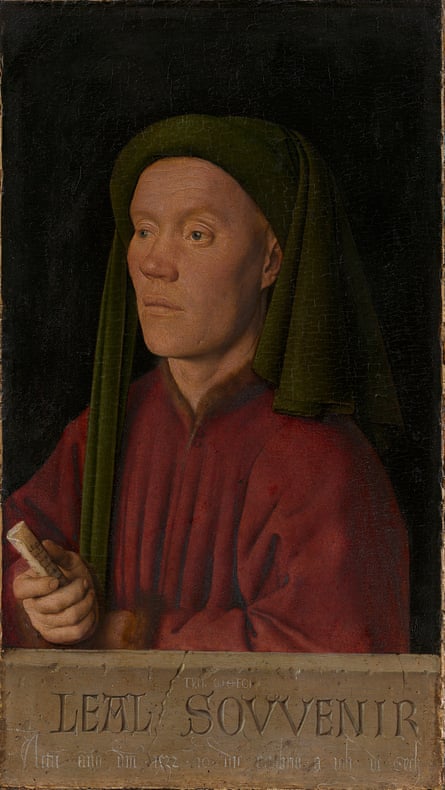
He depicts smooth youth too, in his portrait of a young man glowing in a brilliant twilight, perfect for ever, behind a parapet with the inscription “Léal Souvenir”, which means something like “loyal remembrance”. This portrait is surely an aid to mourning, a souvenir of loss.
That’s fundamental to what Van Eyck does. His portraits are phenomenal acts of preservation. Behind the clinical exactness of each wrinkle, each chin hair, is a desperate attempt to freeze time, defeat death, make loyal memories of people who will soon be gone, even if they are monstrous.
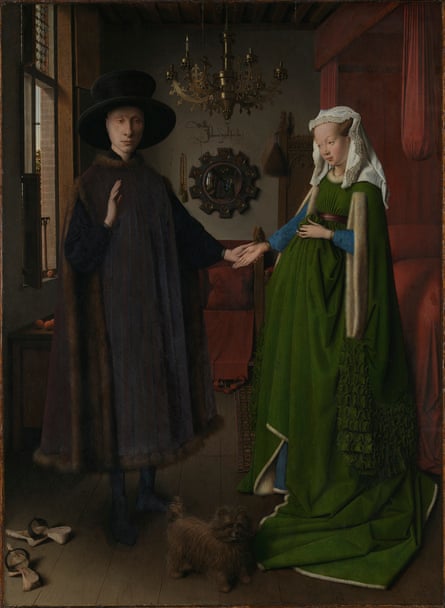
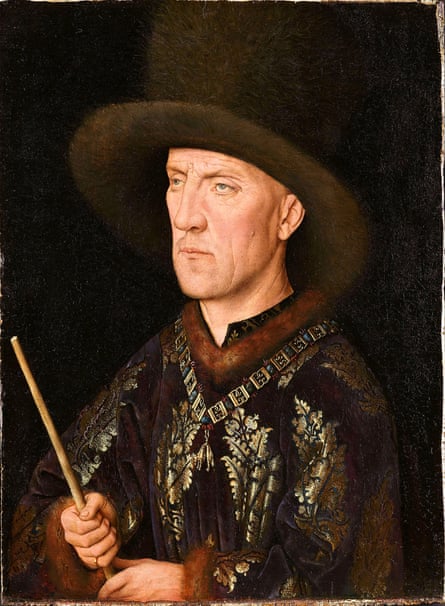
The Burgundian courtier Baudoin de Lannoy looks a total bastard. He gazes to the side sulkily under his huge, felt-rimmed hat. His eyes are hooded orbs, his long face pummelled by jousts and battles. Yet he is preserved for ever, the shape of his ear meticulously recorded as if in a criminal profile. Uglier still is the Italian merchant in the Arnolfini Portrait, his thin, pasty face half in shadow. The shady side of his face has a droopy, rheumy eye. Has he got a palsy? His sickly face couldn’t contrast more with the pearly beauty of his wife. They seem an ill-matched couple: Death and the Maiden.
after newsletter promotion
Yet a portrait of the same man alone, done around two years later, shows him with bright eyes. Is he being flattered here or insulted in the Arnolfini Portrait? Van Eyck is not a camera, passively recording his world. His paintings are full of imagination, even whimsy. His only surviving drawing, which is in this show, is a study of the stubbly old man. Comparing the drawing with the painting, you see that the sketch is more respectful: in the finished painting he elaborates wildly on swags of skin, the vortex of the ear.
The weird geology of ears, chins and wrinkles anticipates the impulsiveness and chaos of Hieronymus Bosch. Van Eyck’s portraits are brooding creations of north European melancholy. Entering his world is perfect as winter deepens.
KioskNews shows a cleaned-up reading view extracted from the publisher’s page — the original always lives on their site, not ours.