Did you solve it? How Super Mario explains Renaissance art
Earlier today I set you the following puzzle. Here it is again with the solution.
Consider a simplified game of Super Mario. He moves from platform to platform. He can either step forward 1 space, to the next platform, or jump forward 2 spaces, to the platform after that.
He starts on the first platform. How many ways are there for Mario to land on the last platform if the level has:
-
3 platforms?
-
4 platforms?
-
5 platforms?
-
10 platforms?
And what has this got to do with Leonardo da Vinci?
Solution 55
We begin by listing the possible routes across each level.
3 platforms: to cross from the first to the third there are two routes:
-
step – step
-
jump
4 platforms: to cross from the first to the fourth there are three routes:
-
step – step – step
-
step – jump
-
jump – step
5 platforms: to cross from the first to the fifth there are five routes:
-
step – step – step – step
-
step – step – jump
-
step – jump – step
-
jump – step – step
-
jump – jump
That’s enough enumeration. There’s a quicker way to do this. Notice that the number of routes on a level with n platforms is simply the sum of the totals of levels with n – 1 and n – 2 platforms.
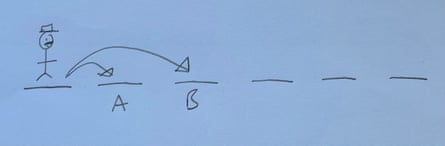
For example, with 6 platforms, illustrated above, there are two choices for the first move – a step or a jump - to either A or B. From A the problem has reduced to a level with 5 platforms (five routes), and from B to four platforms (three routes). So the total is five + three = eight routes.
So with 7 platforms, there are thirteen routes (8 + 5).
With 8 platforms there are twenty-one (13 + 8).
With 9 there are thirty-four (21 + 13).
With 10 there are fifty-five (34 + 21)
The sequence in bold may be familar to some readers. It is the Fibonacci sequence, named after the Italian mathematician who wrote about it in the early 13th century. It starts with 0, 1, and every new term is the sum of the two previous terms.
0, 1, 1, 2, 3, 5, 8, 13, 21, 34, 55, 89, …
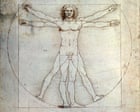
Fibonacci was also known as Leonardo da Pisa, but the question asked about his namesake Leonardo da Vinci. The Fibonacci sequence links to the painter of the Mona Lisa via the golden ratio.
Consider ratio of consecutive terms of the Fibonaci sequence from 1:
1/1, 2/1, 3/2, 5/3, 8/5, 13/8,…
1, 2, 1.5, 1.67, 1.6, 1.625,…
These terms converge on a number, the golden ratio, which is 1.618 to three decimal places. The golden ratio can also be constructed geometrically: imagine a rectangle with long side A and short side B. If (A+B)/A = A/B, then A/B = 1.618…
In 1509, Luca Pacioli published a book about the golden ratio that was illustrated by Leonardo da Vinci. It was called Divina Proportione, divine proportion.
The book helped popularise the idea that the golden ratio captures beauty. While there is no scientific proof that that humans are more attracted to the golden ratio than to any other ratio, many artists, architects and plastic surgeons use the golden ratio in their work.
The maths is pretty cute though!
Thanks to Dr Tom Crawford for today’s puzzle. His new book How Many Pikachus Would it Take to Power a Lightbulb? asks entertaining questions about fantasy worlds and answers them with proper maths. The books is available at the Guardian Bookshop.
I’ve been setting a puzzle here on alternate Mondays since 2015. I’m always on the look-out for great puzzles. If you would like to suggest one, email me.
KioskNews shows a cleaned-up reading view extracted from the publisher’s page — the original always lives on their site, not ours.