Pingtung museum showcases juvenile whale fossil
By Tsai Tsung-hsien and Fion Khan / Staff reporter, with staff writer


The National Museum of Marine Biology and Aquarium in Pingtung County has for the first time exhibited a 6m-long prehistoric whale fossil that was unearthed in the Szekou Formation (四溝層) on the Hengchun Peninsula (恆春半島).
The discovery was the second large whale bone find on the Hengchun Peninsula in a three-year period, following the discovery of a fossil tentatively identified as a gray whale several years earlier.
The prehistoric whale, believed to have lived 50,000 to 100,000 years ago, was discovered by fossil expert Lin Ching-wen (林景文) in July last year, after torrential rain caused rock layers in the Szekou Formation in western Hengchun to collapse.
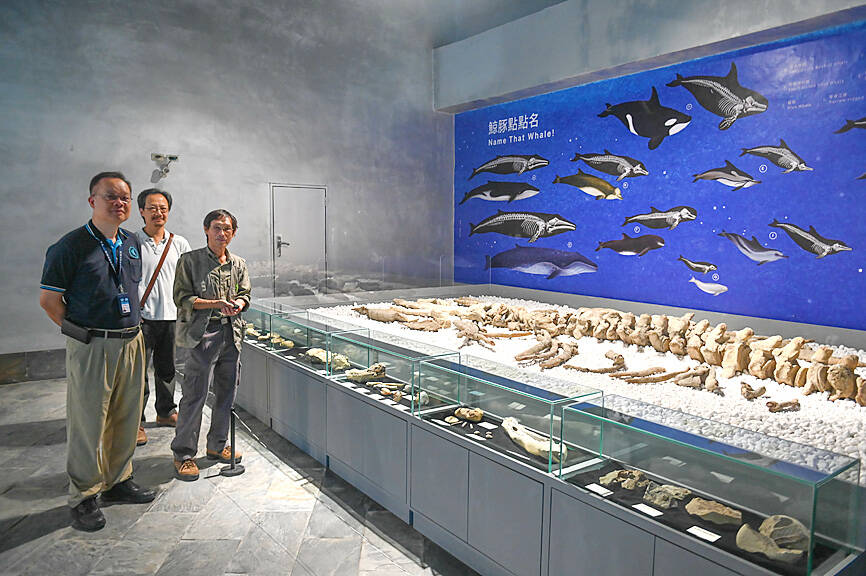
People stand next to a whale fossil unearthed on the Hengchun Peninsula at National Museum of Marine Biology and Aquarium in Pingtung County on Saturday.
Photo: Tsai Tsung-hsien, Taipei Times
Lin spent 135 days excavating the fossil, recovering more than 130 skeletal pieces, including a complete lower jaw, parts of the skull, ribs and vertebrae, with more than 80 percent of its skeleton preserved.
A preliminary assessment suggested that the specimen might belong to the right whale family, museum fossil expert Lee Shih-wei (李世緯) said on Saturday.
The growth plates in its vertebrae had not yet fully fused, suggesting that the whale was probably still a juvenile when it died, he said.
About 100,000 years ago, the waters off the Hengchun Peninsula were relatively shallow and calm, potentially providing a safe haven where mother whales could rear their calves and forage, Lee said.
While modern whales near Taiwan are frequently observed in Pacific waters off the east coast, the discovery provides valuable clues about changes in ancient marine environments and whale migration routes, he said.
Taiwan had previously lacked a specialized paleontological collection focused on locally discovered marine fossils, museum director Wen Chih-hung (溫志宏) said.
A large whale fossil discovered earlier had been acquired by the National Museum of Natural Science in Taichung, but this time, the National Museum of Marine Biology and Aquarium worked with private and academic partners to ensure that the juvenile whale fossil would remain on the Hengchun Peninsula, he said.
The exhibition opened on Sunday.
The museum is planning to establish a paleontology section to create a dedicated repository for fossils documenting Taiwan’s prehistoric marine life, Wen said.
The museum aims to raise Taiwan’s international profile in marine research and share local finds with the public through science education, he said.
KioskNews shows a cleaned-up reading view extracted from the publisher’s page — the original always lives on their site, not ours.