Tourism Administration issues diving guidelines for better water activity safety
By Fion Khan / Staff writer, with CNA


The Tourism Administration has issued new guidelines for diving activities, following a series of diving-related accidents over the past few years.
Earlier this month, a diving student experienced hypoxia, lost consciousness and died after a training dive at a bat cave in New Taipei City’s Rueifang District (瑞芳) when sea conditions worsened.
On Sunday last week, six divers were trapped by high waves off Longdong (龍洞) in New Taipei City’s Gongliao District (貢寮). They were rescued by the Coast Guard Administration and no injuries were reported.
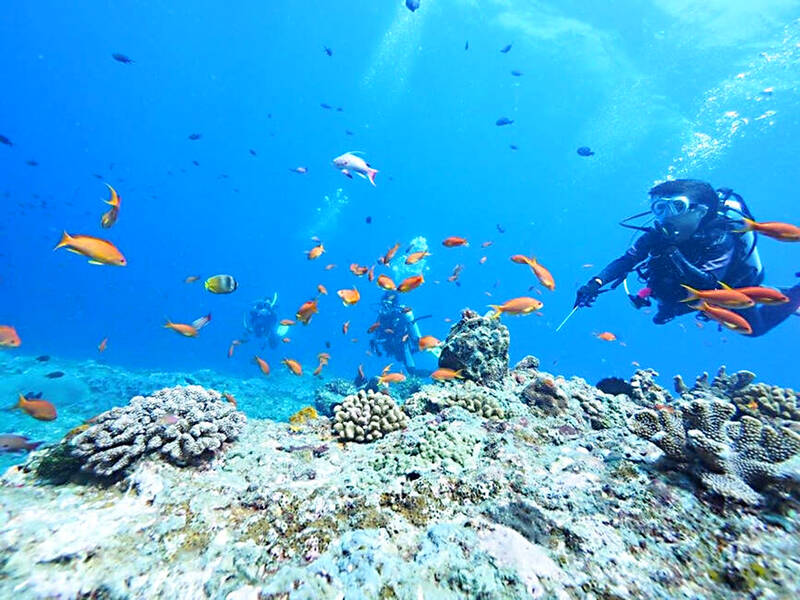
A diver explores waters off Pingtung County’s Hengchun Township in an undated photograph.
Photo: Tsai Tsung-hsien, Taipei Times
To improve safety and provide a clearer regulatory framework for operators, the Tourism Administration published guidelines covering snorkeling, scuba diving and freediving.
The guidelines define snorkeling as diving activities involving a mask, fins or snorkel; scuba diving as diving with a mask, fins, snorkel and breathing apparatus; and freediving as diving without breathing equipment.
The guidelines outline the legal framework governing water recreation activities, clarify the responsibilities of the authorities, and define diving activities and equipment requirements, the administration said.
They also provide guidance on dive leaders and dive buddies, and address safety and risk management, it added.
Under the guidelines, people scuba diving or freediving must hold a qualification certificate issued by domestic or international diving organizations.
People who engage in such water activities should meet internationally recognized training standards, including age and health requirements, basic swimming ability, marine safety awareness, and appropriate supervision and companion arrangements, the guidelines state.
Scuba divers should be equipped with a complete breathing system, including a regulator, buoyancy compensation device and air tank, while freediving gear includes a snorkel, mask, wetsuit and surface identification devices, they say.
Contravening the Act for the Development of Tourism (發展觀光條例), such as engaging in water recreation activities in prohibited areas, are punishable by a maximum fine of NT$50,000, while commercial operators may face fines of up to NT$200,000, the guidelines state.
Other violations involving facilities, personnel or certification requirements would be handled under the regulations of the responsible authorities.
Taiwan Freediving Development Association secretary general Wu Ping-yu (吳秉宥) said the guidelines are an important first step in clarifying responsibilities and obligations.
While the guidelines primarily aim to help the public and operators understand regulations, few follow new rules, he said.
The Tourism Administration could produce simplified guides or use other methods to improve public awareness of the new standards, he added.
The Tourism Administration said the guidelines are advisory in nature and can serve as a reference for local governments, national park administrations and national scenic area administrations responsible for managing water recreation activities.
Government agencies, site managers, diving organizations and divers can also use the guidelines as a reference for site management, professional practices and improving safety standards, the administration said.
KioskNews shows a cleaned-up reading view extracted from the publisher’s page — the original always lives on their site, not ours.