Government agencies driving AI adoption in India: GitHub’s Sharryn Napier

GitHub sees India’s public sector as a growing market for artificial intelligence (AI), with government agencies increasingly interested in using the technology to improve service delivery to citizens.
“One of the areas where we are getting good commentary and strong traction in conversations is government and the public sector. I think this will be a key market for adoption in India, especially when it comes to delivering services to citizens faster,” Sharryn Napier, GitHub’s Vice President for Asia Pacific, India and Japan, told indianexpress.com in an interview on the sidelines of GitHub Universe in San Francisco.
Napier, who called India its “jewel in the crown”, described the Indian government as a GitHub customer, adding that public sector adoption of AI was still evolving.
“I think the market, particularly in the public sector, is still maturing. However, we already have some substantial customers in the public sector,” she said.
India’s AI ambition
Governments around the world, including India, are using artificial intelligence to rapidly develop services such as chatbots to answer citizens’ questions, grievance-redressal systems, and tools to make public administration more efficient. New Delhi is fast-tracking government initiatives as part of a wider global push to develop its own AI ecosystem.
“I think governments in some of these [Asia Pacific] countries have tried to set the tone and perhaps the pace. They expect businesses, government agencies and other organisations within their countries to step up and take on global players and compete in international markets,” Napier said.
“I think governments are leading this conversation, providing support and, rather than educating people, encouraging them to embrace AI because they recognise how transformative the technology can be,” she said.
Story continues below this ad
However, AI can improve public administration only with a robust local ecosystem. This requires governments to access reliable, high-quality data that can be shared seamlessly across systems. In low-income economies, however, gaps in data quality and availability remain among the most frequently cited barriers to AI adoption.
India aims to grow its domestic AI industry and reduce its reliance on systems developed by foreign companies as part of a broader push toward sovereign AI. The term refers to countries strengthening their ability to develop and use the AI technologies they rely on while retaining greater control.
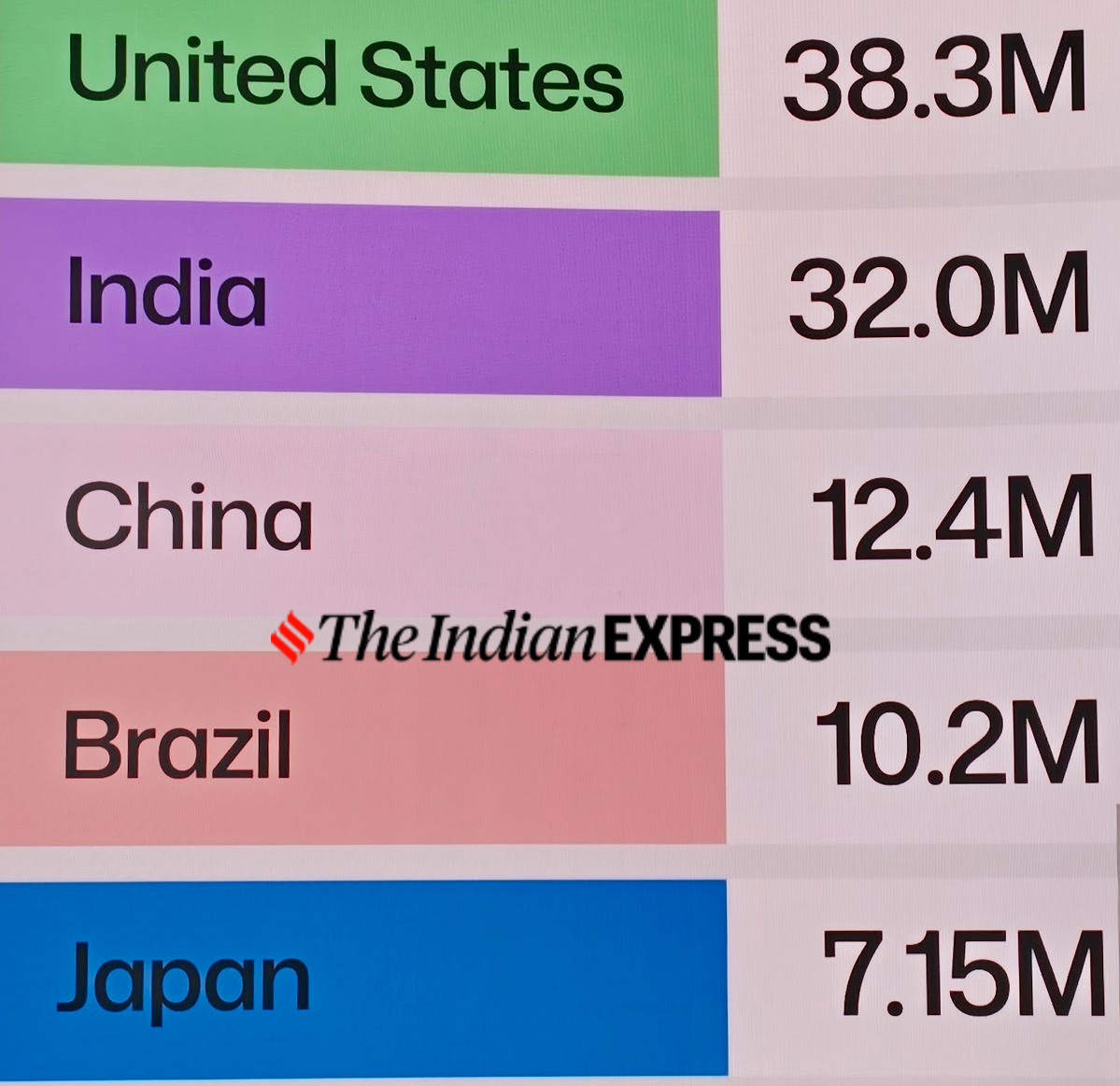 India has about 32 million developers on Github. (Image credit: Anuj Bhatia/Indian Express)
Sovereignty means controlling everything needed to develop and run AI, including building domestic AI models and keeping data within national borders.
India is building its own sovereign AI platforms under the IndiaAI Mission, focusing on expanding domestic computing capacity and promoting homegrown AI models. Its India AI Mission has deployed around 38,000 graphics processing units (GPUs), specialised processors used to develop and run AI systems, to boost computing capacity for developers.
Story continues below this ad
New Delhi hosted an AI summit earlier this year that attracted top executives from the world’s biggest technology companies, as well as scientists and academics. The summit brought together global technology executives, scientists, and academics as India sought to position itself as a major player in the global AI ecosystem.
India’s AI strategy aims to move the country beyond being a consumer of the technology toward becoming an AI powerhouse on par with the US and China. India is drawing on its large technology workforce and established AI hubs, including Bengaluru and Hyderabad, to expand its AI capabilities.
However, AI depends on computer chips, data, electricity, skilled workers, internet connectivity and cybersecurity. These elements must work together within a clear framework of ownership, legal jurisdiction and data storage, determining who controls the chips, data centres and AI models, which laws govern them, and where the data resides.
 Sharryn Napier, GitHub’s Vice President for Asia Pacific, India and Japan. (Image credit: Anuj Bhatia/Indian Express)
AI adoption in India
Napier disagrees that Indian organisations have lacked AI adoption.
Story continues below this ad
“When we released Copilot in 2023, our very first early adopter was Infosys. They really embraced the technology and helped us shape the product as it evolved. I think that’s a strong indication of how enthusiastic Indian global systems integrators (GSIs), in particular, are about adopting AI at an early stage and working with vendors to extend its capabilities.”
“Infosys embraced the technology from day one and has benefited from AI. They are now using it extensively in delivering services to their customers because those customers expect them to do so,” she said.
“If a service provider says it will deliver something in six months but can deliver it in three, that’s highly valuable to the client. I think these are the kinds of benefits Indian GSIs are seeing. AI is helping them improve their margins, make customers happier, and generate repeat business because clients are satisfied with the results,” she added.
India is developing initiatives such as BharatGen AI, a multilingual AI model, and AIKosh, a platform that gives startups and researchers access to anonymised training data. However, developing AI models alone is not enough.
Story continues below this ad
Countries seeking to build their own AI systems must also develop the underlying layers of the AI stack: the technologies and infrastructure needed to develop and operate AI systems.
 Attendees at GitHub Universe, a two-day developer conference held in San Francisco from October 28 to 29. (Image credit: Anuj Bhatia/Indian Express)
GitHub in India
Napier said it has seen 30 per cent year-on-year growth in developers on its platform, with the country now boasting 32 million developers, second only to the US. Microsoft owns GitHub, which it bought in 2018 for $7.8 billion.
Napier said GitHub is focusing not only on large Indian companies but also on startups, which quickly adopt AI and prioritise rapid product development and delivery. However, the growing popularity of newer tools such as Cursor and Anthropic’s Claude Code is challenging GitHub’s early lead in generative artificial intelligence.
The world’s largest cloud platform for hosting, sharing, and collaborating on software source code is looking to expand its presence in India, where its growing developer base offers opportunities to further adopt AI-powered coding tools. Its position as a Microsoft-owned platform also gives it access to the company’s broader enterprise and cloud ecosystem.
Story continues below this ad
“When people began experimenting with AI and AI agents, they were exploring what the technology could do. I think they are now starting to apply it in practice. The approach will vary from one organisation to another, depending on where they want to focus, what they want to automate, what tasks can be handled by AI agents, and what still needs to be done by humans,” Napier said when asked how she viewed the adoption of AI agents.
KioskNews shows a cleaned-up reading view extracted from the publisher’s page — the original always lives on their site, not ours.