VAR has promoted lazy refereeing : Former FIFA referee Keith Hackett’s scathing assessment of Premier League officials
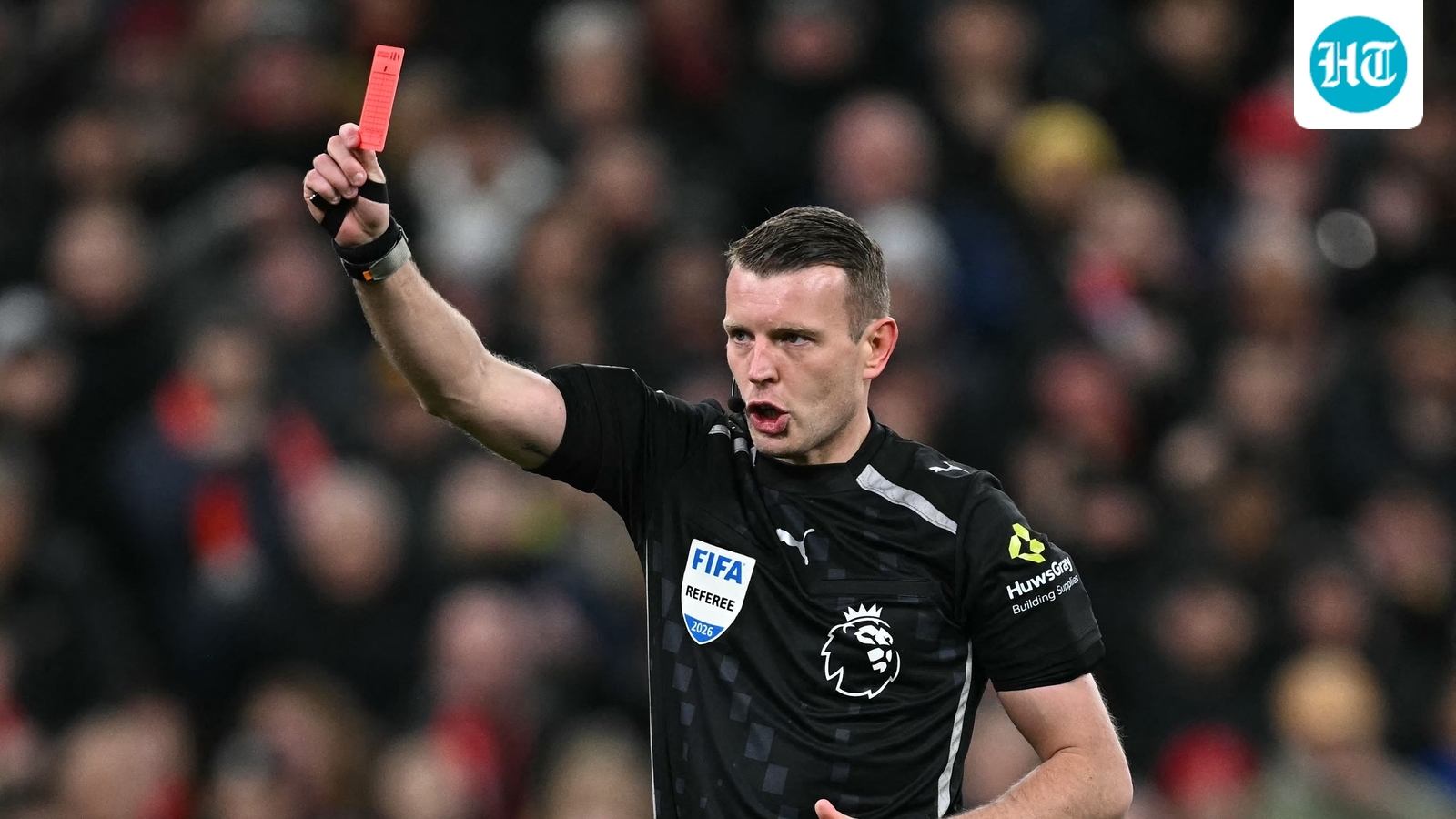
The controversy surrounding Leny Yoro's overturned red card vs Liverpool, has once again put refereeing in the Premier League and VAR under scrutiny. Sent off for apparently denying Alexander Isak a goalscoring opportunity, the Manchester United defender had the dismissal overturned on appeal. In their weekly report just before the last international break, the Premier League’s Key Match Incidents Panel (KMI) identified six on-field errors in a matchday, the joint-record for a single weekend.
For former Premier League and FIFA referee Keith Hackett, who is also an ex-president of the Professional Game Match Officials Limited (PGMOL), the problem goes beyond individual decisions. In a conversation with Hindustan Times, he questioned VAR's effectiveness, while also arguing that referees need better coaching and accountability.
Here are excerpts:
Having refereed across different eras and later led the PGMOL, what would you identify as the biggest changes in football refereeing?
When I retired after 23 years as a senior referee, including 10 as a FIFA official, refereeing was still an amateur pursuit. I was a sales and marketing director, lost a job because of refereeing and once chartered my own aircraft to officiate a European Cup game.
I proposed making refereeing professional in England. After the PGMOL was formed, I introduced sports science, specialist coaching and analytical tools such as Prozone. The biggest change since then is that referees have become full-time professionals, with training tailored to the demands of the modern game.
VAR was introduced to help referees get important decisions right. Seven years into its use in the Premier League, do you believe it has achieved that objective?
No. I don't see the results we need as fans, club owners or managers. The first requirement is better training and a consistent understanding of what constitutes a clear and obvious error. It should be an incident that hits you on the nose. Instead, we are getting re-refereeing.
My solution would be full-time specialist VAR operators. At present, an experienced Premier League referee can work in the VAR room on a Friday and officiate on the pitch the following day. That is too much psychological pressure. If something goes wrong in the VAR room, it can affect his confidence when he returns to the field.
I call it 'lazy refereeing'. The on-field referee hesitates over a clear penalty because he believes VAR will correct him if he gets it wrong. The VAR official, meanwhile, may assume the referee has seen something he has not. The result is that neither takes responsibility.
Look at the Liverpool-Arsenal incident involving Alexander Isak. He was in an offside position but was pulled back by a defender before playing or attempting to play the ball. The law says the foul should be penalised because it occurred before the offside offence. Yet, after a four-minute review, offside was given instead of a penalty. In my view, two experienced officials got the interpretation wrong.
VAR is also used in competitions such as La Liga and the Champions League. Why do we see more controversies in the Premier League?
In Europe and at the World Cup, we are generally seeing the very best referees, selected carefully. I watched Clement Turpin officiate Spain against England recently (in the UEFA Nations League). He oozed confidence.
The referee in the middle must remain in charge. VAR should not turn every decision into a three- or four-minute exercise. A rugby referee once told me when VAR was being introduced, that it would promote lazy refereeing. He compared it to a tightrope walker who concentrates on every step because there is no safety net. Give him a safety net, and his concentration can drop. Sadly, I think that is what has happened.
There is also a difference in leadership. Roberto Rosetti, who oversees UEFA referees, provides clear instructions, performance analysis and direction. In Europe, an indifferent performance can mean no further appointment for the rest of the season. In England, a referee can make a major error and be officiating again two or three days later.
I demoted referees and dismissed a couple when I was in charge (of the PGMOL). Accountability matters. I have to say I am not seeing the same leadership from Howard Webb (current PGMOL president). I didn't see it from Mike Riley either. The PGMOL spends more than £40 million, and if I were an investor, I would want to see a return.
ALSO READ: The El Cholo identity: How Diego Simeone made Atletico Madrid stand alongside Spain's giants
With multiple camera angles, slow-motion replays and constant social media scrutiny, has this environment affected the authority and confidence of on-field referees, particularly in countries such as India where there is no VAR?
Yes. When I was in charge, I ranked the 20 Premier League referees. They knew where they stood, and those at the top were more likely to receive the big appointments. Those lower down received more coaching and guidance.
I also persuaded the Premier League to introduce match delegates, who were former players and managers, alongside referee assessors. Both assessed officials and scored their performances. This created two separate tables: one measuring knowledge and interpretation of the laws, and another looking at player management, communication and how proactive a referee was.
A referee could score highly with an assessor but poorly with former players and managers. That told us where further training was needed. An ex-player could offer a different perspective, for instance, questioning why a referee had not booked a player for a reckless challenge.
I believe this added value to referee development. England still has good officials coming through, including Farai Hallam and Samuel Barrott.
When the Premier League's Key Match Incidents Panel identifies an error, what do you think should happen next?
A major error should have consequences. In my view, an official should not referee for at least seven to 10 games. But when he returns, he should not be carrying baggage. There must be a discussion about how the mistake happened and how it can be avoided.
You have to examine the whole performance, not just one decision. Was the referee in the right position? Were his movement and viewing angles good enough? Was his fitness an issue? The decision-making process is simple: see, recognise, think and act.
This is about training and education, not punishment. But there must be accountability. If a referee is consistently at the bottom of the rankings and is not improving, he may have to drop down to the Championship. Just as a football manager replaces a striker who is not scoring, a referee manager must make difficult decisions.
If you could change two or three things about Premier League refereeing today, what would they be?
I would call for a root-and-branch review of the entire organization. You have to examine assessment, sports science, coaching and accountability, and ask whether each is working as it should.
I expect English referees to be the best. We have the resources, but I don't think officials are being coached well enough, and I don't think clubs are getting value for money from the PGMOL's spending. When I compare today's referees with those of 10 years ago, I don't see the level of improvement I expected.
KioskNews shows a cleaned-up reading view extracted from the publisher’s page — the original always lives on their site, not ours.