Minister urges cooperation to counter cyberthreats
By Shelley Shan / Staff reporter


Democratic countries should work together to address cybersecurity challenges in the age of artificial intelligence (AI) and build trustworthy supply chains, Minister of Digital Affairs Lin Yi-ching (林宜敬) said in a recent interview with Austrian German-language newspaper Der Standard.
Lin led a delegation to the Cyber Security Nordic conference last month and was interviewed while transiting through Vienna on his way back to Taiwan. The interview was published on Nov. 10.
Taiwan, which is a geopolitical hotspot, faces about 2.8 million cyberattacks targeting the government from overseas every day, originating from China, Russia, North Korea and Iran, Lin said.
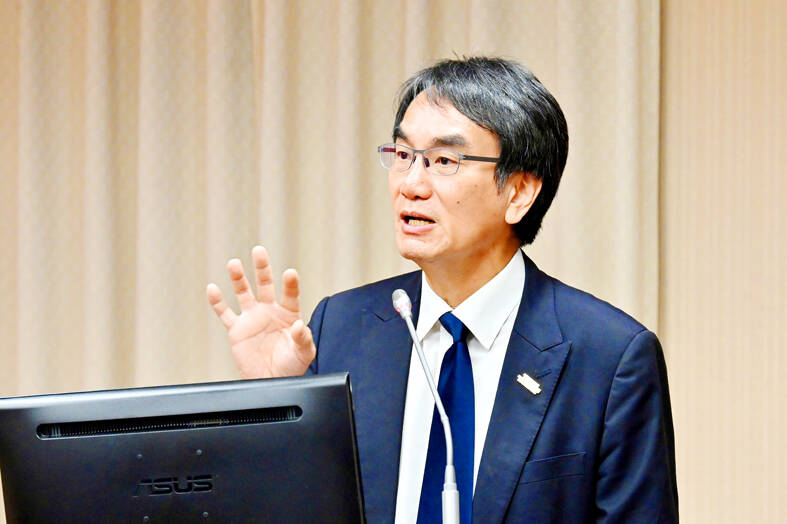
Minister of Digital Affairs Lin Yi-ching speaks at the legislature in Taipei on Oct. 14.
Photo: George Tsorng, Taipei Times
“Taiwan is something of a ‘honeypot’ for the entire free world — a kind of honeypot server where we can observe and investigate hacking attempts,” Lin said. “We have accumulated considerable experience. As the saying goes: What doesn’t kill you makes you stronger. That is why we have a vibrant and robust cybersecurity industry.”
Asked how Taiwan responded to a vulnerability in the PHP programming language that could affect about 70 percent of Web sites, Lin said IT experts in Taiwan, Japan and South Korea stayed up all night testing a new version of PHP.
He added that he was surprised that people in Europe did not appear nearly as alarmed.
“To be honest, I am very worried about Europe,” Lin said when asked whether the region was prepared to handle increasingly intense cyberattacks.
Lin said China and Russia had cooperated in launching cyberattacks.
Hackers from both countries targeted Taiwan during a 2022 visit by then-US House of Representatives speaker Nancy Pelosi, he said.
He cited another instance of alleged cooperation involving two Finnish companies whose operations were compromised by Chinese hackers.
With advances in AI, hackers, particularly those from China, could use AI tools to launch cyberattacks in Europe, Lin said.
However, the development of large language models (LLMs) could be a game changer, he added.
Anthropic’s Mythos model was reportedly capable of identifying thousands of critical security vulnerabilities within weeks, rather than hundreds, Lin said.
He said Anthropic had launched Project Glasswing, an initiative that gives selected organizations early access to its unreleased Claude Mythos Preview model to identify and fix vulnerabilities in critical software systems.
At least one Taiwanese company has formally joined the international collaboration, he said.
Lin said global information and communications technology supply chains were increasingly divided into democratic and China-led blocs.
Taiwan is promoting cybersecurity certification to harden supply chain security, he said, urging European businesses to exercise caution in their dealings with China to avoid having their core technologies absorbed before being shouldered out of the market.
Citing a recent incident in France in which networked refrigerators were hacked, Lin said networking unnecessary devices, such as refrigerators and traffic signals, to the Internet could create cybersecurity vulnerabilities and put urban infrastructure at risk.
Taiwan is reviewing and disconnecting unnecessary network connections to reduce systemic risks, he said.
Lin praised Europe and Japan for their emphasis on privacy, contrasting their approach with the use of ubiquitous cameras and AI facial recognition by authoritarian governments for mass surveillance.
Taiwan shares Europe’s commitment to protecting citizens’ privacy and freedom from unwarranted government surveillance, he said.
KioskNews shows a cleaned-up reading view extracted from the publisher’s page — the original always lives on their site, not ours.