MODA working on better social media AI disclosure
IDENTIFICATION: Posters must be required to disclose content as AI-generated and platforms must mark posts as such when necessary, the digital ministry said
By Sam Garcia / Staff writer, with CNA


Given the proliferation of deepfake content on social media platforms, the Ministry of Digital Affairs (MODA) said it is pushing platforms such as Meta and Google to disclose artificial intelligence (AI)-generated content through a three-layer system.
Clearly labeling posts as AI-generated content would help build a trustworthy digital environment and prevent deepfake content from misleading people, the ministry said.
The digital ministry has over the year met with Meta, Google, Line, industry associations and experts to discuss ways to ensure that AI-generated content is appropriately labeled so people can easily identify it, Department of Digital Strategy Director Tsai Shou-chuan (蔡壽?) said yesterday.
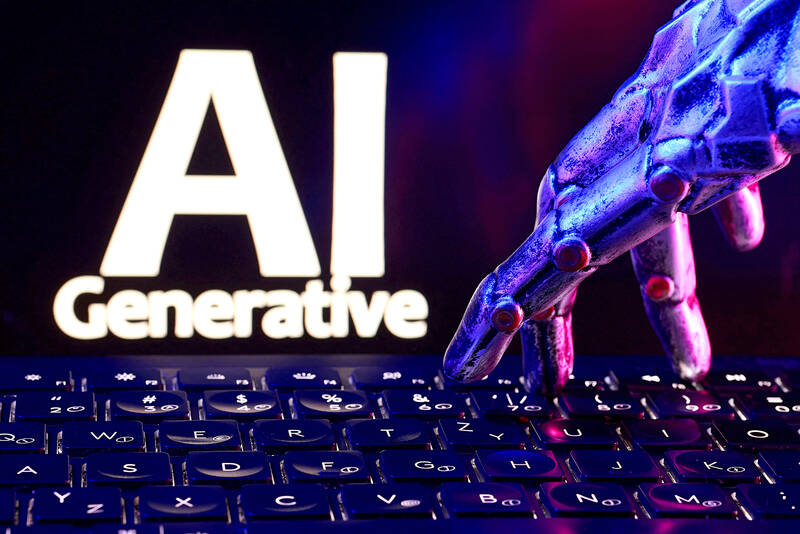
The words “AI Generative,” a keyboard and a robotic hand are pictured in an illustration taken on Sept. 23.
Photo: Reuters
It is requiring platforms to make AI content labels prominent, he added.
For example, YouTube’s label for AI-generated content is not visible enough, because people have to click “more” in the video description to see it, so the ministry is pushing YouTube to put the label right below videos, Tsai said.
The ministry’s proposed labeling system has three layers, he said.
First, creators would have to disclose AI-generated content by checking a box when uploading it, Tsai said.
Second, platforms should automatically label content as AI generated if there are signs that the tech was used, but the post was not labeled properly during upload, he said, adding that the right system can detect AI content.
Third is establishing channels for the government and people to report unlabeled AI-generated content, he said.
Some posts might slip through the first two layers if creators remove embedded AI markers or platforms have too much content to sort through, Tsai said, adding that reporting channels could help platforms add labels as needed and take action against content that contravene its rules.
If AI-generated content is used in scams or infringes on people’s rights, the ministry would coordinate with platforms to determine appropriate measures, such as adding labels or removing the content, he said.
Google is making fast progress while Meta is still making technical adjustments, Tsai said.
As Line mostly involves private communication, labeling would initially focus on publicly available content, he said.
The ministry would also promote education on AI literacy so people can recognize AI-generated content, he added.
KioskNews shows a cleaned-up reading view extracted from the publisher’s page — the original always lives on their site, not ours.