Indigenous Toronto man with a criminal record of 101 break-ins gets time served
A Toronto man with Indigenous heritage who has 101 break-ins on his criminal record won’t serve any more time in jail after his recent sentencing, even though he was arrested with nearly an ounce of fentanyl.
Sign In or Create an Account
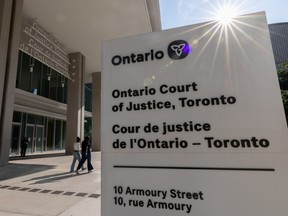
Kieron Tierney — who had already done time for 85 previous break-ins — was sentenced to time served and probation for 16 more break-ins in an Ontario Court of Justice Gladue Court. The same judge handed him a suspended sentence on the drug charge after Tierney pleaded guilty to possession of fentanyl for the purpose of trafficking.
Gladue Courts stem from a 1999 Supreme Court of Canada ruling that said judges should consider the often-tumultuous personal backgrounds of Aboriginal accused and seek alternatives to prison time if possible.
“Kieron Tierney has now accumulated 549 days of pre-trial custody on the present charges,” Justice André Chamberlain wrote in an Oct. 8 decision.
Even if he applied only the standard credit of multiplying days spent in pre-trial custody by 1.5, Tierney would have already served more than two years in custody, said the judge.
“The Crown nevertheless seeks a total sentence of four years’ imprisonment, noting that, unlike his previous matters, the present offences include the more serious charge of possessing nearly one ounce of fentanyl for the purpose of trafficking.”
Chamberlain started his decision with a quote from the Supreme Court of Canada in the 2016 case of Cheyenne Sharma, an Indigenous woman who pleaded guilty to importing two kilograms of cocaine in exchange for $20,000 from her boyfriend — a task she said she carried out to avoid seeing her and her daughter evicted.
“Sentencing law cannot erase this country’s colonial past. Nor can it remove the causes behind an offender’s crime. But it is uniquely positioned to ameliorate — or aggravate — the racial inequalities in our criminal justice system,” the country’s top court said in the Sharma decision.
The Gladue Court heard Tierney’s 16 most recent break-ins cost victims $26,000.
“This represents a substantial financial impact and is a significant aggravating factor,” Chamberlain said, noting Tierney’s lengthy record is “undeniably extensive.”
Tierney began using opioids at 15 and is now addicted to fentanyl, the judge said, noting his “ongoing struggles with depression and post-traumatic stress disorder.”
For 188 days of full or partial lockdown during remand at the Toronto South Detention Centre, Tierney spent “much of his time triple-bunked in a two-person cell, often leaving him to sleep on the floor near the toilet,” his lawyer said, noting his client had a “serious toothache” that went untreated behind bars for 10 months.
“We keep building jails to lock people up and expand our capacity,” said the judge. “Politicians bemoan the criminal justice system’s catch-and-release policies, yet they can hardly staff the jails we have now. Kieron Tierney pays the price for that failure through substandard care and a total disregard for his medical and cultural needs.”
Tierney, who traces his Indigenous ancestry through his paternal grandmother, was denied “Indigenous cultural and spiritual supports” at Toronto South, Chamberlain said.
“It may be seen that although imprisonment is intended to serve the traditional sentencing goals of separation, deterrence, denunciation and rehabilitation, there is widespread consensus that imprisonment has not been successful in achieving some of these goals,” he said.
“Over-incarceration is a long-standing problem that has been many times publicly acknowledged but never addressed in a systematic manner by Parliament. In recent years, compared to other countries, sentences of imprisonment in Canada have increased at an alarming rate.”
Tierney “has been separated from the community in particularly harsh conditions for over 18 months,” said the judge.
“Given the clear message from the Supreme Court of Canada, on many fronts, to work to address over-incarceration and give real meaning to the life circumstances of individuals coming before the court, I am not satisfied that a further period of incarceration will serve any benefit to either the community, the victims or Kieron Tierney himself.”
Tierney has completed his GED, withdrawn from opiates, and “regained the support of his family,” Chamberlain said. “He deserves a chance to prove himself and to move forward with his life in a healthier fashion.”
The judge recognized “the risk and harm to the community posed by fentanyl. The risk of overdose and death is significant.”
But Tierney is a fentanyl addict who needs treatment “and support to stay off the streets and stay safe,” Chamberlain said. “He will not find that in the provincial system. He is just as unlikely to access it through the federal system.”
Our website is the place for the latest breaking news, exclusive scoops, longreads and provocative commentary. Please bookmark nationalpost.com and sign up for our daily newsletter, Posted, here.
Join the Conversation
This website uses cookies to personalize your content (including ads), and allows us to analyze our traffic. Read more about cookies here. By continuing to use our site, you agree to our Terms of Use and Privacy Policy.
KioskNews shows a cleaned-up reading view extracted from the publisher’s page — the original always lives on their site, not ours.