Huge planet, tiny star: discovery challenges textbook view of how giants form
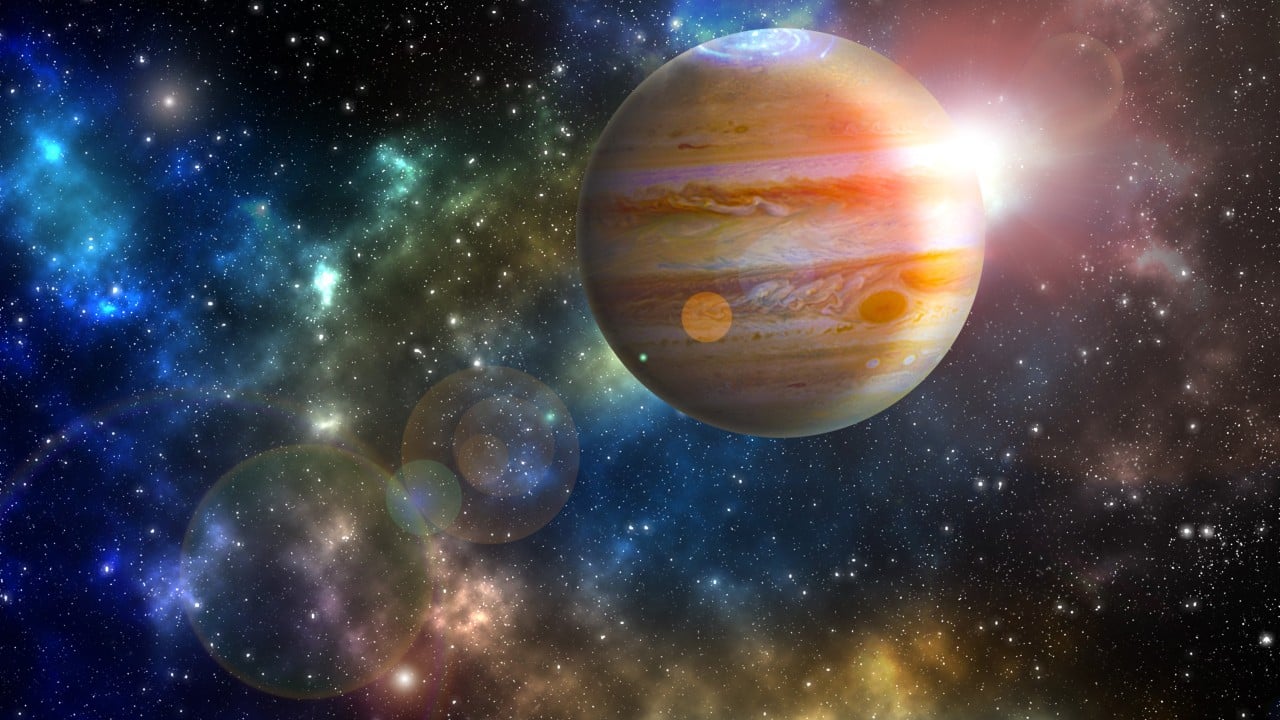
Chinese and American astronomers have found a planet nearly five times the mass of Jupiter circling a small, dim star, challenging the textbook view of how giant planets form and how many of them are out there.
The team, from Carnegie Science in Washington and Shanghai Jiao Tong and Tsinghua universities, spotted the planet – known as HIP 88962 b – with the Magellan Clay Telescope in Chile after 16 years of observations.
Its host star has only two-thirds the mass of our sun – too small to build a world this big under the leading theory that gas giants grow slowly around a rocky core, the researchers reported in The Astrophysical Journal Letters on Tuesday.
Alan Boss, the paper’s lead author and an astrophysicist who studies how planets are born, said the discovery did not appear to fit the widely accepted picture.
Instead, it supports what he called a “heretical” idea: that some giants like Jupiter are not built pebble by pebble, but form almost at once when the gas around a young star collapses into clumps.
He said that if there were more than one way to make such planets, there were likely to be many more of them than expected – including in places where astronomers would not think to look.
02:08
Jupiter seen in ‘remarkable’ detail in new images from Nasa’s James Webb Telescope
For this study, Boss said the Carnegie scientists made the telescope observations, while colleagues in China analysed satellite data that helped pin down the planet’s mass.
Scientists have for decades believed that giant planets are assembled from the bottom up, starting with a small core of rock and ice that later gathers a thick shell of gas.
But that slow route struggles around small stars, which start out with thin disks of raw material. Computer models predict such stars rarely produce gas giants, especially far from home.
HIP 88962 b defies those predictions. It orbits at about six times Earth’s distance from the sun, on a stretched, oval path unlike the rounder ones that core-built giants tend to follow. It better fits the reverse, top-down scenario Boss first proposed in 1997, the researchers wrote.
The planet turned up in a Magellan survey of nearby stars that began in 2010. It is too faint and too close to its host to be seen directly, so the astronomers used the so-called wobble method to track how its gravity rocked the star back and forth, slightly shifting the colour of its light.
Since the planet takes about 19 years to complete one orbit, the team needed well over a decade of patient watching to trace its full pattern. An earlier study with a smaller telescope in Chile had found nothing, because its observations spanned only about two years.
The discovery also matters for the search for life beyond Earth. Nasa counts the star among those that could host Earth-like planets, and the team said they had picked up a faint signal that might come from a second, much closer planet.
“We will continue to monitor HIP 88962 to search for any wobbles caused by other exoplanets in this system,” Boss said.
KioskNews shows a cleaned-up reading view extracted from the publisher’s page — the original always lives on their site, not ours.