Whalefall Review: A Compelling Concept Adrift In Shallow Storytelling
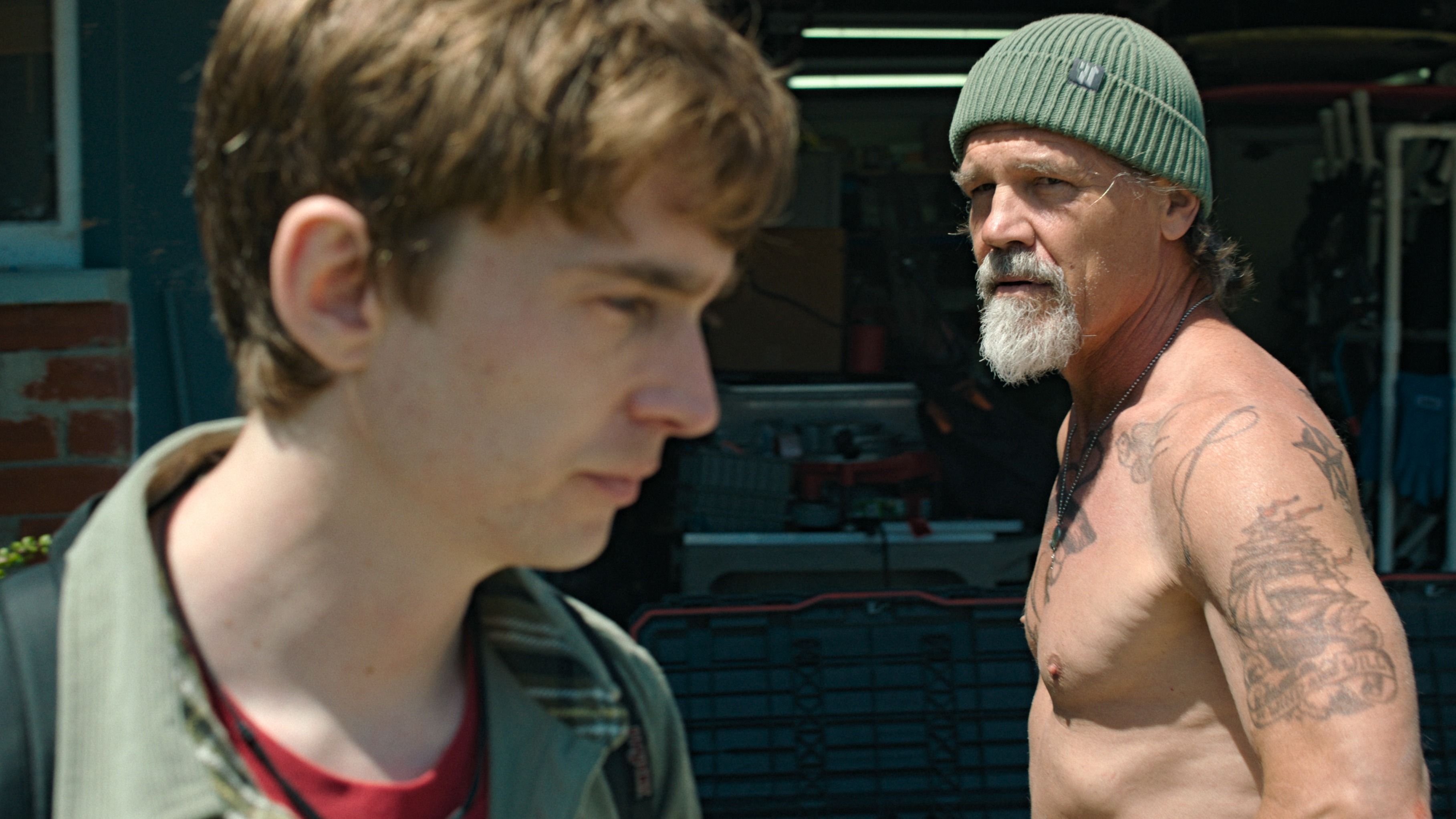
Austin Abrams acts his heart out, but even that isn't enough to make Whalefall's flimsy narrative and many nonsensical plot points work.

Liz Declan is a Lead Writer for ScreenRant, primarily covering movies. She is a massive fan of Star Wars, the MCU, and Supernatural. In addition to writing, Liz loves attending and covering conventions and interviewing actors. Find her on TikTok and Instagram @va.va.vera
I love a good survival thriller – even a ridiculous one. In fact, no matter how ludicrous the concept, if it delivers action, tension, and larger-than-life, cataclysmic events, there is quite a bit that I'm willing to forgive and plenty of disbelief that I'm willing to suspend. I was, therefore, more than ready for Whalefall, the premise of which was automatically going to require the latter.
In the film, Austin Abrams plays Jay, a young man who is struggling with the loss of his father (Josh Brolin), with whom he had an incredibly complicated and at times very painful relationship. Setting out to find his father's remains after he intentionally sunk himself into the ocean to avoid death in a hospital bed, Jay uses all the scuba diving skills his dad taught him to make his way deep underwater. Very early in that expedition, however, Jay is swallowed by a whale, at which point the narrative shifts to his desperate attempt to survive in what is actually a fairly unique framework.
Rarely, if ever, does a survival thriller see the protagonist fighting his way out from inside an animal, and while that, of course, cannot happen in real life, it offered all the terrifying thrills that are actually present in our mostly unexplored ocean, peppered with claustrophobia, aquaphobia, and body horror. Unfortunately, while promising, that basic idea fell apart on screen in a movie that clearly had a fascinating concept but failed to deliver on the narrative.
Austin Abrams Gives Whalefall His All, But The Story Still Sinks
It must be said that Abrams deserves his flowers for Whalefall. More often than not, he is acting entirely on his own, and because his mouth is covered with a breathing apparatus, he frequently can only use his body and grunts and groans to communicate what he's feeling. That, combined with the fact that he's having to pretend he's being suffocated by a whale's innards, shocked by a jellyfish, and burned by stomach acid, makes his performance more than impressive.
Yet even Abrams' acting chops cannot save what is a disorganized, thinly constructed narrative. As Whalefall progresses, it begins to feel as though, at some point, someone said, "What if there was a movie about a person getting swallowed by a whale?" and that was more or less where the imagination stopped. The primary characters are Abrams' Jay and Brolin's Mitt, and although Jay has a mother and two sisters, all three consistently feel irrelevant to the story.
What Whalefall seems to suffer from most is indecision.
Perhaps worse still, while Brolin is always going to deliver in his performances, Mitt as a character makes absolutely no sense. He acts completely erratically, and his only defining traits seem to be that he was obsessed with the ocean and was a terrible, borderline abusive dad – although, he takes a knife to his son at one point, so it's not all that borderline. Brolin yells most of his lines, and the ones that aren't shouted over the ocean spray are bizarrely on the nose (at one point, he leans in and says the title of the movie, which is almost never a good sign).

What Whalefall seems to suffer from most is indecision. It felt as though the movie never decided whether it wanted to be: an exaggerated, purely fun-to-watch survival story that leaned into thrills no matter how nonsensical, or a profound exploration of a son grieving his imperfect father. Perhaps in theory both could co-exist, but the execution just wasn't there.
The absurdity of Jay screaming for help while lodged inside a whale's gullet detracted from the movie's ability to deliver on its emotionally profound moments, and the father-son strife interspersed throughout scenes in which Jay is fighting a squid inside a whale or using a jellyfish as a flashlight distracted from what should have been delightfully ridiculous action-packed sequences.
Adding to that issue was the fact that, much like a Transformers movie, certain scenes were entirely indiscernible. At times, the screen was just a jumble of whale parts and Jay's distressed face, without any clarity on where in the whale he was or what, specifically, was happening to him at that moment. In part, that issue stemmed from the fact that almost all the action took place inside the whale, and while that is an interesting premise, the movie wasted its scariest setting of all: the deep ocean.
Early on, Whalefall seemed to be taking advantage of just how terrifying the ocean can be, with disembodied rumblings and animal calls coming from total darkness, beyond where Jay could see. This was also the point at which the film made best use of beautiful visuals. Had there been more perilous scenes of Jay navigating the rough waters (which was actually a peak of the movie, in which audiences are made to feel like they are actually drowning) and confronting terrifying, alien-like creatures, there needn't have been so many repetitive scenes of him squished inside whale intestines.
Still, Whalefall isn't a total loss. For those who love survival flicks and just want to see a man fighting his way out of a whale, there are some wonderfully disgusting moments and big screen-worthy thrills. In the end, though, the amount of disbelief that has to be suspended just isn't warranted by the underwhelming plot.
Whalefall releases in theaters nationwide on Friday, October 16.

- Release Date
- October 16, 2026
- Runtime
- 98 minutes
- Director
- Brian Duffield
- Writers
- Brian Duffield, Daniel Krauss
- Producers
- Allan Mandelbaum, Brian Duffield, Brian Grazer, Jeb Brody
KioskNews shows a cleaned-up reading view extracted from the publisher’s page — the original always lives on their site, not ours.