Notes from Central Taiwan: Taiwan’s urban renewal needs a human focus
Rising costs are stalling Taiwan’s housing redevelopment, but renewal should also preserve neighborhood life and create safer, more walkable communities
By Michael Turton / Contributing reporter


As skyscrapers claw at the sky across the nation’s major cities, urban renewal efforts continue. Planners face a daunting environment. Nearly 60 percent of the housing stock is over 30 years of age, with Penghu, Yunlin and Chiayi counties exhibiting the highest average building ages, all over 40 years. In Taipei, 673,000 residences — over 70 percent of all homes — are over 30 years old, with an average age of 39.1 years. Taiwan’s shining office towers conceal a world of aging homes badly in need of replacement.
Rising housing prices are killing more than just the future of Taiwan’s young. They are also making urban renewal projects vastly more expensive and riskier. At the same time, construction costs are rising. The result is that many projects are being abandoned.
ABANDONED PROJECTS
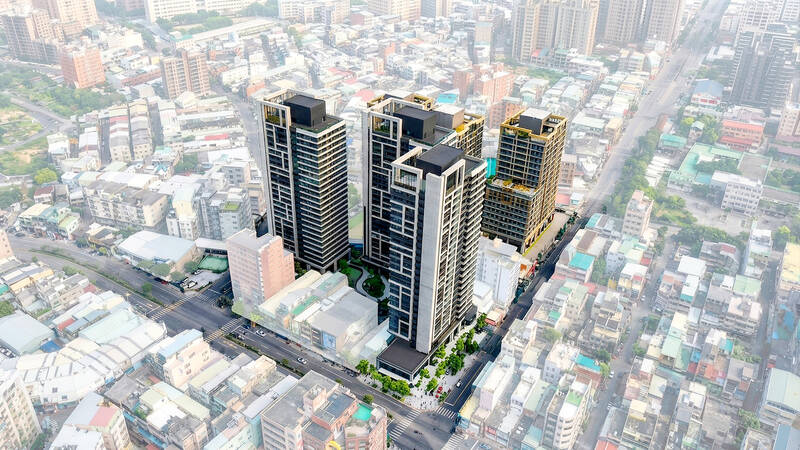
A rendering of the Zhengguang Garden New City public urban renewal project in Taoyuan, which will feature three residential towers, each with 24 stories above ground and four stories below ground, for a total of 564 units. The project is surrounded by buildings that were constructed over 30 years ago, many of which are badly in need of replacement.
Photo courtesy of the National Housing and Urban Regeneration Center
A recent piece in a United Daily News (UDN) series on urban renewal, “Urban renewal is not what you think,” looked at two typical projects. One was a 140 ping project involving an old building in Taipei’s Daan District (大安). Initially the developer thought the project would go for a good price, but as construction costs rose, the developer abandoned the project and the site was put up for auction.
The second case took place in Taipei’s Songshan District (松山). There the residents had taken it upon themselves to contract out the cost of replacing their building and had all moved out. Their construction company had estimated the project at NT$200,000 per ping, but the cost rose to NT$300,000 per ping, too much for the residents.
Urban renewal projects are more costly for construction companies because of the presence of the residents. In an ordinary project, if the construction firm experiences a NT$10,000 per ping rise in costs, it can just raise the selling price NT$10,000. However, urban renewable projects are often split, with residents receiving two-thirds of the sale price and the construction company one-third. This implies that if costs per ping rise NT$10,000, the price per ping must rise NT$30,000 for the construction firm to cover the cost increase.
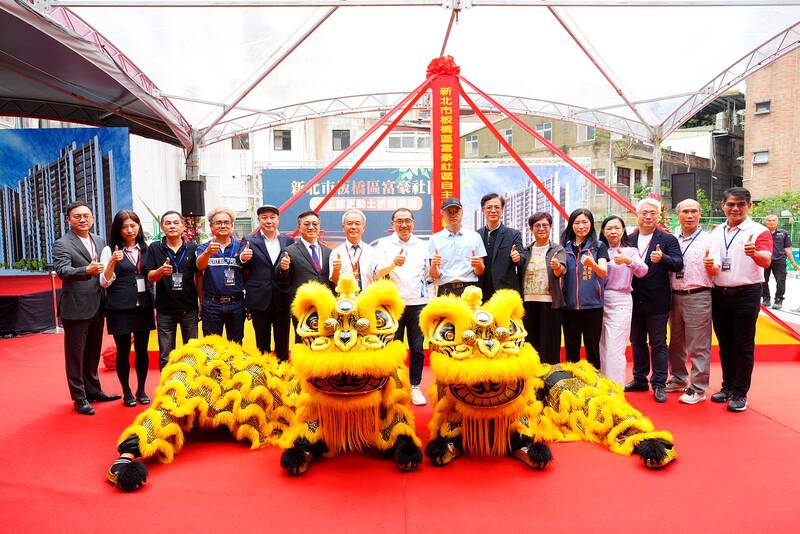
Government officials and residents of an urban renewal association in April preside over a groundbreaking ceremony for a renewal project in New Taipei City’s Banciao District.
Photo courtesy of the New Taipei City Bureau of Urban and Rural Development
INCREASED COSTS
Costs are in fact increasing. The Directorate-General of Budget, Accounting and Statistics said early last month that the overall price index for construction projects rose 6.54 percent year-on-year in August, remaining at its highest level since July 2022. The increase was driven by an 8.12 percent year-on-year increase in wages, nearing a five-year high. Demography is having its day: construction industry labor shortages, domestic construction investment and factory construction demand, are pushing up demand for labor and in turn, salaries.
The problems in the two cases discussed above are being replicated across Taipei. The Liberty Times, our sister paper, reported that, based on statistics from the Taipei City Construction Management Office, by the end of July, Taipei had approved 1,079 projects under the dangerous and old buildings reconstruction scheme, while at least 188 approvals (17.42 percent), one in every 5.74 projects, had become invalid.
One problem identified in the UDN series on rising construction costs in Taipei is that the city benchmarks construction costs. Currently the 2024 benchmark cost for a 15 story building, according to a construction industry official quoted, is NT$204,000 per ping. However, the actual cost is NT$285,000.
Moreover, financing rates have risen. Banks face higher risk of non-performing loans in real estate and their provisions for loan non-performance are higher. The result is higher financing costs for urban renewal (The financial industry has proposed lowering the provisioning requirement for qualifying redevelopment loans, but the Financial Supervisory Commission has not endorsed that proposal.) Since urban renewal projects generally take long periods for permitting and construction, the result is rising project costs unforeseen by any of the participants.
A key reason for this is that Taipei’s projects are on average much smaller than those of other cities. Smaller projects are more likely to stall when construction costs rise because their initial construction costs are higher. Out of the 188 dead projects, 132 involved sites 150 ping or less.
The government has established subsidy programs to bring older buildings up to modern earthquake regulations and extend their lives. But only a few thousand buildings have been processed this way, out of well over 5 million needing renewal.
BIRTH RATES
In Kaohsiung the city has integrated its urban renewal program and the semiconductor industry’s southward expansion. According to the Liberty Times, city government officials announced that the program around the R17 World Games MRT station allocates to the city government a 17-story mixed-use building, with housing for industry employees, high class office space, commercial facilities and public childcare. Three other buildings are planned as 21-story residential and commercial facilities, with childcare facilities. A skybridge will connect an adjacent block to the MRT station, and the project calls for taking advantage of the green spaces around Banpingshan (半屏山). The project takes advantage of the large space available for “urban renewal.”
The recognition that child care should have its own designation in the complex is a step forward. But an irony of urban renewal is that demand for housing will almost certainly slump within a decade or two.
Births last year hit a record low of 107,000, with something like 1.8 million for the period 2015-2025. Who is going to live in all those residences needing renewal? Couples from that cohort will not be seeking to purchase homes until after 2050. The government might be better off simply knocking down all the old housing and putting in greenspace, or single family homes where possible. That will help sustain housing prices as well.
The public policy changes proposed by the various parties involved all focus on keeping it sustainable for the construction and real estate firms — rearranging the subsidy regime to maintain things the way they are. If planners view urban renewal as something that markets should determine, then they will get the spaces that markets build: sterile and inhuman, filled with empty immensity. These policy approaches merely replace existing dense housing with updated dense housing, or as Kaohsiung is doing it, with futuristic glass-and-steel building complexes that look like something out of the high-class areas of a dystopian science fiction tale (where, for example, will the street vendors hang out?).
The fundamental program with urban renewal in Taiwan is that it does not address the urgent problems of human living. It does not create livable, walkable environments with enjoyable, energetic atmospheres constructed out of the everyday, organic behavior of its residents, with small shops, street vendors and needed services right at hand, accessible by walking from single family, detached homes.
It goes without saying that those things could increase marriage and birth rates. Shouldn’t that be a foundation of public policy in Taiwan?
Notes from Central Taiwan is a column written by long-term resident Michael Turton, who provides incisive commentary informed by three decades of living in and writing about his adoptive country. The views expressed here are his own.
KioskNews shows a cleaned-up reading view extracted from the publisher’s page — the original always lives on their site, not ours.