Swiss glaciers lose more than 5% of ice after record heatwave
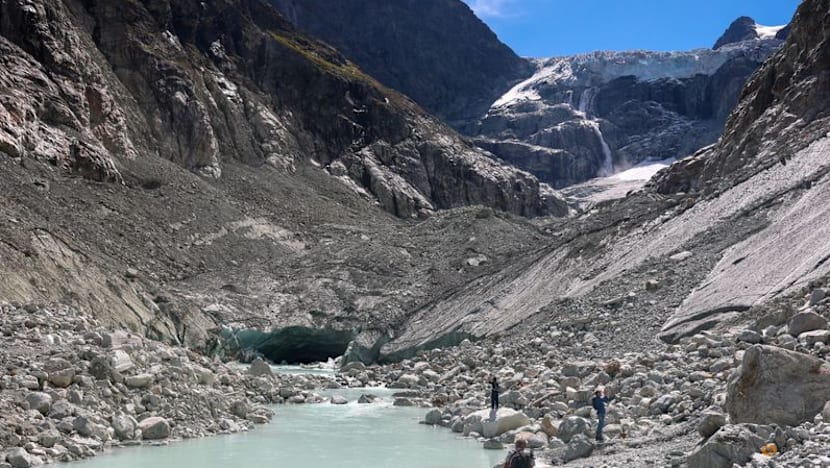
LES DIABLERETS, Switzerland: Swiss glaciers are shrinking rapidly after suffering one of their worst years of ice loss during a record-breaking European heatwave.
Switzerland's glaciers lost more than 5 per cent of their ice in 2026, a report by the Swiss Glacier Monitoring Network (GLAMOS) and the Swiss Commission for Cryosphere Observation of the Swiss Academy of Sciences showed on Thursday (Oct 1).
The findings underscore the accelerating pace of glacier retreat as extreme melt years become routine. Over the past five years, Swiss glaciers have shed almost a fifth of their ice, the report showed, threatening future water supplies and raising questions about the long-term survival of Europe's ice fields.
"Now we are in this new world, in this future, where glaciers are just melting away," Matthias Huss, director of GLAMOS, said.
A combination of a winter with too little snow and record temperatures in the summer led to what Huss called "enormous" melting this year.
"A REALLY WORRYING SITUATION"
"We are seeing extreme years almost every year now and this is really a worrying situation," Huss said.
Still, the rate of ice loss has not yet quite reached the record highs of 2022, when dust clouds from North Africa settled on the snow and accelerated melting, Huss said.
Switzerland's largest glacier, Aletsch Glacier, suffered its biggest-ever melt this year, while Glacier de Tsanfleuron lost more than 4m of average thickness. Huss said this would have been unthinkable a few years ago.
In total, the scientists estimate Swiss glaciers lost around 2.2 trillion litres of water between July and September alone, equivalent to more than four times the annual drinking water consumption of Swiss households.
That has one positive side effect: glacier melt contributes to easing summer water shortages.
But, as ice-covered areas shrink and glaciers become smaller, this benefit is decreasing, Huss said.
"It's not that we're surprised because we know how fast the glaciers are melting, but to see the colours of the mountains where there is no snow left, there are just these rocks," Huss said. "It makes me sad."
KioskNews shows a cleaned-up reading view extracted from the publisher’s page — the original always lives on their site, not ours.