How the 1982 Asian Games sparked India’s colour TV revolution against the odds
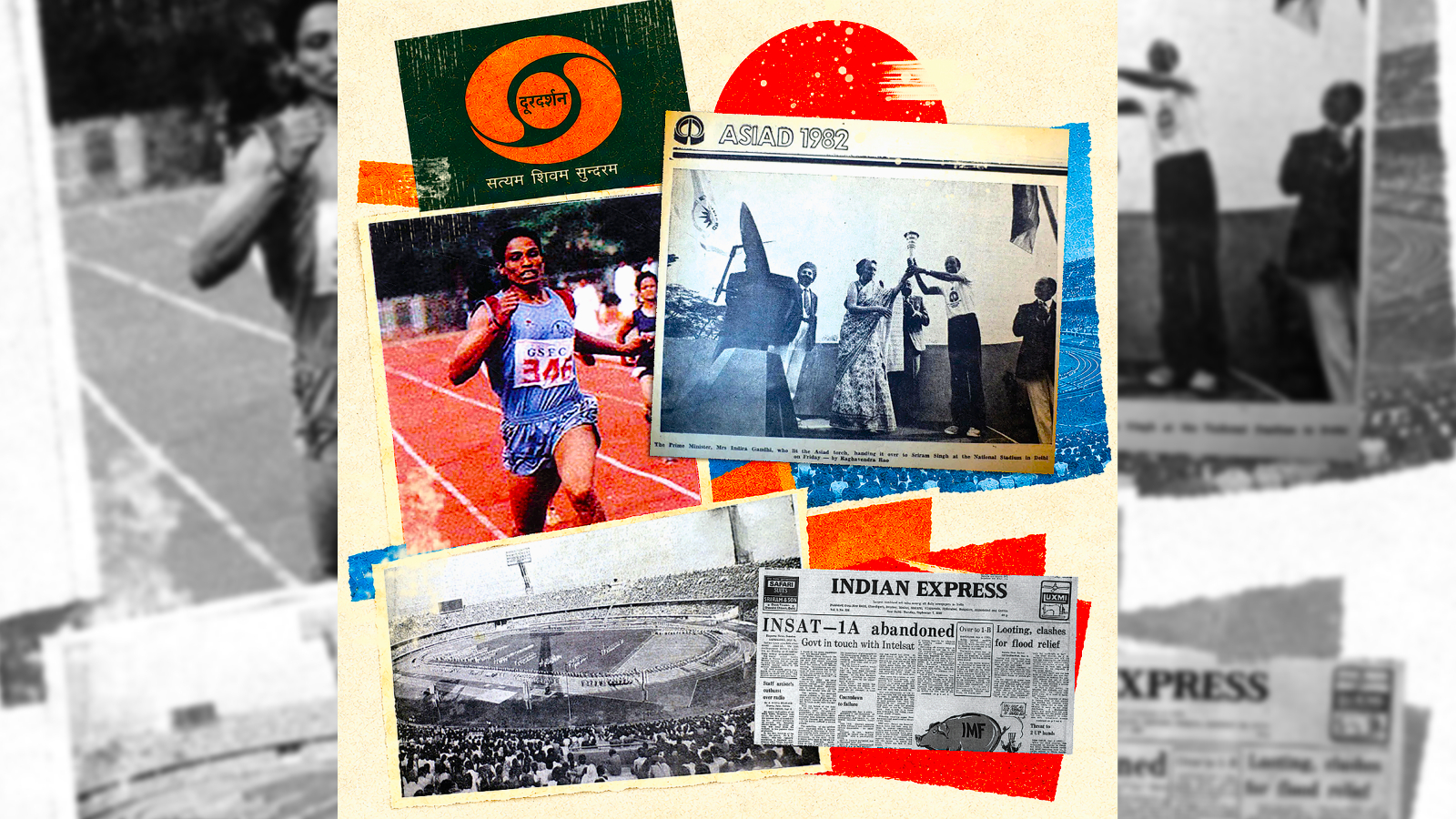
The 1982 Asian Games will go down in history for many reasons. It was the first real sighting of PT Usha’s prodigious talent. It was the reason venues like the Jawaharlal Nehru Stadium, the Indira Gandhi Indoor Stadium, the Siri Fort auditorium, and the Karni Singh shooting range exist today. It was the second — and the most recent time — that India hosted the continental mega event. It was an occasion that provided a measure of the country’s capacity to host big-ticket events. It was also the first time China ended up on top of the medal tally, a spot it has refused to relinquish ever since.
However, several months before the Asian Games were to begin in November 1982, the country’s space scientists at Indian Space Research Organisation (ISRO) were running a different race: one against time, and space itself. Then prime minister Indira Gandhi had set an ambitious target: she wanted the Asiad to be broadcast in colour.
That would require work on multiple fronts: ISRO would have to send a communications satellite in space to beam the images; Doordarshan would have to set up on-ground infrastructure like signal-receiving stations to capture and relay the visuals; and people would have to own colour TVs to watch them in the comfort of their homes.
The first part was the hardest to execute. ISRO contracted an American company, Ford Aerospace, to build the satellite — called INSAT 1A, the country’s first multipurpose operational satellite — based on a concept they had been working on since the 1970s. NASA launched the satellite from Florida’s Cape Kennedy Space Centre on April 10, 1982, seven months before the Asian Games were to begin.
But after the satellite detached from the vehicle carrying it, it ran into turbulence. On September 6, about two months before the Asiad, it had to be deactivated.
ALSO READ | Floating castle, a missing ceremonial kit, vacant seats: Japan welcomes 2026 Asian Games
“During the launch, immediately within a few hours, we noticed that there was a problem. It was sorted out before the satellite reached its final orbit. But in the final orbit, we had another problem: the solar sail did not deploy. The satellite was heating up,” Pramod Kale, a Padma Shri awardee who was the Project Director of INSAT 1 at the time, tells The Indian Express. “We were not certain how many hours we could actually support the broadcasting operations.”
Story continues below this ad
Kale and his team had spent many months of long, sleepless nights and travelled several times from Karnataka’s Hassan – where ISRO had built a master control facility – to Palo Alto in the US for the project. But now, there was no satellite.
A desperate government reached out to the Soviet Union, who agreed to provide their satellite to broadcast the Games.
“It was a very good decision taken by the Information and Broadcasting Ministry to have an alternate plan for the Asian Games,” says Kale.
On the ground, Doordarshan was doubling its efforts. In those days, the public broadcaster was capable of reaching only the big cities in the country. So before the Asiad, a team from Doordarshan was sent to Germany, four OB vans and mobile cameras were added to its arsenal, recalls Mission ISRO, a podcast about India’s space ambitions. By 1982, Doordarshan had built 20 TV stations in different cities.
Story continues below this ad
“The Asian Games definitely gave a big fillip to television broadcasting throughout the country because by that time, a large number of television transmitters also had come up in cities,” says Kale. “In colour television transmission, there was a slightly raised cost in terms of the making of TV studios, making them colour compatible, the lights used, the cameras used. So, there was a question of investment from the government. Then the colour television sets would have to be purchased by the consumers.”
The third front in this Asian Games-infused colour TV revolution was the easiest one to be tackled.
“By one estimate, India had about 84,000 TV sets in the early 1970s,” Ronojoy Sen, the author of India at Play, was quoted as saying on the Mission ISRO podcast. “Of these, about 90 percent were in Delhi and Bombay. Outside these two cities, the presence of TV was very minimal.”
But the government eased rules around owning colour TVs, as long as they were gifted by someone from abroad.
Story continues below this ad
A report from 1982 in India Today stated that people were so eager to own a colour television set that they were happily forking out an eye-watering amount of Rs 7,000 to the government as tax. The demand grew so much that airlines organised special charter flights just to bring TV sets to India. Shops in some of Asia’s biggest commercial centres of Hong Kong, Singapore and Dubai were running out of TV sets. The report added that the government earned customs revenue of around Rs 70 crore from imported sets, which almost covered the cost of hosting the Asian Games.
Turning point
Eventually, when the Asian Games came along, thousands of Indians got to see their athletes competing in colour.
Kale, who is now 85 years old, was one of them, watching the Games on a colour TV made by the Bush company in Bangalore.
The impact of India getting to watch the Asiad on colour TVs was such that by the time the Los Angeles Olympics came along two years later, they had almost become a must-have accessory in many living rooms around the country.
Story continues below this ad
Usha, who had become a star at the 1982 Asiad by winning two silver medals, went to the 1984 Olympics and finished fourth in the 400m hurdles race. The Kerala government honoured her by gifting her… what else, a colour television.
“During the 1982 Asian Games, we had a black-and-white TV at home. But that changed soon. When I went to the 1984 Los Angeles Olympics, we still had a black-and-white TV. So my father went to a relative’s house to watch me on a colour TV,” Usha recounts to The Indian Express.
“After I narrowly missed out on a medal at the Olympics, Kerala Chief Minister K. Karunakaran said, ‘For us, it is like you have won a medal’, and he gave me a colour television. It was a Keltron TV made in Kerala. Once you start watching colour television, you will never go back to black-and-white television.”
That’s exactly what the rest of the country felt after experiencing the colour TV revolution fuelled by the Asian Games.
KioskNews shows a cleaned-up reading view extracted from the publisher’s page — the original always lives on their site, not ours.