Notes from Central Taiwan: Annexation could sever Taiwan’s chip lifeline
Even without war, Chinese control of Taiwan could jeopardize the technology, investment and international connections that sustain the semiconductor industry
By Michael Turton / Contributing reporter


The South China Morning Post (SCMP) article from earlier this month on how Beijing would govern a post-annexation Taiwan (Amber Wang, “Beijing’s policy advisers map out how post-reunification Taiwan could be governed,” Oct. 6, 2026) is a reminder that even “peaceful” (coerced) occupation by the People’s Republic of China (PRC) will beggar Taiwan.
The “scholars” cited in the SCMP piece argued that Taiwan would be governed in a manner similar to Hong Kong. As I observed in my piece for Monday (“Beijing’s intimidation tactics in Taiwan and beyond,” Oct. 12, 2026), that claim is simply a form of cognitive warfare. One of the functions of “One country, two systems” is to conceal the profound changes to Taiwan’s economy and to the global trade system that would occur if Taiwan were forced inside the PRC.
SEMICONDUCTOR INDUSTRY
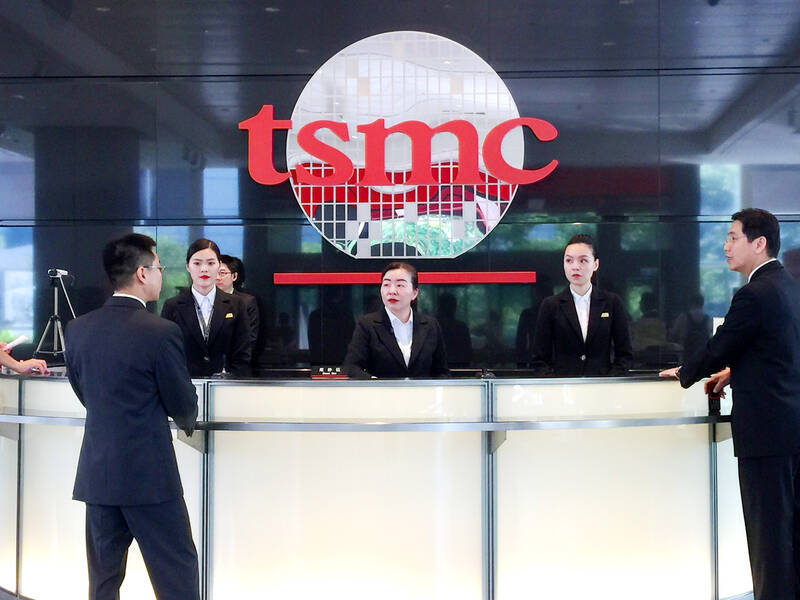
The US, which currently permits Taiwan to export semiconductor products made with US technology, would rescind that permission for factories in Taiwan if China peacefully or violently took control of the country. US investment in Taiwan technology firms, including Taiwan Semiconductor Manufacturing Co, would almost certainly end.
Photo: Hung You-fang, Liberty Times
Consider Taiwan’s semiconductor industry, currently driving Taiwan’s world-beating economic growth and stock market performance. What would happen to this industry if the PRC occupied Taiwan peacefully? For starters, it would become subject to US export controls.
Many governments, led by the US, at present are conducting a coordinated campaign to prevent the PRC from gaining access to critical semiconductor manufacturing technology, chips, materials and personnel. These include bans on exports of advanced chips. The US, the Netherlands (home to ASML) and Japan restrict exports of critical chipmaking machinery, especially Extreme Ultraviolet (EUV) and advanced Deep Ultraviolet (DUV) lithography systems.
Further, US investment rules under the Outbound Investment Security Program prohibit US venture capital, private equity and joint ventures from financing PRC firms in the fields of “semiconductors and microelectronics, quantum information technologies and artificial intelligence.”
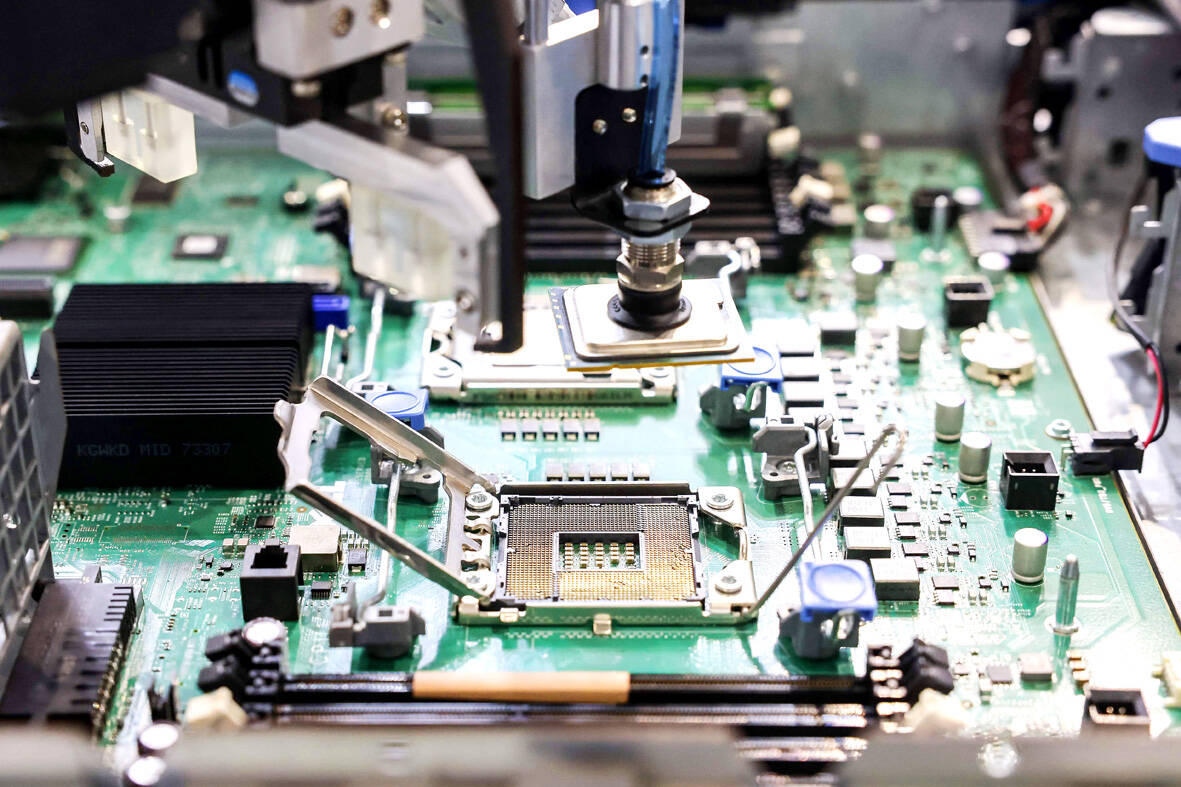
An AI server assembly station is displayed on Sept. 10 at the Century Trading Corporation booth during the Semicon Taiwan exhibition in Taipei.
Photo: AFP
Another US initiative is the Foreign Direct Product Rule. First promulgated in 1959, it was intended to control the trade in US technologies. It says that if a product is made using US technology, the US government has the right to forbid the sale of that product. This includes products made outside the US, if the production technology came from the US.
Under these rules, the flow of technology required to keep the semiconductor industry running and up to date would halt. The industry would begin falling behind the technological frontier as production technology continued to advance outside Taiwan. Moreover, the US, which currently permits Taiwan to export semiconductor products made with US technology, would rescind that permission for factories in Taiwan. US investment in Taiwan technology firms, including Taiwan Semiconductor Manufacturing Co (TSMC, 台積電) would cease.
This ripple effect would cascade across many other firms, firms that are not as famous as TSMC, but are nevertheless key industry players, such as Powertech Technology Inc (PTI, 力成科技), a semiconductor testing and assembly firm, or King Yuan Electronics Co (KYEC, 京元電子), a semiconductor testing company, which recently committed to a US$1.4 billion investment in the US. These firms are also powered by materials and technologies from Japan and the US.
Many observers have noted Taiwan’s paradoxical “K-shaped” economy, with its electronics industries experiencing soaring growth while its traditional industries shrivel. In an occupied Taiwan, with the electronics industry under US sanctions, those traditional industries would be much of the economy. Not for long, though, as competition from the PRC would almost certainly wipe them out.
In other words, even if we assume that all goes as the pro-PRC shills would have it, and occupation proceeds smoothly, Taiwan is finished as an industrial power. The PRC is well aware of the US sanctions regime and will simply loot Taiwan for what it can get.
What will happen to the migrant workers who are a crucial part of the electronics industry, and who care for Taiwan’s aged? In a 2023 survey the PRC doesn’t even appear on top 10 lists of preferred work destinations for Filipino overseas workers.
TAIWAN-PRC ANSCHLUSS
Note too that the PRC has its own restrictions on technology and on the people who make it. As Inquirer.net has pointed out, a law took effect last month gave PRC officials the power to stop engineers, founders and other specialists from leaving the country if their expertise is in batteries, rare earths or artificial intelligence (AI). When Taiwan becomes part of the PRC its technologists will come under these rules. For decades Taiwanese technology researchers have circulated out to western countries to absorb the latest technology. All of that motion, an important source of information and technology, will be cut off.
Moreover, many technology workers in Taiwan probably think that a PRC-Taiwan Anschluss won’t affect them since, they figure, they can easily get a job elsewhere. They won’t realize how wrong they are until they try to leave for the US or Europe, and find they cannot. How then will major Taiwan firms run their investments in the US?
The joint effect of US and PRC restrictions sheds new light on criticisms of President William Lai (賴清德) by the Chinese Nationalist Party (KMT) over the semiconductor industry’s investments in the US. When the wave of investment first began, KMT politicians immediately attacked it. Former president Ma Ying-jeou (馬英九) said Lai was “selling” TSMC to the US. KMT heavyweight Fu Kun-chi (傅崑萁) was quoted in the Taipei Times as saying “Where would Taiwan’s safety be when it no long has its ‘sacred mountain protecting the nation’ (護國神山)?”
A Voice of America (VOA) piece by William Yang (“Taiwan lauds TSMC investment as ‘historic moment’ for US relations” March 6, 2025) quotes wise words from Taiwan-based scholar Lev Nachman, who observed that critiques of the semiconductor industry’s investments abroad appear only in relation to the US, never to Japan or other countries. That indicates, Nachman noted, that they are really attempts to drum up skepticism of America in Taiwan.
That is true. But the KMT maintains these criticisms even though many of its leading members must know that if Taiwan’s electronics firms do not have factories outside Taiwan they will soon cease to function if Taiwan is occupied, whether coercively or violently. They must also know that there is no “silicon shield.” Is it just an attempt to drive skepticism of the US? Or are the KMT’s criticisms one with the party’s quiet opposition to nuclear power and more open opposition to renewables, part of a larger program to hem in the nation and reduce its options in the face of PRC threats?
For the global economy, whether TSMC and its supply chain is seized coercively or violently, the end result will be the same: the flow of high-end chips will stop almost immediately as Taiwan begins to fall under US sanctions. Recall that before Nancy Pelosi’s trip to Taiwan in August, 2022, US commerce secretary Gina Raimondo warned that the loss of US access to Taiwan’s semiconductor industry production would cause “a deep and immediate recession” in the US. Hundreds of millions in products and investments would be lost. In the near term there is no replacement for TSMC production. Instead, it will take years to rebuild that capacity.
Somewhere else, of course, someplace not under PRC control.
Notes from Central Taiwan is a column written by long-term resident Michael Turton, who provides incisive commentary informed by three decades of living in and writing about his adoptive country. The views expressed here are his own.
KioskNews shows a cleaned-up reading view extracted from the publisher’s page — the original always lives on their site, not ours.