Mangrove Army: How Sundarbans’ ‘tiger widows’ are protecting the forest, one sapling a time
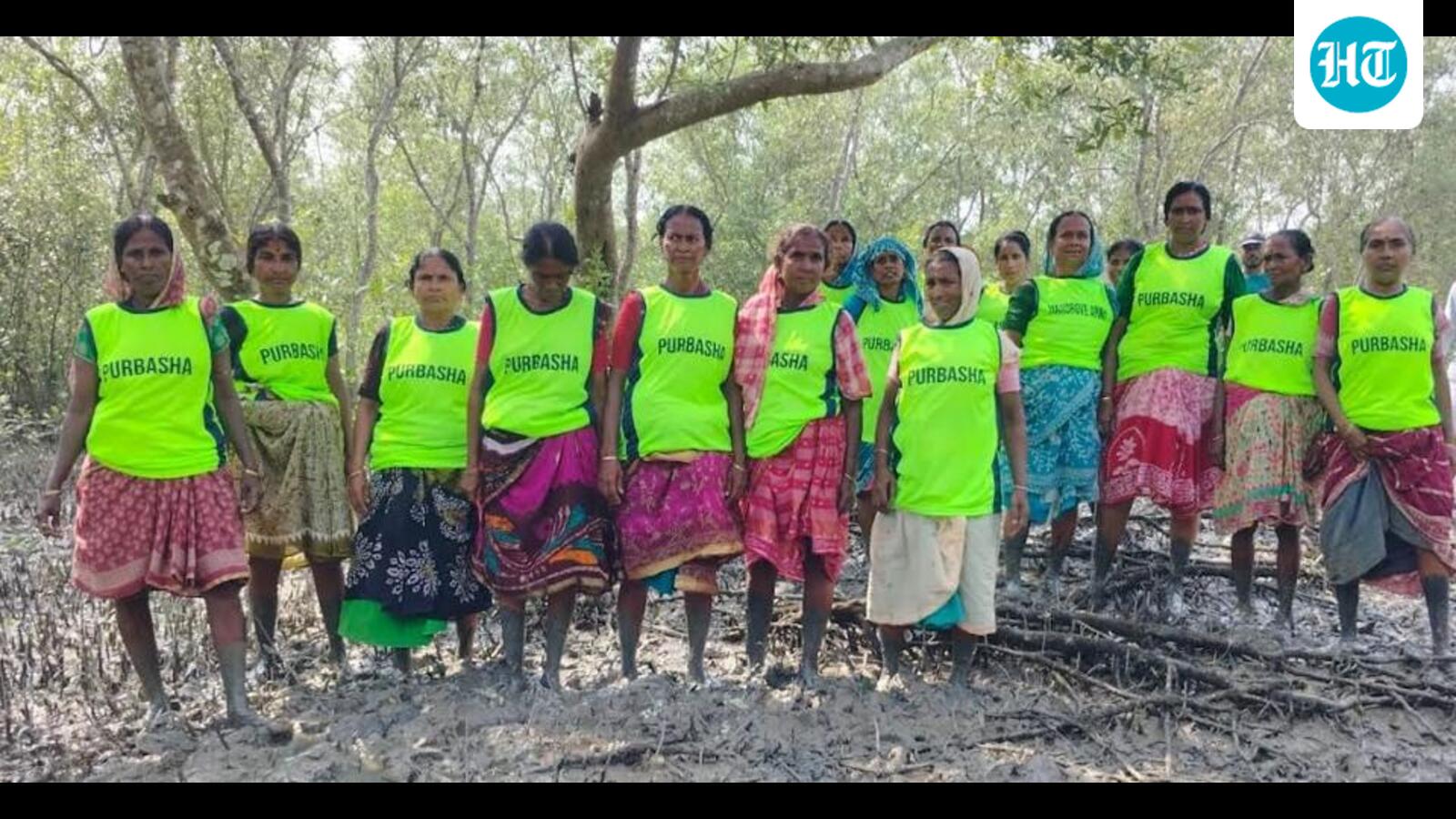
An ‘army’ of women, many of whom have lost their husbands in tiger attacks, are now fighting to save the Sundarbans in West Bengal, the world’s largest mangrove delta and home to more than 100 tigers.
Known as the “Mangrove Army”, the group was recently praised by Prime Minister Narendra Modi in his Mann Ki Baat address aired on September 27. The women plant mangrove saplings along riverbanks to protect their villages from cyclones and help conserve the fragile ecosystem.
Namita Kayal, 45, a resident of Lahiripur, a remote island in the Sundarbans, lost her husband to a tiger attack in 2021. He was killed while catching crabs in the creeks inside the forest. Her sister-in-law, Anita Kayal, lost her husband in a similar attack in 2017.
The two women now work with the Mangrove Army, planting mangrove saplings along the riverbanks that separate their village from the forest inhabited by tigers. The group provides them with essential household supplies in return for their work.
Also Read:Green tribunal impleads BMC in mangrove-dumping case in Diva
“My sister-in-law and I have both lost our husbands in tiger attacks. They were the only earning members of our families. Now, we both work for the Mangrove Army. We receive ration and other items for planting mangroves on the muddy banks. There are many others in the group like us who have lost their husbands in tiger attacks,” Namita told HT over the phone.
The group that is now called the ‘Mangrove Army’ was formed in 2009, after cyclone Aila devastated the Sundarbans, by Umashankar Mondal, a government schoolteacher in West Bengal. He brought together around 200 village women to plant mangrove saplings along riverbanks. Over the years, the initiative has grown to include around 600 women, of whom approximately 120 have lost their husbands in tiger attacks.
“Since 2009, we have planted more than 1.3 million mangrove saplings along the riverbanks of 12 remote islands, including Satjelia, Kumirmari and Choto Mollakhali. We have been working silently all these years, away from the focus of mainstream media. It was only in July 2023 that we officially named the women’s group the ‘Mangrove Army’. It was recently highlighted by the Prime Minister,” said Mondal, secretary of the Purbasha Eco-helpline Society, the non-profit organisation behind the initiative.
Also Read:4.5-acre mangrove forest to make way for Tata Power switching station
The women, ranging in age from 25 to over 60, wade through knee-deep mud along riverbanks to plant thousands of saplings every year. They do not receive wages for their work but are provided with essential supplies to support their families.
“In return, we don’t get any money. Instead, we receive everyday items needed to run the family — rice, dal, cooking oil and spices. Sometimes, we also get sarees, sanitary napkins, seeds to grow vegetables, fish fingerlings for our ponds and chickens for poultry. Recently, the society organised free eye-testing camps, and those who needed spectacles were provided with them,” Anita said.
In his Mann Ki Baat address, PM Modi praised the women for restoring the mangrove forests despite the personal losses they suffered.
“In the Sundarbans of West Bengal, some women are setting an inspiring example of the special bond [that humans share] with nature. These women are growing and restoring mangrove forests. Many of these women lost their husbands in tiger attacks. After losing their husbands, they got support for their livelihood from the Sundarbans. The mangroves they had planted have now become a natural shield for the villages. They are also earning by planting these mangroves,” Modi said.
Also Read:Sunderban crocodiles losing their nesting grounds due to climate change: Govt report
The Sundarbans comprises around 102 islands, of which only 52 are inhabited. The remaining islands are home to national parks, tiger reserves and wildlife sanctuaries. The region is also a UNESCO World Heritage Site.
Mangroves serve as a natural barrier against cyclones, helping protect coastal settlements from storm surges and strong winds. The Sundarbans also acts as a buffer for Kolkata, located around 100km to the northwest, against cyclones originating in the Bay of Bengal.
However, the region’s mangrove cover remains vulnerable. Data from the Forest Survey of India (FSI) show that while the overall mangrove cover in the Sundarbans increased marginally between 2019 and 2021, the gains were largely driven by an expansion in open mangrove cover, which primarily includes plantations.
According to the FSI’s 2021 report, the total mangrove cover in the Sundarbans, including very dense, moderately dense and open mangroves, increased from 2,112 sq km in 2019 to 2,114 sq km in 2021. The moderately dense mangrove cover remained unchanged during the period.
Tiger attacks, meanwhile, continue to pose a risk to people who enter the forest to earn a living. Senior officials said such fatalities have declined over the years. At least 15 people were killed in tiger attacks in 2018, while no deaths were recorded in 2023 and one was reported in 2024. Some deaths may go unreported when villagers enter the forest without permission.
For Namita, the Prime Minister’s recognition has brought long-awaited attention to the women’s efforts on the remote islands.
“The Prime Minister himself flagged our work. It came as a huge achievement for us who work on the remote islands trying to save the Sundarbans and their villages,” she said.
KioskNews shows a cleaned-up reading view extracted from the publisher’s page — the original always lives on their site, not ours.