The IMF casts doubt on Mexico’s chances of cracking the top 10 of world economies by 2030
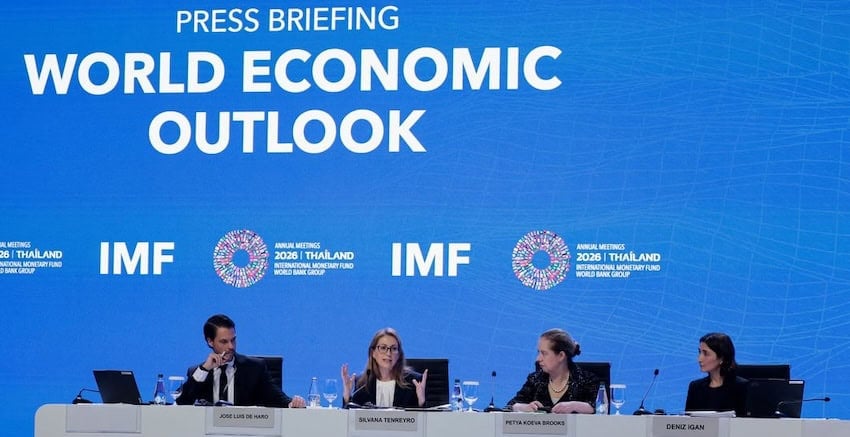
The International Monetary Fund (IMF) has thrown cold water on Mexico’s ambitious plan to return to the world’s Top 10 economies by 2030 by declaring in its latest World Economic Outlook, released on Tuesday, that the goal is unlikely to be reached until at least 2031, if then.
Citing underinvestment as a major factor, the IMF indicated that the expected maximum GDP growth rate over President Claudia Sheinbaum’s first term (ending in 2030) is 2.2%, not enough to reach 10th place among world economies. Sheinbaum had announced that goal shortly after her first 100 days in office two years ago in presenting her Plan México, which has guided Mexico’s economic policy since.
The IMF expects the average annual rate to reach 1.7% during President Sheinbaum’s term, compared with 0.9% under her predecessor Andrés Manuel López Obrador and 1.9% under Enrique Peña Nieto (2012-2018).
On October 2, the IMF revised its projections for Mexico’s economic growth to 1.5% in 2026 and 1.8% in 2027. It is projected at 2% in 2029, 2030 and 2031, which is lower than the average for Latin America and the Caribbean, which is is expected to exceed 2.5% in those years.
Mexico had held a top 10 position from 1999 to 2004, but by 2025 it had slipped to 15th. It is expected to rise to 13th this year, overtaking Australia and Spain, and is likely to remain there until 2030, when it will displace Russia to reach 12th place.
What Mexico needs to do to move up
In its report, the IMF stressed Mexico’s need to increase private investment by closing infrastructure gaps, reducing regulatory burdens and uncertainty and strengthening trade integration. It also highlighted the need to improve security, combat corruption and reduce informality.
The director of analysis and strategy at the Mexican financial institution Kapital, Alejandra Marcos Iza, cited a lack of investment, moderate consumption and the ongoing United States-Mexico-Canada Agreement (USMCA) negotiations as limiting factors for economic growth, suggesting that ongoing uncertainty surrounding trade fragmentation and U.S. tariffs has hindered new productive projects.

Meanwhile, a Bank of Mexico survey published in July, which assessed the opinions of 42 economic analysis groups from the national and international private sectors, highlighted governance issues as a major hindrance to economic growth, including public insecurity, the lack of the rule of law, internal political uncertainty and corruption.
KioskNews shows a cleaned-up reading view extracted from the publisher’s page — the original always lives on their site, not ours.