Temiar facial art tradition embraces a modern touch while preserving its heritage
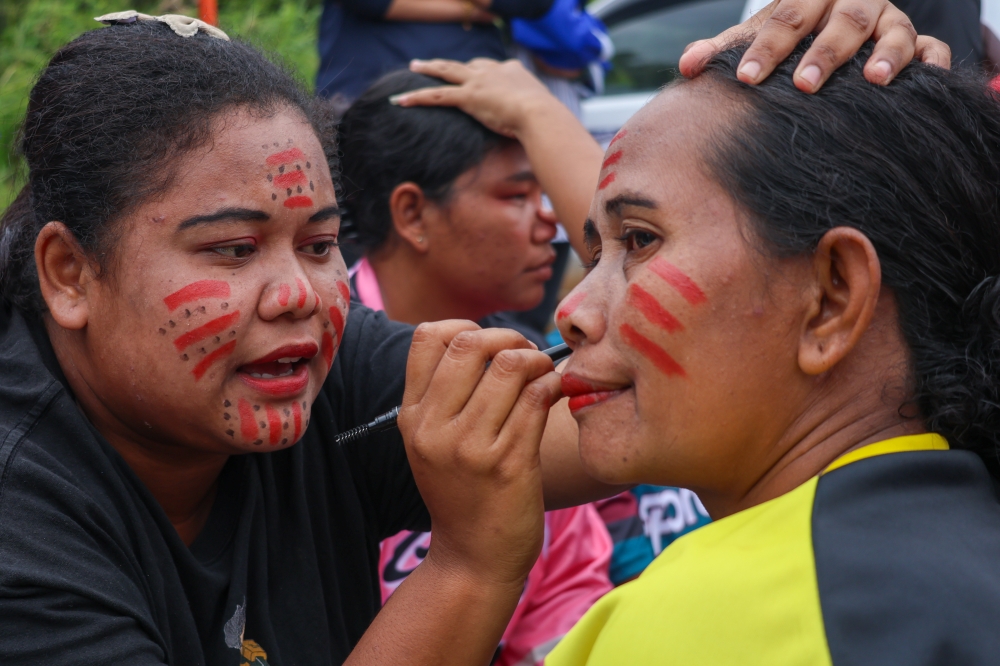

Orang Asli women from the Temiar community continue to preserve their traditional facial adornment using modern cosmetics at Kampung Tapai, Pos Hau, here. — Bernama pic
First Published: Sunday, 13 Sep 2026 7:00 AM MYT
GUA MUSANG, Sept 13 — Lipstick and face powder may have replaced charcoal and limestone paste in the beauty routines of the Orang Asli from the Temiar tribe, but modernisation has not erased the centuries-old tradition of facial adornment passed down through generations.
Endah Angah, 37, said the practice of painting geometric motifs, including long and wavy lines and dots, on the face remained deeply cherished by her community as an enduring symbol of its cultural heritage.
She said the growing difficulty of sourcing traditional beauty ingredients such as kesumba seeds had led her community to increasingly rely on modern cosmetics, which were easier to obtain than having to venture into the forest in search of the natural materials.
“In the past, these natural ingredients were easy to find, so we didn’t have to go deep into the forest to look for them. But now, they’re getting harder to find.
“Using modern cosmetics is much easier for us. The red and black colours from lipstick and eyeliner also make the patterns on our faces look neater and brighter, and they last longer too,” the housewife told Bernama recently.
Rahimah Punai, 39, said modern cosmetics might have changed the way the facial motifs were created, but their spiritual meaning and connection to their ancestral heritage remained intact.
“We make sure every horizontal and wavy line, as well as every dot, is drawn carefully because each one has its own meaning. The lines represent the river, while the dots symbolise our connection to nature.
“Nothing has changed, except that we now use modern cosmetics. We have to follow what our ancestors passed down to us and keep it the same to preserve our customs and heritage. So, we cannot just add streaks to the forehead, nose or cheeks,” she said.
Abong Busu, 55, said the custom remained deeply rooted among the Temiar tribe and continued to be practised during religious ceremonies such as the sewang and at community gatherings.
“This is how we introduce the tradition to the younger generation. The children are very interested and often ask us a lot of questions about it,” she said.
Meanwhile, Kelantan State Department for Culture and Arts (JKKN) director Rohaniza Abdullah said the use of modern cosmetics, while retaining the original facial motifs, represented a new way of preserving and continuing the traditional heritage practice.
She said creativity in producing modern-style facial decorations was a way to keep the heritage relevant while preserving its originality and aesthetic value as an important part of Orang Asli identity and socio-cultural life.
“The use of modern cosmetics is a positive development for the community because the traditional facial motifs can still be recreated while retaining their original patterns and colours. This also helps preserve the tradition for future generations.
“Preserving this tradition for the next generation is important, so efforts by various parties, especially to engage young people, must continue,” she said.
Rohaniza added that the uniqueness and symbolism behind the facial motifs could make the traditional art an iconic representation of Orang Asli culture. — Bernama
KioskNews shows a cleaned-up reading view extracted from the publisher’s page — the original always lives on their site, not ours.