Kanhaiya then, Neha Bora and Abhijeet Dipke now: Can the new anti-BJP stars last?
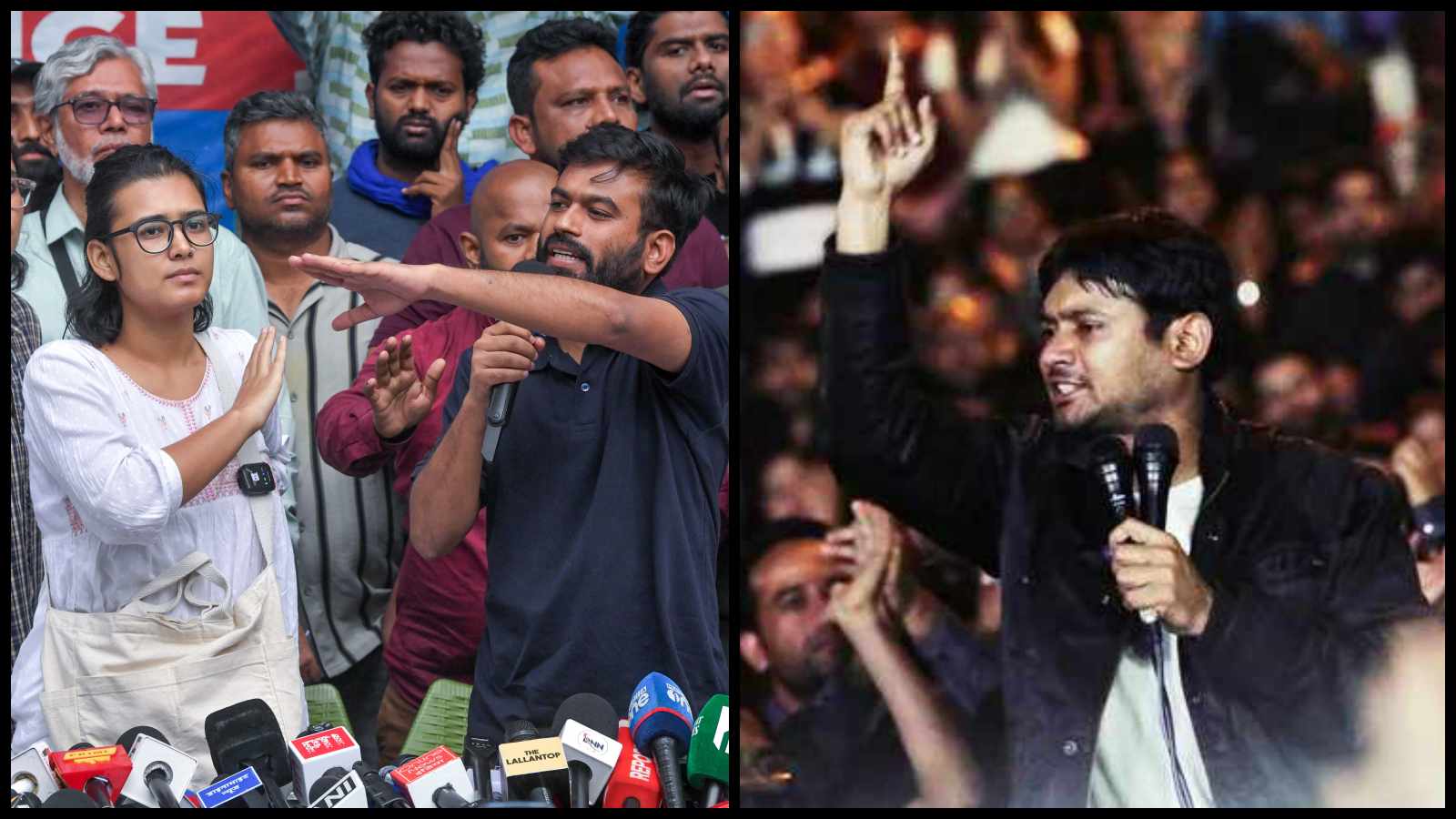
The recent protests demanding the resignation of the Chief Election Commissioner (CEC) have brought forward next-generation faces, much like earlier demonstrations against the BJP-led government at the Centre.
Left student leader Neha Bora of the CPI(M-L) Liberation’s student wing All India Students’ Association (AISA) and Cockroach Janta Party (CJP) founder Abhijeet Dipke are the new stars on the political horizon. In the last 12 years, many such faces that emerged from anti-BJP protests have faded away soon after emerging. Whether this template will change this time remains an open question.
A structural and organisational deepening of the Opposition space to take on the deeply entrenched electoral machinery of the BJP does not appear to have happened.
Hardik Patel
The trend began with the sudden rise of 22-year-old Hardik Patel in 2015 on the back of the Patidar reservation agitation in Gujarat. He was feted by the BJP’s critics, as he seemed to be turning the tide against the ruling party in Prime Minister Narendra Modi’s home state. However, the BJP won 99 out of the 182 seats in the state in the 2017 Assembly elections, while the Congress increased its tally to 77. While it was not a typical landslide BJP victory, the party survived the challenge. Hardik joined the Congress in 2019-20 and served as working president of the Gujarat Pradesh Congress Committee. He eventually joined the BJP in 2022 and was elected MLA.
Kanhaiya Kumar
In 2016, Jawaharlal Nehru University Students’ Union (JNUSU) president Kanhaiya Kumar, who was then with the CPI’s student wing, the All India Students’ Federation, rose to national fame when he was arrested during a crackdown on the campus after an event in which anti-India slogans were allegedly raised. His oratory in Hindi made many people his admirers. However, Kanhaiya lost his own election from Begusarai in Bihar against the BJP’s Giriraj Singh in 2019 and later joined the Congress.
In the 2024 Lok Sabha polls, he lost his election from Delhi against the BJP’s Manoj Tiwari. He is at present the All India Congress Committee in-charge of the National Students’ Union of India, the party’s student wing, but faced flak when the NSUI lost all posts in the Delhi University student elections this year after the Jantar Mantar protest. The NSUI and Kanhaiya came under criticism after Deepanshu Shokeen, who did not get an NSUI ticket, got elected Vice President as an Independent by a huge margin.
Jignesh Mevani
Jignesh Mevani also rose to fame in 2016, when he organised protests against the flogging of Dalits at Una in Gujarat. A Dalit activist and lawyer, Mevani also won the Vadgam Assembly election in Gujarat as an Independent in 2017. He joined the Congress later and again won Vadgam on a Congress ticket in 2022. However, he is no longer making waves the way he used to.
Chandrashekhar Azad
Chandrashekhar Azad rose to fame as the founder of the Bhim Army, which aggressively took up Dalit issues, at a time when Mayawati’s Bahujan Samaj Party has been steadily declining. He comes from her caste — the Jatavs — and her region, western UP. He is also the founder of the Aazad Samaj Party and won the Nagina Lok Sabha seat in 2024 on its ticket. He is now among the claimants of the BSP’s voter base and faces a big test in next year’s UP elections, which will show how much of an impact his party can have.
Abhijeet Dipke
Abhijeet Dipke became a known name a few months ago as he floated the CJP as an online satirical platform after Chief Justice of India Justice Surya Kant described unemployed, restive youth as “cockroaches”. The remarks triggered an uproar, following which the CJI clarified that it was “totally baseless” to suggest that he had criticised the youth.
The CJP immediately gained traction on Instagram, and Dipke has successfully turned the online phenomenon into an agitation that can bring people to the ground as protesters, particularly after activist Sonam Wangchuk’s fast demanding the resignation of Dharmendra Pradhan as Union Education Minister over NEET exam cancellation began to draw crowds. The CJP managed to achieve its objective as Pradhan was forced to step down. In the second iteration of their on-ground protests, the CJP leaders have faced a much stronger response from the state. How Dipke and his associates Saurav Das and Ashutosh Ranka, both of whom are currently in Tihar Jail, fare henceforth remains uncertain at the moment.
Neha Bora
AISA national president Neha Bora was among those who went on hunger strike during the July protests. Her fiery speeches, the hunger strike, and protest marches have captured the imagination of many. During the Opposition’s protest march to the Supreme Court on October 12, Bora was seen alongside the Gandhi siblings, leading to murmurs of discontent within sections of the NSUI. A few days later, she courted controversy by praising the Bangladesh youth uprising as an inspiration to the Gen Z movement here. The BJP was quick to jump on this to allege that Bora and the Opposition were seeking “regime change” on the lines of the uprising in Bangladesh in 2024 that overthrew the Sheikh Hasina government.
Structural weaknesses
One weakness of constructing sudden faces of the anti-BJP protest movement as potential challengers is that it does nothing to strengthen the organisational structures of Opposition parties, particularly the Congress. Conversely, in the case of the sudden rise of Bora and the Congress leadership’s tacit endorsement of her, or the shifting over of Kanhaiya to the Congress and becoming the NSUI’s in-charge, the result is further demoralisation in the NSUI and the Youth Congress.
“This is nothing but manufacturing leadership when you cannot create leadership within your own organisation. The state of affairs in the Congress is in a permanent state of turmoil and instability,” BJP national spokesperson Guru Prakash told The Indian Express. “It shows their lack of willingness to take up a political fight upfront because of lack of organisation. So, they bank upon imported leadership, which is a tried, tested and a failed model of leadership, like Kanhaiya Kumar and Jignesh Mevani. This formula of imported leadership will not work.”
A Congress leader, however, said on condition of anonymity that this was nothing new: each movement became identified with some faces. “The Gandhian movements are called so because Gandhi became their symbol. The same is true for the JP movement of the 1970s or the Anna Hazare movement of 2011. How can we then say that individuals are being deliberately projected as a counter to Modi? People identify movements with faces that become associated with them.”
He, however, agreed that unlike these faces from outside the party, the Congress had not been able to create a face out of a movement for the past several decades.
The Congress leader added that the BJP did have a face for the Ram Janmabhoomi movement in the late 1980s and early 1990s: L K Advani. “The Congress has been unable to achieve this since Mahatma Gandhi, as we have often been the establishment and such leaders are born out of resistance. However, none can deny that Rahul Gandhi is one of the faces of this movement already, and that is something positive for the Congress,” he said.
KioskNews shows a cleaned-up reading view extracted from the publisher’s page — the original always lives on their site, not ours.