In Delhi University students’ union polls, student housing takes centre stage after hostel collapse
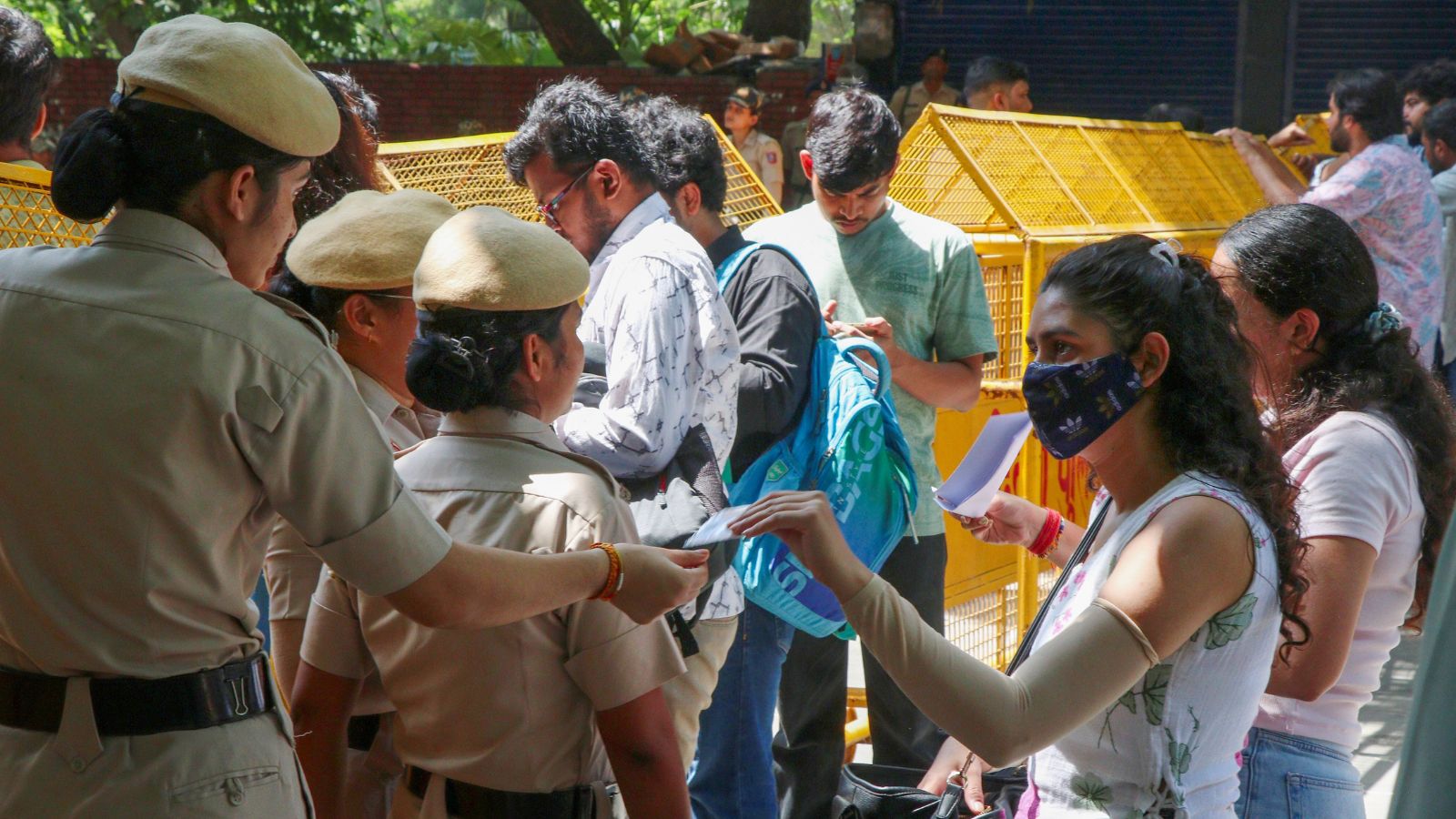
Security personnel check students' identity cards as security tightens across Delhi University's North Campus ahead of Delhi University Students' Union (DUSU) election nomination filings, in New Delhi on Thursday. (ANI Photo)
Student housing has emerged as the focal point in the Delhi University Students’ Union (DUSU) election campaign days after seven people, including five students, were killed in a building collapse in Satya Niketan. The incident yet again raised concerns about the dependence of students on private accommodations amid limited institutional hostel capacity.
The student elections are set to be held on September 18, and the results will be declared the next day. Key contenders, the AISA-SFI alliance, Akhil Bharatiya Vidyarthi Parishad (ABVP) and Association of Students for Alternative Politics (ASAP), are placing affordability and safety prominently in their manifestos. On one hand, AISA-SFI has demanded enforcement of the Rent Control Act within a 2-km radius of every college, university assistance and subsidies for verified private accommodation, and at least two hostels in every college. On the other hand, RSS-backed ABVP has made Awas (housing) the first of its four-pillar manifesto, promising separate girls’ hostels in every college, a dedicated Student Housing Cell and helpline, and fire audits of PGs and hostels across the Capital.
The Congress-backed National Students’ Union of India (NSUI) is scheduled to release its manifesto on Monday.
AISA-SFI flags ‘dark reality’
The AISA-SFI manifesto has termed the collapse “another dark reality” of DU. “This collapse must not be addressed as an accident when it is a clear case of negligence,” it underlines, adding that the incident exposed “the huge shortage of hostel accommodation and the nexus of PG mafias regulating these spaces around the varsity”.
The group said less than 5% of DU students get hostel accommodation, against the University Grants Commission (UGC) norm set for at least 60%.
It has demanded at least two hostels in every college and a mechanism to identify subsidised, standardised and certified private accommodation. It has also called for the Rent Control Act within a 2-km radius of every college and major university zone.
Meanwhile, the wider agenda includes retaining DU’s own entrance examination instead of Common University Entrance Test or CUET, removing mandatory attendance and debarment, and revising the 45% internal assessment component.
Story continues below this ad
The alliance has also called for “50% reservation for women in the central panel, functional Equal Opportunity and Grievance Redressal Cells, a merit-cum-means fellowship, concessional metro passes and menstrual leave”. It has sought higher non-Junior Research Fellowship PhD stipends, voting rights for PhD scholars, gender-neutral washrooms, horizontal reservation for transgender students and public disclosure of DUSU expenditure and its annual budget.
ABVP promises new hostels
ABVP’s ‘Awas’ agenda has promised new hostels across DU and its colleges, separate girls’ hostels in every college, a ‘Student Housing Cell’ and a helpline, and sanitation and hygiene standards in hostels.
It has called for the implementation of the PG and Student Accommodation Regulation Act across Delhi-NCR, Rent Regulation Act, and fire and safety audits of PGs and hostels. It has also proposed reviews of college infrastructure for student safety.
Among other focal points — defined as pillars — in its manifesto are participation, safety and outcomes. Bhagidari, one of the four pillars, includes student representation in the Academic and Executive Councils and greater support for students with disabilities, including increased hostel seats, and assistive technology. Under Vishwas, ABVP has proposed an Anti-Discrimination and Grievance Cell, legal aid in sexual harassment and assault cases, women-staffed police booths near colleges and hostels, sanitary-napkin vending machines and a full-time gynaecologist.
Story continues below this ad
Parinam has included fixed timelines for results, access to answer sheets at minimal cost, supplementary examinations for final-year students, changes to the scheduling of GE and SEC examinations and centralised placement cells.
ASAP promises ‘Hostels for All’
The Aam Aadmi Party’s student wing ASAP has made “Hostels for All” one of its four key demands, calling on the Central government to construct hostels for students and saying, “Till hostels are allotted, the government must bear students’ PG expenses,” it says.
Its infrastructure agenda also calls for “affordable hostels for all” and proposes cutting rents crossing Rs 1 lakh. Its wider affordability demands include rolling back fee hikes and refunding fees already collected, 100% concession on Delhi Metro fares and free travel on DTC and cluster buses for students.
Beyond housing, ASAP has proposed free counselling in every college, a 24×7 student helpline, strengthened Internal Complaints Committees (ICCs), menstrual leave of up to 15 days a semester without attendance penalty, permanent PCR vans outside girls’ colleges and gender-neutral washrooms.
It has also called for every DU college to participate in DUSU, a uniform hostel reservation policy across colleges, stronger scholarships for SC, ST and OBC students, and transparent spot rounds for reserved-category seats.
© The Indian Express Pvt Ltd

Sophiya Mathew is a Correspondent at The Indian Express, based in New Delhi. She joined the Delhi bureau in 2024, and has specialization in Integrated Multimedia Journalism from the Asian College of Journalism (ACJ), Chennai. Professional Background Core Beats: Her reporting is primarily focused on the Environment and Education. Specialization: She has gained recognition for her ground-level reporting on the Yamuna floodplains and the socio-economic challenges faced by those living on its banks. She also focuses on the disparities in Delhi's education system, ranging from elite private schools to government institutions and refugee education. Recent Notable Articles (December 2025) Her recent work has been heavily centered on Delhi's severe winter pollution crisis and the government's regulatory responses: 1. The Air Pollution Crisis "A tale of two cities: Delhi govt schools choke in bad air, private classrooms set up air filters" (Dec 20, 2025): A high-impact feature contrasting the "Clean Air Bubbles" in elite schools with the reality of government school students who are exposed to an equivalent of 17 cigarettes a day due to outdoor exposure. "Delhi sees season's worst air day, second worst December AQI in nearly a decade" (Dec 15, 2025): An analytical report on the meteorological patterns trapping pollutants in the NCR. "Delhi bans non-BS VI vehicles from outside: Why curbing vehicular pollution is key" (Dec 17, 2025): Explaining the science behind targeting specific vehicle vintages to lower particulate matter. 2. Enforcement & Regulations "No fuel at pumps in Delhi without valid PUC certificate from December 18" (Dec 17, 2025): Breaking the news on the environment ministry's strict "No PUC, No Fuel" policy. 3. Education Policy "Law to regulate school fee in Delhi risks becoming procedural, say parents" (Dec 13, 2025): Investigating the loopholes in the new Delhi School Education (Transparency in Fixation and Regulation of Fees) Bill, 2025. "Monsoon Session: Private school fee regulation Bill cleared after four-hour debate" (Aug 9, 2025): Covering the legislative passage of the controversial fee hike regulation. Signature Style Sophiya is known for her observational depth. Her reporting often includes vivid details from school corridors, hospital waitlists, or the banks of the Yamuna to illustrate how policy failures affect the city's most vulnerable residents. She is a frequent expert guest on the 3 Things podcast, where she explains the complexities of Delhi’s environmental laws. X (Twitter): @SophiyaMathew1 ... Read More
Stay updated with the latest - Click here to follow us on Instagram
KioskNews shows a cleaned-up reading view extracted from the publisher’s page — the original always lives on their site, not ours.