Fighting AI with AI: how a Chinese cybersecurity giant is defending against new hacks

Chinese President Xi Jinping and US President Donald Trump met this week in Shenzhen on the sidelines of the Apec meeting, where they discussed introducing shared guard rails on artificial intelligence amid growing numbers of AI-enabled cyber hacking incidents affecting banks and governments worldwide. In the last part of a three-part series profiling Chinese organisations at the forefront of efforts to ensure that innovation does not come at the expense of safety in China’s AI industry, we profile one of China’s biggest cybersecurity firms and outline how it is navigating the agentic AI era.
Qi An Xin Technology Group vice-president Chen Huaping had a lot to say when he stepped onto the stage at a conference organised by China’s public security and cyberspace watchdogs last week in Xiamen, in eastern Fujian province.
Late last month, an Israeli-American cloud security company used the latest AI models to discover critical flaws in PHP, the programming language used by an estimated 70 per cent of websites, causing a surge in hacking attempts.
The incident prompted urgent warnings from Chinese authorities, including the first public vulnerability bulletins published by the national cybersecurity emergency response system since 2021.
Addressing the crowd, Chen revealed that the number of assets affected in China by the PHP discoveries was in the “millions”. AI, he said, was multiplying the cost of leaving known vulnerabilities unpatched by “hundreds or even thousands of times” if they were not fixed immediately.
As one of China’s biggest cybersecurity firms, Qi An Xin has unparalleled insights into China’s sprawling cyberspace. Founded in 2014, the Shanghai-listed company, which has over 5,000 employees, became part of China’s state-backed “national team” for cybersecurity following a landmark investment of roughly 3.73 billion yuan (US$559 million) in 2019 from state-owned China Electronics Corporation.
Its customer base spans some 400,000 major organisations in China, including over 98 per cent of China’s central government departments, centrally administered state-owned enterprises and major banks.
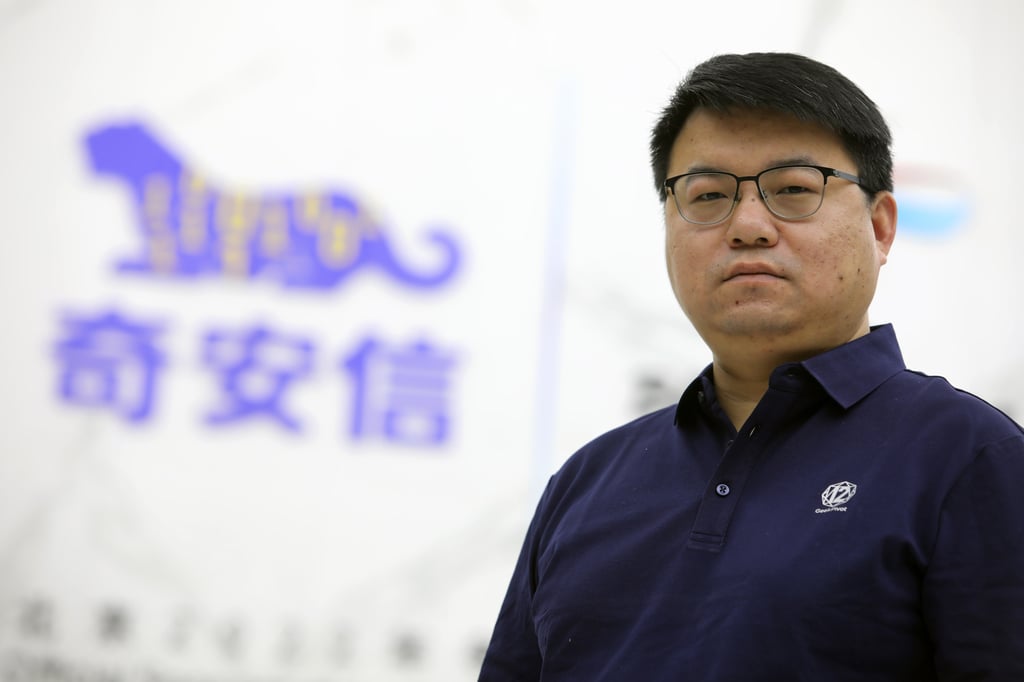
As AI gives malicious actors access to skills once reserved for seasoned hackers, the Beijing-based firm is racing to secure Chinese cyberspace. A major part of its strategy is to leverage AI as a defence. Spearheading those efforts is Gong Yushan, chief executive of the subsidiary through which Qi An Xin operates its AI security business.
According to Gong, the subsidiary focused on two main priorities: using AI to defend its customers and securing the AI systems used by its clients. Both reflect a broader change confronting cybersecurity providers worldwide, as AI ushers in an unprecedented period of cybersecurity challenges while simultaneously representing a possible solution.
“Overall, AI has significantly lowered the barrier to carrying out attacks,” Gong told the South China Morning Post. “It has lowered the level of skill attackers need and raised the operational demands on defenders.”
An evolving threat landscape
The uptick in cyber incidents is mainly because of AI systems’ mastery of coding and software development.
While these capabilities could be used to develop new mobile apps or fix software bugs, some malicious actors were increasingly using AI to automate the exploitation of vulnerabilities. This enabled faster and larger-scale intrusions and compressed the time available for defenders to respond, Qi An Xin’s threat intelligence team said in a midyear report published in August.
For instance, a new unidentified group that emerged this year, which Qi An Xin called “UTG-Q-022”, broke into Chinese routers and VPN devices and stole files, including core design drawings, from an unnamed shipbuilding organisation.
Qi An Xin investigators concluded that the malware was likely generated by AI.
In response, the company has pursued an “All in AI” strategy this year with the AI unit headed by industry veteran Gong at its centre. Before taking up his current role, Gong was head of Qi An Xin’s core in-house research unit Guanxing Laboratory, which specialises in technical work to discover and patch vulnerabilities.
As AI systems have rapidly improved in recent years, the research lab has increasingly turned its attention to stress-testing AI models through simulated attacks.
That shift towards AI is reflected in the company’s broader product line-up, with a range of AI-related products launched or upgraded this year.
These include an AI security operations platform called Aisoc, allowing customers to use the company’s in-house QAX-GPT AI model to assess internal alerts of potential cyber incidents.
According to Gong, the platform could assess the alert in about nine seconds and determine the appropriate response, compared with around five minutes for a human analyst.
These gains in speed compound as AI systems discover increasingly larger numbers of vulnerabilities. In one case shared by the company involving a provincial power-grid customer, Aisoc was able to handle more than 10,000 alerts a day, compared with a human specialist, who could handle an estimated few hundred.
“Security capabilities need to be embedded throughout the AI life cycle,” said Gong.
Other Chinese cybersecurity giants are pursuing similar strategies. Qihoo 360, another “national team” cyber vendor, has ramped up its AI offerings this year to include AI agents that analyse alerts, investigate incidents and detect phishing emails.
Meanwhile, Shenzhen-based Sangfor Technologies’ similarly named Sangfor Security GPT products also automate threat analysis and help security teams filter false alarms.
For Qi An Xin, there were early signs that its new products were gaining traction. In a November research note, Huatai Securities analysts described Qi An Xin’s AI products as moving from pilot projects towards larger-scale deployment. They cited AI-related orders exceeding 50 million yuan in the first nine months, up 223 per cent from a year earlier, including more than 35 million yuan for Aisoc.
The brokerage maintained its “buy” recommendation, while flagging government spending pressures and intensifying competition, including from 360 and Sangfor. Revenue for the company was 2.27 billion yuan for the first nine months of the year, down 20.2 per cent, according to its latest quarterly filing.

Closing the gap
According to Gong, one of the biggest issues was getting Chinese companies and institutions to take cybersecurity seriously. There was generally lower willingness to pay for software products in China, with its software-as-a-service market far smaller than that of the US.
According to US cybersecurity firm Censys, as of Friday, China had patched 5.8 per cent of PHP vulnerabilities since they were discovered. In contrast, the US had patched 33.9 per cent.
However, there is heightened attention on whether new entrants in China’s cybersecurity market could provide a boost to the industry. One of these is Beijing-based AI model developer Z.ai, also known as Zhipu AI, which in recent months has advertised its GLM models’ ability to discover software vulnerabilities.
In August, the Hong Kong-listed company launched an open-source initiative that offered free security audits to help users patch software vulnerabilities, as well as automated code-auditing tools via its ZCode platform.
A growing debate, however, was whether the open-source ecosystem – advocated for by firms like Z.ai – was a net positive for cybersecurity in China. Some experts have warned that open-weight models could allow malicious actors to more easily conduct cyberattacks. Meanwhile, its supporters said that open models could help shore up cyberspace by proliferating the cyber defensive capabilities of AI systems more widely.
For Gong, while open models have their benefits, his company was seeing rapid acceleration in how quickly vulnerabilities were being exploited “on an hourly basis” due to automated attacks.
The number of vulnerabilities discovered by the company in the first half of the year had increased by 51.9 per cent year on year, with 30.2 per cent of the most high-risk vulnerabilities exploited on the day of their discovery.
Earlier this month, Qi An Xin researchers noted that an unspecified hacker used a jailbroken DeepSeek open model to attempt to breach a dozen organisations, including a European telecommunications provider. DeepSeek did not immediately respond to a request for comment.
According to Gong, the situation was placing greater pressure on defenders than attackers in the near term, though it remains to be seen whether open-weight models could be harnessed to better help defenders in the long term.
“If defences cannot evolve as quickly as attacks, openness itself will become a source of risk,” he said.
KioskNews shows a cleaned-up reading view extracted from the publisher’s page — the original always lives on their site, not ours.