Politicization of defense spending raises concern
URGENT: The KMT needs to follow through and deliver the resources needed to build Taiwan’s critical defense capabilities, a US lawmaker told a visiting KMT delegation
By Lin Hsin-han and Hollie Younger / Staff reporter, with staff writer


The politicization and delay of Taiwan’s increased defense spending has raised concerns among Taiwan’s partners, US Representative John Moolenaar, chairman of the House Select Committee on the Strategic Competition Between the US and the Chinese Communist Party, said on Tuesday.
Moolenaar released an official statement after meeting with a delegation of Chinese Nationalist Party (KMT) lawmakers on Capitol Hill in Washington.
The delegation, led by KMT Legislator Hsu Chiao-hsin (徐巧芯), discussed Taiwan’s national defense, energy independence and cross-strait policy.
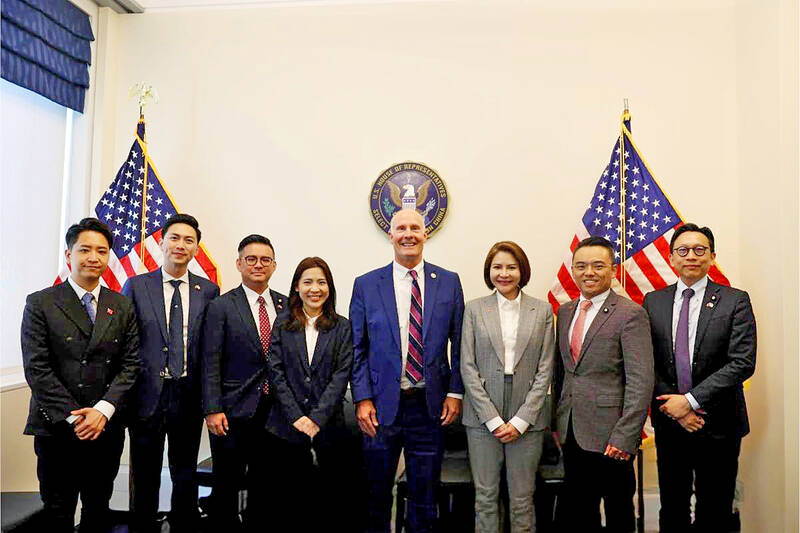
US Representative John Moolenaar, fourth from right, takes a group photograph with Chinese Nationalist Party legislators in Washington on Tuesday.
Photo courtesy of US House Select Committee on Strategic Competition between the US and the Chinese Communist Party, via CNA
Moolenaar said that, having met with members of the leading parties in Taiwan, they “all share the belief that there is an urgent need to strengthen Taiwan’s defense,” as China’s harassment of Taiwan has grown in recent months, including cyberattacks, intrusions and military exercises.
The KMT-proposed drone budget would increase support for critical drone capabilities, he said, adding that it would be essential for the KMT to “follow through and deliver the resources needed to deliver on Taiwan’s plans to build critical defense capabilities.”
Meanwhile, a statement from the KMT delegation said that they stressed to Moolenaar that the people of Taiwan love and firmly defend their free and democratic way of life, but understand the threat of war as seen in the ongoing Russia-Ukraine, Middle East and Iran conflicts.
The party fully supports the key defense spending necessary to maintain Taiwan’s self-defense capabilities, it said, evidenced by the drone development act and the passage of a special defense budget.
Alongside weapons procurement, critical infrastructure is key to deterrence, and energy security remains one of Taiwan’s most critical vulnerabilities, it said.
The party referenced its proposal to hold a referendum on restarting nuclear power, which could be used to provide a stable supply of electricity during a blockade or crisis.
Speaking on cross-strait issues, the KMT said it places equal emphasis on dialogue and deterrence when dealing with Beijing and seeks to establish stable communication channels to reduce the risk of miscalculation and manage crises.
The KMT said it will continue to deepen cooperation and dialogue with the US Congress in areas including national defense, high-tech supply chain resilience, energy transition, trade and economic affairs, working together towards peace and prosperity in the Indo-Pacific region.
KioskNews shows a cleaned-up reading view extracted from the publisher’s page — the original always lives on their site, not ours.