Surf’s up, lights up: floodlight-lit night surfing could be coming to the Gold Coast – but could it bring unwanted fins?
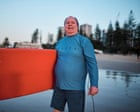
As the sun sets on one of the world’s most iconic breaks, thousands of surfers paddle into one last wave, exit the water and disappear into the bright lights of the Gold Coast. But that could change after the city council this week endorsed plans to floodlight Snapper Rocks – a famous rocky outcrop and world-class right-hand point break, located at the southern end of Rainbow Bay – for night surfing.
The $100,000 temporary trial would be part of the 2027 World Surf League championship tour event held at Coolangatta, the southernmost suburb of the Australian coastal city.
The plan has raised concerns that more regular use of floodlights on the water could attract sharks – and risks transforming a place of natural beauty into a theme park.
A local surfing identity, Andrew “Andy Mac” McKinnon, says night surfing at Snapper would be “a great spectacle” for special events such as the WSL, or the Olympics. Framed on two sides by rocks that cut into the ocean and by the Rainbow Bay surf club and Snapper Rocks road on another, McKinnon says the point break is the “ideal bay to light up”.
“Snapper’s absolutely perfect,” he says. “It is one of the greatest surfing amphitheatres, a natural amphitheatre. To add night surfing to it would be so dynamic – I think everyone will be pretty excited about this.”
McKinnon led efforts to create the Gold Coast World Surfing Reserve in 2016 and continues to preside over the nonprofit committee dedicated to protecting this 16km stretch coast from Burleigh Heads to Snapper a decade later. A champion surfer in his own right, Andy Mac’s storied career saw him surf with Coolangatta mates who would become some of the sport’s global legends including the first WSL world champion, Peter “PT” Townend, and fellow WSL champ Wayne “Rabbit” Bartholomew.
The 73-year-old is no stranger to night surfing, both as a participant and as an organiser. In 1971, McKinnon surfed under “Hollywood-style” floodlights at Hawaii’s famous Mākaha beach, while in 1988 he took on the legendary left handers of New Zealand’s Manu bay at night. McKinnon recalls both as unnerving experiences.
“There were times you’d be totally blinded by the floodlights, and then there were times when you weren’t under the lights and you’d be in total darkness out there,” he says. “It was pretty spooky.”
Describing the latter scenario as “surfing by braille”, McKinnon says it was harder to catch waves under the lights of those pioneering events than by the light of a full moon – which he has done a couple of times for pleasure, rather than for competition’s sake.
McKinnon also helped organise the first light night surfing in Queensland at the Gold Coast’s Surfers Paradise in 1996, an event he recalls as “a pretty wild time”.
“There were these electrical storms going off out on the horizon,” he says. “The city chief lifeguard at the time, Warren Young, was sitting right alongside me and with the storm, the lights and the surfers out in the water … we were both having kittens.”
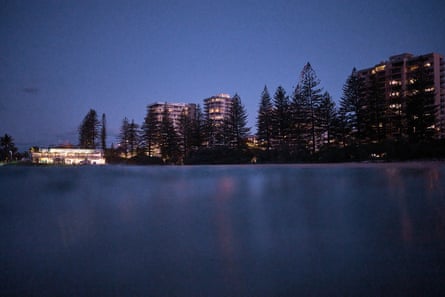
But while McKinnon is otherwise pretty relaxed about the idea of entering the ocean at night, he believes lighting it up seven days a week could be “inviting trouble”. He is not alone. News of the night surfing plan drew hundreds of comments online with one key theme circling them: sharks.
Councillor Donna Gates raised that concern at the transport and infrastructure committee meeting on 2 November, asking if it was “an old wives’ tale” that sharks were “more prevalent at dusk or evening”.
A city officer responded by saying staff found no evidence to suggest that “surfing at night carries any increased risk of shark attack than any other time of the day”.
Dr Vincent Raoult, a Griffith University shark expert, says however that – when it comes to one of the state’s most infamous shark species, at least – Gates was not peddling in folklore.
“After sunset and into the night coincides with the time where bull sharks, in particular, are most active,” Raoult says. “So there’s a bit of a heightened risk there.”
Raoult, who is a senior lecturer in environmental sustainability and management, says Snapper Rocks is near the Tweed River. “We already know that areas around river mouths are at risk of heightened bull shark activity and greater risk to swimmers and surfers – and [night surfing] would just increase those risks,” he says.
Raoult says a one-off night surfing event “sounds like a cool experience” and, if well planned, could have negligible impacts on the environment. But the light pollution of more regular use could cause significant environmental impacts, including attracting bait fish and squid which would, in turn, attract predators such as sharks.
after newsletter promotion
“Sharks are really good at learning and learning patterns,” Raoult says. “So if they do start to get exposed to a pattern where, if they come to this beach that’s lit up like a Christmas tree and there’s a bunch of food that’s available, then they’ll actually learn to visit that spot for an easy feed.”
Council’s report identifies “overcrowding of surf breaks” as a challenge for “one of the world’s great surfing cities”, noting the number of “annual surf craft riders” increased from 1.1 million to 3.2 million over the decade to 2025. Night surfing is flagged as means of accommodating the ever-increasing number of surfers, and the proposed WSL event was pitched as a trial to provide “an evidence base” for more of it.
These overcrowded breaks have already led to a community of surfers who paddle out on to Gold Coast waves after dark, says Harry Gordon, from Surfrider Foundation Australia’s Gold Coast and Tweed branch.
“On a decent swell, you could go to Snapper and you’ll see 50 or 60 people surfing in the middle of the night – if the moon’s right,” Gordon says. “People night surf. That’s OK. But do you need lights to do it?”
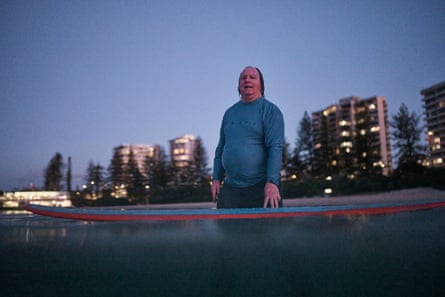
Gordon says that, as a “one-off spectacle”, night surfing seems a reasonable proposal. But “longer-term trials or a permanent initiative” was “a very different proposition” – one that he says would require “significant assessment and consultation well beyond what is proposed in this trial”.
“We’re open to all options to reduce overcrowding and enable people to have a healthy lifestyle and to surf,” he says. “But that can’t be at the cost of the environmental values of our area.”
The passionate bodysurfer and boardrider acknowledges that the Gold Coast relies heavily upon tourism, but says the city is not, in of itself, “a theme park”.
“It’s a place where people live and it’s our community,” Gordon says. “So while attractions are good, we don’t need to turn our whole lifestyle and our community into a tourism attraction.”
A city spokesperson says its Surfing Infrastructure Masterplan (SIM) has undertaken investigations “into the potential ecological and safety impacts of using artificial lighting for ocean recreation after dark”.
This work included a risk assessment that considered shark interactions and identified a range of mitigation measures, including “limiting the use of lighting to specific periods and not operating after heavy rainfall”, the spokesperson says.
“It should also be noted that the underlying risk of shark attack in Australia is extremely low and the city is focused on managing a range of risks that might be introduced through lighting of a surf break.”
The night surfing event proposal must still be issued permits by the city.
KioskNews shows a cleaned-up reading view extracted from the publisher’s page — the original always lives on their site, not ours.