Miners and tech stocks send ASX higher after Wall Street rebounds
The Australian sharemarket pushed higher in early trade on Friday, led by a rally in mining and tech stocks, after US stock pulled closer to their records overnight.
The S&P/ASX 200 was up 86.3 points, or 1 per cent, at 8806 shortly before 11.30am AEDT, with gains for all 11 industry sectors bar financials and consumer staples. The strong morning comes after the local bourse slipped 0.1 per cent on Thursday. The Australian dollar traded at US69.22¢.
The big mining heavyweights powered the early gains on the ASX, with copper and iron ore giants BHP and Rio Tinto climbing 2.8 per cent and 2.1 per cent, respectively - bouncing back from Thursday’s sell-off as bargain hunters stepped in, and further buoyed by the rebound for tech stocks, with copper being the physical backbone for AI companies. Dip buyers powered a recovery on Wall Street overnight after a chip-stock selloff fuelled by concerns about the artificial intelligence trade.
Gold stocks jumped after bullion rose as much as 1.8 per cent to trade near $US4180 an ounce, recouping from previous session’s losses, while silver also gained. US Treasury yields were down to the lowest in several weeks overnight after a tech-driven stocks rout had spurred haven demand. Lower yields typically push up gold, which suffers when bond yields rise as it pays no interest.
Amid the local gold miners, Northern Star Resources rose 2.5 per cent, Evolution Mining added 1.7 per cent and Newmont jumped 3.7 per cent. Silver producer South32 gained 2.6 per cent.
Tech stocks followed their US peers’ rebound on Wall Street, with software makers WiseTech and Xero up 4.3 per cent and 3.4 per cent, respectively, while AI data centre operator NextDC gained 2.4 per cent and family tracking app Life360 surged 7.3 per cent.
Construction company Maas Group, whose shares tanked over the past week over its connection to the failed IPO of tech company Firmus, rallied 10.3 per cent after it told investors its electrical engineering arm JLE was still delivering on its contracts with Firmus, with about $1.1 billion in work that would be finished by the end of 2027. It has been paid $373 million so far, and had a strong balance sheet with $1.7 billion in available liquidity.
Meanwhile, financial stocks struggled after the big four banks surged on Thursday after weaker-than-expected jobs data lowered the likelihood of the Reserve Bank hiking interest rates above 4.6 per cent when it meets in early November. While the banks pass on rate rises to their mortgage customers, they have to brace for more bad debts as borrowers struggle to meet their payments in the high-rate environment.
Commonwealth Bank dropped 0.9 per cent, National Australia Bank fell 1.3 per cent, Westpac lost 1.5 per cent and ANZ Bank edged down 0.3 per cent.
Defensive sectors such as consumer staples and real estate investment trusts struggled in early trade. Supermarket giants Woolworths and Coles were both down 1.2 per cent, and shopping centre landlords Scentre and Vicinity were flat and down 0.4 per cent, respectively.
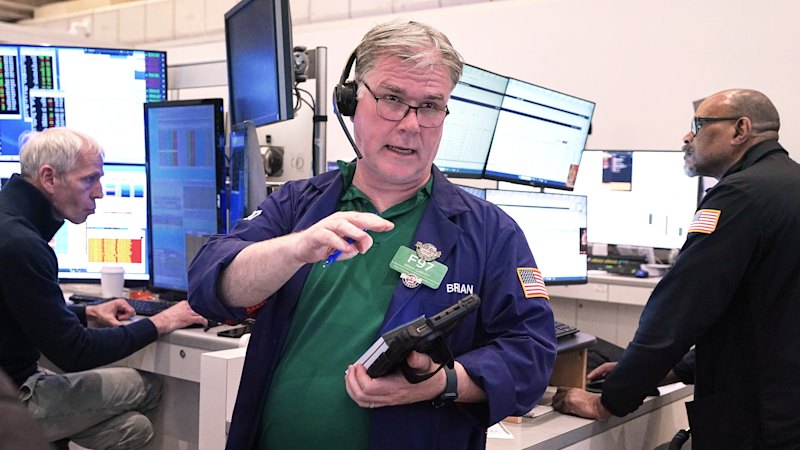
On Wall Street overnight, the S&P 500 rose 0.3 per cent after erasing an early-morning loss and pulled closer to its all-time high set last week. The Dow Jones Industrial Average jumped 556 points, or 1.1 per cent, while the Nasdaq composite added 0.1 per cent.
Marsh & McLennan rallied 4.6 per cent after the insurance and professional services firm that updated its brand name to Marsh reported a stronger profit for the summer than analysts expected.
Expectations are high for growth in profits from all kinds of companies this reporting season, which began in earnest this week. That’s what’s allowed US stocks to set records despite high inflation and the many other worries weighing on Wall Street.
Kimberly-Clark climbed 4.7 per cent after the company behind Huggies, Kleenex and Kotex said it expects to report revenue and profit for the latest quarter above what analysts had been expecting. Bank of New York Mellon rose 3.2 per cent after reporting a stronger profit than analysts expected, and CEO Robin Vince said BNY saw strength across its regions.
Markets had been much shakier earlier in the day. A sell-off for AI stocks that began on Wall Street Wednesday whipped around the world and sent South Korea’s Kospi stock index down 7.6 per cent and Japan’s Nikkei 225 down 4.9 per cent before knocking the S&P 500 lower in early trade.
They’re the latest jarring moves for AI stocks after they led the market for years. Companies are pouring money into the technology in hopes of bigger profits and improved productivity. But data centres and AI chips cost money, and many companies have been borrowing the cash to get them.
Now, after yields in bond markets worldwide hit their highest levels in years and made borrowing money more expensive, worries are rising about how resilient that boom in spending can be. High yields in the bond market also generally make investors less willing to pay high prices for stocks, particularly those seen as the most expensive.
Nvidia, the chip company that’s ridden the AI boom to become Wall Street’s most valuable company, fell 1.8 per cent and was the heaviest weight on the S&P 500. It came into the day with a nearly 1,415 per cent gain since the end of 2022.
But the losses for AI stocks moderated as the day progressed, which helped broad US indexes to steady. Nvidia more than halved an early-morning loss that had reached 3.8 per cent.
Taiwan Semiconductor Manufacturing Co. ‘s stock that trades in the US dropped as much as 5.3 per cent in the morning before finishing with a more modest loss of 1.8 per cent. The bellwether for the AI industry reported a profit for the latest quarter that topped analysts’ high expectations.
CoreWeave, which offers AI computing power to customers over the cloud, fell as much as 9.5 per cent in the morning after tumbling 15.5 per cent a day earlier. It later flipped to a gain and finished 5.9 per cent higher.
In the bond market, Treasury yields fell, which means investors were willing to pay higher prices to buy US government bonds. Treasurys have a reputation as a safer investment, and investors often flock to them when feeling nervous.
The yield on the 10-year Treasury sank to 5.09 per cent from 5.19 per cent late on Wednesday. It had topped 5.30 per cent earlier this month and touched its highest level since 2002 because of worries about high inflation, signals of a strong US economy and other factors.
The drop in yields came even though another report signalled inflation has worsened in the world’s largest economy.
In other international markets South Korea’s loss was the headliner. Its Kospi index is dominated by two chip companies, Samsung Electronics and SK Hynix, and it fell to its worst day since July. It has dropped 39 per cent since setting a record in June.
Indexes were stronger in Europe, which has less of a dependence on tech stocks. London’s FTSE 100 rallied 1.1 per cent for one of the world’s biggest gains.
KioskNews shows a cleaned-up reading view extracted from the publisher’s page — the original always lives on their site, not ours.