From Bird Paradise to Amara Hotel: How inclusive workplaces help improve operations, strengthen teamwork
When Sarah-Jane Lishi Joseph joined Mandai Wildlife Group (MWG) as a cook, her first assignment was to make penguin-shaped icing decorations in the central kitchen at Bird Paradise.
The bakery room was quieter than other parts of the central kitchen, giving Joseph, who has a mild intellectual disability, a more comfortable environment in which to settle into the job. Almost a year later, she has progressed to preparing apple crumble and working in different parts of the central kitchen.
Across workplaces in Singapore, persons with disabilities (PWDs) are not simply filling vacancies. Their contributions are strengthening teams, improving service and prompting employers to rethink processes in ways that can benefit the wider workforce.
At MWG, the approach has been more practical – match employees to suitable starting tasks, provide structured training and support, then give them room to take on more as their confidence and skills grow.
Over at Ah Meng Restaurant in the Singapore Zoo, service crew member Gabriel Sim, who also has a mild intellectual disability, started by wiping and sorting cutlery. As he grew more confident, he volunteered to help colleagues replenish supplies at the front counter.
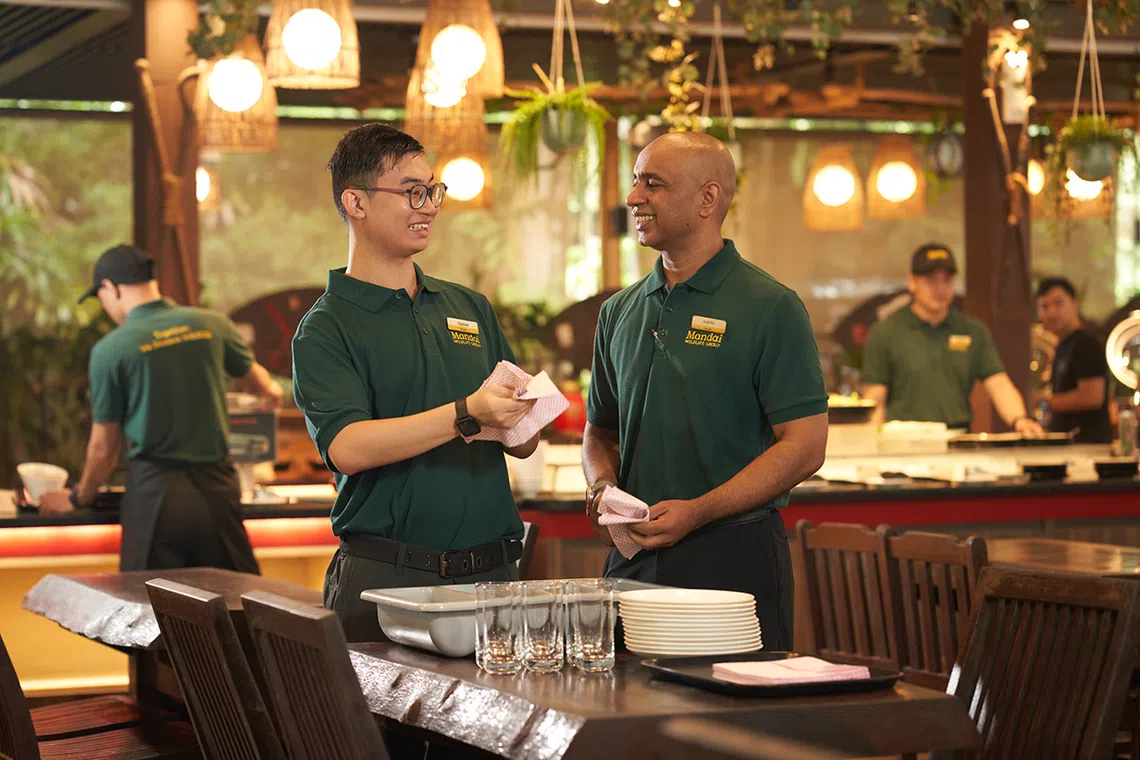
Gabriel Sim (left), who also has a mild intellectual disability, works closely with his buddy, senior manager of food and beverage Indran Nair (right), at Ah Meng Restaurant in the Singapore Zoo, where a supportive culture helps build confidence and stronger teamwork.
PHOTO: SPH MEDIA
To support employees like Joseph and Sim, MWG took a structured approach to hiring and onboarding. Staff from MWG attended training sessions supported by SG Enable, the national agency for disability. These sessions included topics such as disability awareness and customer inclusiveness.
Managers also worked with SG Enable and other partners to assess employees’ strengths, comfort levels, support needs and preferred ways of learning before matching them to suitable tasks.
Training for employees with disabilities was structured around step-by-step demonstrations, hands-on practice and support from colleagues assigned as buddies.
MWG found that these efforts benefited the wider team too.
Indran Nair, MWG’s senior manager of food and beverage and Sim’s buddy, saw how the experience of working alongside employees with disabilities has changed the team dynamics – in unexpected ways.
“Seeing our colleagues grow in confidence and take on new responsibilities has been incredibly rewarding. But what surprised me most was how much the rest of us have grown, too,” he says.
“We’ve become more patient, understanding and willing to support one another, and that has made us a stronger, more united team.”
Making inclusive hiring easier
SG Enable and its partners work with companies at different stages of their inclusive employment journey – from recruitment outreach and job redesign to workplace integration, job coaching, assistive technology assessments and grant support.
In addition, SG Enable stewards the Enabling Mark, a national-level accreditation framework that benchmarks and recognises organisations for good practices and outcomes in disability-inclusive employment in Singapore.
Launched in 2020, the Enabling Mark has three tiers that reflect an organisation’s maturity in disability-inclusive employment:
Silver recognises emerging practices;
Gold reflects more embedded practices;
Platinum recognises leading practices with sustained, organisation-wide impact.
Ready to take the next step?
Register for the Enabling Mark Business Conference on Nov 10, 2026, and discover practical ways to put inclusive employment into action.
Hear from business leaders and employers through talks and breakout sessions as they share strategies for hiring and supporting persons with disabilities, building more inclusive workplaces and embedding inclusion into long-term workforce strategies.
Better customer service, from design to delivery
At CPF Board, officers with disabilities work across areas including information technology, customer service and corporate functions.
Their first-hand perspectives also help inform how public services are designed.
For instance, when CPF Board was preparing for changes to the Matched Retirement Savings Scheme to be extended to younger Singaporeans with disabilities, it drew on insights from officers with disabilities and caregivers through service-journey testing.
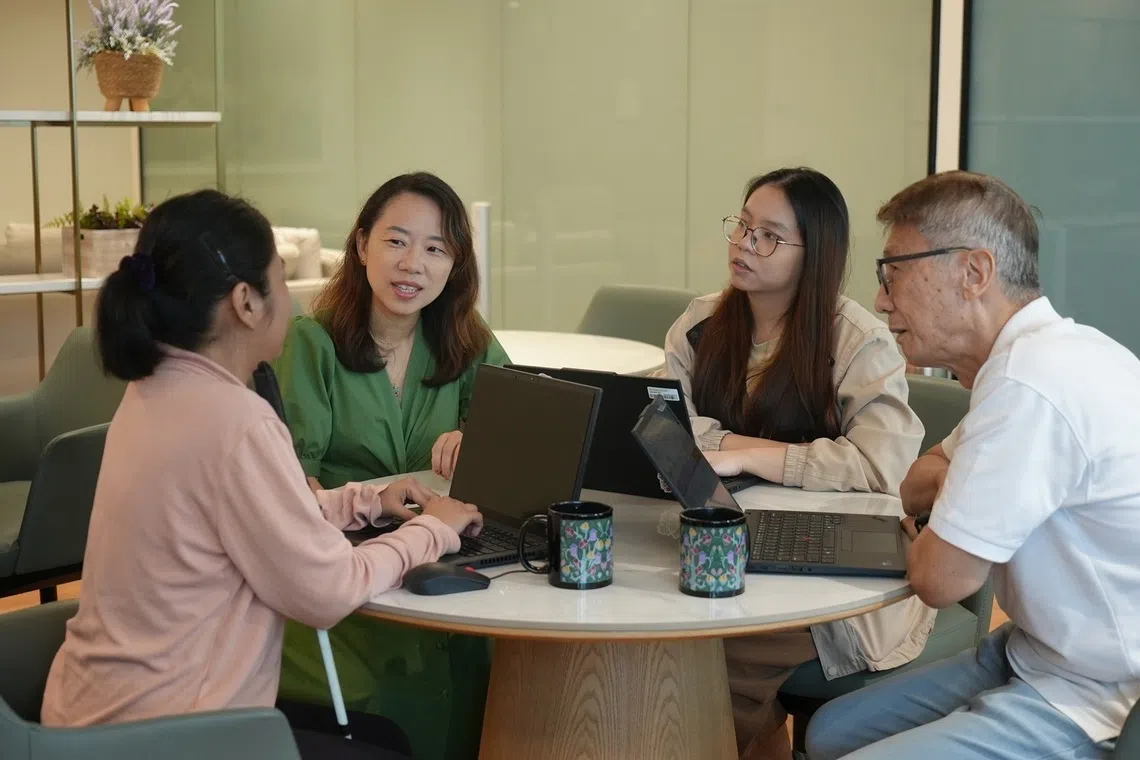
At CPF Board, disability inclusion spans hiring, tailored onboarding and workplace support. Charles Soh (right), who is hard of hearing, is pictured with his colleagues from the home protection and education department.
PHOTO: CPF BOARD
Their feedback helped CPF Board identify potential difficulties and improve how information, processes and support could be made more accessible and inclusive before the changes were rolled out.
For Tey Chee Keong, group director, human capital management at CPF Board, such contributions demonstrate how inclusive employment can benefit both employees and the public.
“It shows that inclusion is not only about creating employment opportunities,” says Tey. “The organisation gains from our officers’ skills and diverse perspectives, and our members benefit from better-designed services. Better inclusion makes us a better employer – and a better service organisation.”
In the hospitality sector, employees with disabilities are similarly showing how their individual strengths can make a difference to the customer experience.
Muhammad Idil Sudin, who has an intellectual disability, has been part of the bell and concierge team at Amara Singapore for more than two years.
When he was recruited, Amara worked with the Movement for the Intellectually Disabled of Singapore (MINDS) to break down the requirements of the role and identify responsibilities suited to his strengths.
Idil has a strong memory for faces and names, interacts warmly with guests and is reliable with routine tasks.
Initially, his duties focused on greeting guests, helping with luggage and coordinating taxis, with more complex requests referred to senior colleagues. An experienced concierge was assigned as his buddy during his first six months.
But Idil has gone beyond his assigned duties.
His supervisor Keith Kang recalls an occasion when a woman fell at the hotel. Idil immediately went to her aid, checked whether she could walk and offered her a wheelchair.
“What impressed me was that he acted on his own initiative, without waiting to be told what to do. To me, that moment showed his strength in understanding how a guest may be feeling and responding in a way that makes the guest feel supported,” says Kang.
Idil’s attentiveness has not gone unnoticed by guests, who regularly compliment him by name in their feedback.
He has also maintained a 100 per cent attendance record, demonstrating the reliability that has made him a valued member of the hotel’s team.
Ivy Lau, Amara’s regional director of human resources, says the hotel has benefited from the contributions of employees like Idil.
She adds: “What we didn’t anticipate was how much PWD colleagues would elevate the team as a whole. Their exceptional attention to detail, consistency and empathy with guests set a new standard, and turnover in key operational roles dropped as a result.”
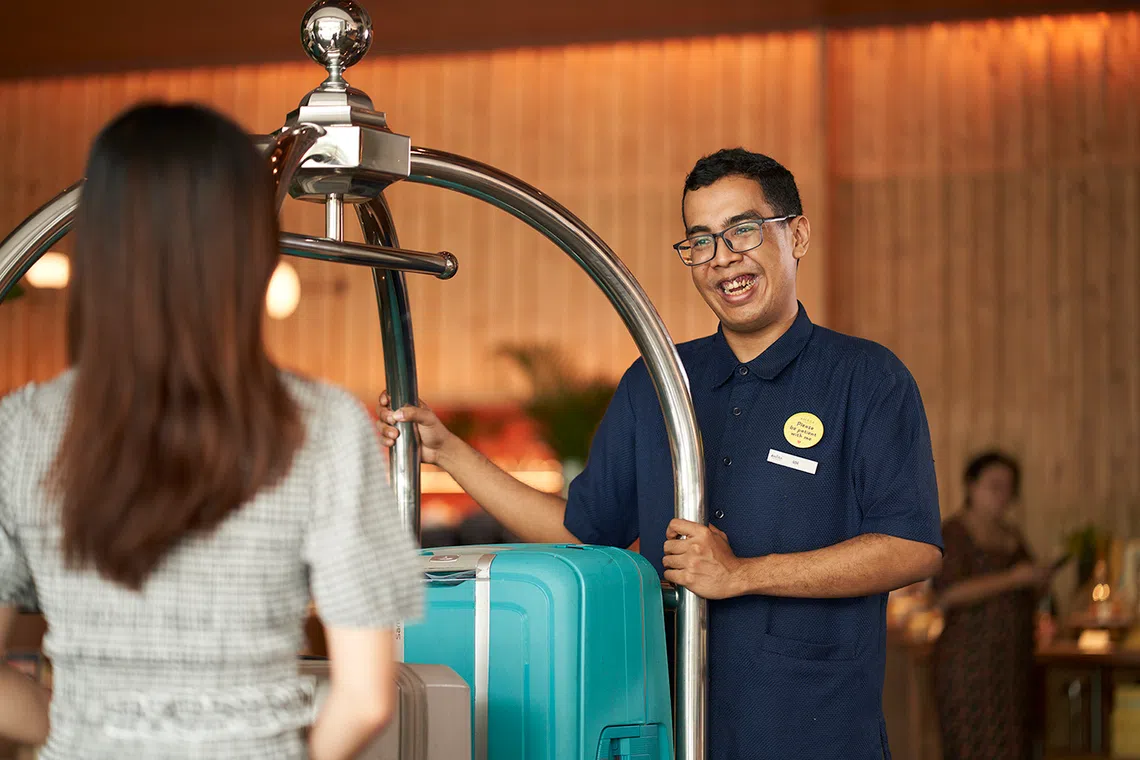
At Amara Singapore, Muhammad Idil Sudin’s attentiveness and reliability helps strengthen guest service, earning him regular compliments from hotel guests.
PHOTO: SPH MEDIA
Streamlined workflows, clearer communication
Inclusive employment has also led Amara Singapore to rethink some of its processes behind the scenes.
One example is the hotel’s luggage storage system, where bags were organised in different ways depending on timing, tags, quantity and available space. The process could be confusing, particularly for new employees.
Rather than simply expecting Idil to adapt to the system, the team involved him in developing a clearer workflow.
“This made a difference because Idil was not just being instructed – he was part of the solution,” says Kang.
The resulting process was clearer and easier for everyone, and the simplified workflow is now used to help new concierge employees learn their responsibilities. It has also helped Idil perform his job more confidently and independently, even when Kang is not around.
Working with colleagues with disabilities has also changed Kang’s approach to managing people.
He says: “It has taught me to better understand each person’s strengths and areas for improvement, rather than expecting everyone to learn or perform in the same way immediately.”
CPF Board has seen a similar ripple effect. For Charles Soh, who is hard of hearing, his supervisor and colleagues made practical adjustments, such as providing clearer written instructions.
His department director, Lyndis Kang, says these practices have since improved internal documentation and helped the wider team keep abreast of procedural and policy changes.
Senior director of the employment and lifelong learning group at SG Enable Edward Chew says that inclusive hiring is not just about creating opportunities for persons with disabilities.
“As these employers have shown, it also brings value to businesses through stronger teams, better ways of working and improved customer experiences,” he adds. “When employers recognise individual strengths and provide the right support, everyone stands to benefit.”
Find out how other employers are putting inclusive hiring into practice at the Enabling Mark Business Conference on Nov 10. Register here.
KioskNews shows a cleaned-up reading view extracted from the publisher’s page — the original always lives on their site, not ours.