Senior civil servants could face disciplinary action over Tai Po fire if named in report
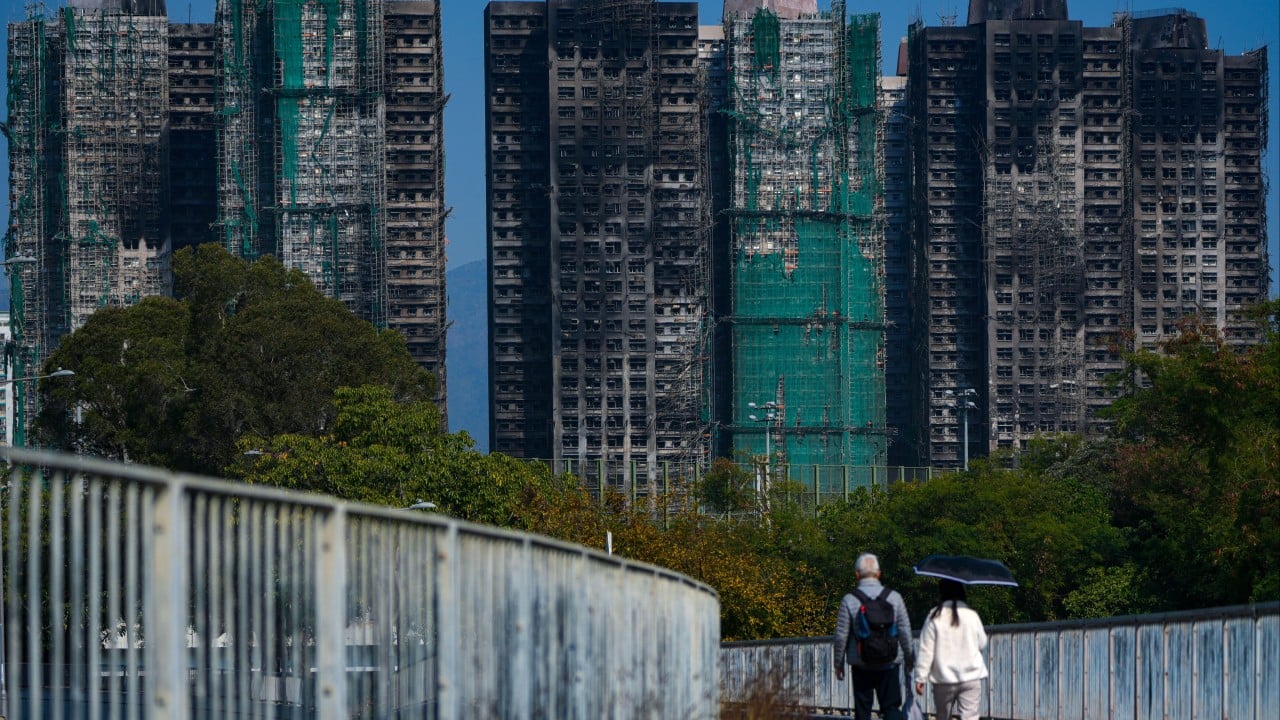
Senior public servants found accountable for last year’s deadly Tai Po fire could face disciplinary action if named in an investigation report that a government-appointed panel is expected to submit this month, Hong Kong’s civil service chief has said.
Secretary for the Civil Service Ingrid Yeung Ho Poi-yan also said on Saturday that a support unit was being set up to assist the Public Service Commission if investigations into officials’ “administrative responsibilities” were eventually launched.
“If the [investigation] report clearly pinpoints an individual [official] and points out what he or she has done inadequately, or there is prima facie evidence established, I would not rule out the possibility of launching disciplinary action directly,” she told a radio programme.
“Otherwise, if system failure is said to be a main issue, the Public Service Commission could also probe the officials’ administrative responsibilities.”
Yeung was referring to the two-tier administrative accountability system, implemented in July as part of reforms pushed by the city leader John Lee Ka-chiu to improve governance.
A first-tier investigation covers relatively minor problems and will be handled by department heads.
Serious or systemic government problems, or cases that involve permanent secretaries or department heads, will trigger second-tier investigations conducted by the commission.
It is understood that a special task force is being set up under the commission to follow up on efforts to establish accountability for the fire and will be led by former sports commissioner George Tsoi Kin-pan and former deputy secretary for security Benjamin Mok Kwan-yu.
Yeung declined to comment, saying the deployment was a “normal” exercise as preparations were being made in the wake of the commission’s expanded roles.
Yeung reiterated that the government would decide what to do next after receiving the report of the committee looking into the fire tragedy but promised that accountability would be pursued.
She added, however, that the government might not make the commission’s investigation report fully public, citing the need to protect privacy and confidentiality.
The devastating fire at the Wang Fuk Court housing estate in Tai Po claimed 168 lives last November.
A judge-led committee was appointed by the government last December to investigate the cause of the blaze and make recommendations. During its hearings, the panel was told that the government’s lax monitoring and heavy reliance on the contractors’ self-supervision were partly to blame.
The panel’s 30 evidential hearing sessions, held over five months, exposed how the use of non-fire-retardant materials such as scaffolding nets and polyfoam boards, the removal of fireproof windows from emergency staircases and the deactivation of fire alarms at the estate, which was under renovation at the time, led to the rapid spread of the flames.
02:48
Wang Fuk Court residents hope people ‘learn lessons’ as hearing ends
Victor Dawes, the committee’s lead counsel, also singled out four government bodies for failing to heed fire risks in the run-up to the disaster – the Fire Services Department, the Buildings Department, the Labour Department and the Housing Bureau’s Independent Checking Unit.
The committee is expected to submit a report by the end of this month.
Meanwhile, Yeung said in Saturday’s interview that 41,000 government employees across about 100 job grades had been covered in the first phase of a revised civil service appraisal scheme launched this month.
Under the revised system, staff performances are assessed on a six-level rating scale, with about 5 to 10 per cent of those deemed to have underperformed not being granted a salary increment.
Yeung said the figures were not rigid targets. She also said the scheme would be reviewed after two years to see whether any adjustments were needed.
KioskNews shows a cleaned-up reading view extracted from the publisher’s page — the original always lives on their site, not ours.