‘Are they going to take my son away?’: The common parenting taboo nobody talks about
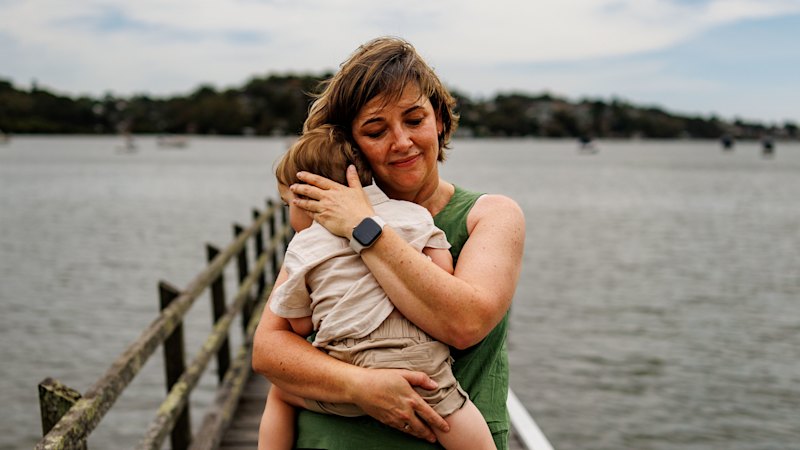
After her son was born, Lynn Baker couldn’t get the thought of his pram rolling under a train out of her head.
Baker, 46, is a single mother by choice and her anxiety was already high by the time she became pregnant, due to a difficult IVF process.
Intrusive thoughts about harming her son Micah, who is now two years old, only worsened during her first year of motherhood. Another thought that plagued her was accidentally banging Micah’s head on the kitchen counter.
Looking back on this time, she remembers asking herself: “It’s not my intent, but am I going to do that?”
“I didn’t, at one point, know if I could trust myself to be alone with my son, and that was so devastating, right, because my son was also my dream come true,” she says.
And Baker is far from alone. UNSW recently conducted a research survey of 439 people who had given birth one to six months ago. Participants reported that 95 per cent had thoughts about accidentally harming their baby.
Researchers Jodie Pestana and Susanne Schweizer say this survey is part of a larger body of work yet to come on perinatal mental health.
Schweizer says intrusive thoughts are common and while more evidence is needed about why they occur, the leading theory is that they are evolutionary.
“Imagine you’re out on a high-rise balcony with a newborn thrust into your arms, and you have an intrusive thought of the baby accidentally falling over the railing. You’re probably taking a step back,” says Schweizer.
Fifty-four per cent of survey respondents reported intrusive thoughts about intentionally harming their baby, and one in five reported severe or extreme distress about having these thoughts.
Schweizer says thoughts of intentional harm are still normal and are not associated with an increased risk to the baby, unless they occur with postpartum psychosis, a condition which affects less than one per cent of people.
Schweizer emphasises the normalcy of the thoughts but also how confronting the experience can be for new parents, particularly if they are unaware of them.
As a psychologist and mother herself, Schweizer wasn’t prepared.
“You think, ‘Why is my brain producing this thought?’ Speaking from experience as a mum of three, this is so in contrast with every single thing you’re feeling about this infant and about being their mother, it’s the furthest thing from what you actually would want to do.
“I hope that no mum has to have these thoughts in the future and not know what they are,” says Schweizer.
Narelle Dickinson, a perinatal psychologist and director of Lotus Health and Psychology in Brisbane, agrees that intrusive thoughts are harmless until they cause consistent distress.
While there are no rules about when to seek help, diagnostically, Dickinson says the general timeframe is distress lasting about two or more weeks.
“What I normally say is everyone has bad days or maybe you’re having a tough afternoon because baby won’t settle, unfortunately that’s the life of a new parent. But when you are having more of those tough days than good days then it’s time to check in with someone on your healthcare team or even a loved one,” says Dickinson.
When Baker was struggling, she was reluctant to ask for help, fearing being judged or having her worst fears come true and being deemed an unsafe mother.
“I asked my GP, ‘Are they going to take my son away from me?’”
When asking for help, it’s OK if the healthcare professional doesn’t understand perinatal intrusive thoughts, says Dickinson.
“If you seek help, and they react as if what you’ve said is terrible, or they want to take the baby because they don’t think you’re safe, they might not understand intrusive thoughts. If they react like this, talk to someone else,” says Dickinson.
Researchers Pestana and Schweizer say this is one of the key reason for research like theirs, as a foundation to train clinicians, particularly as mental health disorders climb in pregnancy.
According to a recently published national report from the Gidget Foundation and Women’s Mental Health Australia, perinatal anxiety and depression is increasing, with one in four mothers experiencing anxiety or depression.
Baker says if a doctor had told her about the possibility of intrusive thoughts, she might not have been as stressed. Eventually, she found herself Googling and found an explanation that confirmed she “wasn’t crazy”.
The thoughts also generally get worse when they are bottled up. And Baker agrees she started to feel relief when she spoke about the things running through her mind.
“The minute you start talking about the thoughts, they diminish, right, they become less powerful.”
Make the most of your health, relationships, fitness and nutrition with our Live Well newsletter. Get it in your inbox every Monday.
KioskNews shows a cleaned-up reading view extracted from the publisher’s page — the original always lives on their site, not ours.