Citi supports Taiwanese companies’ growth in central and eastern Europe amid supply-chain shifts
By Crystal Hsu / Staff reporter


Amid ongoing shifts in global supply chains, Taiwanese companies are increasingly seeking to diversify their operations, move closer to customers and strengthen their presence in key overseas markets. Citi is drawing on its global network and on-the-ground capabilities to help clients assess opportunities and navigate their expansion in Central and Eastern Europe, including Poland, Citi Country Officer for Poland Elzbieta Czetwertynska said on Monday in Taipei.
She told a small group of Taiwanese reporters that the needs of Taiwanese companies in the region span across multiple industries.
Citi supports clients by providing local market insights and solutions tailored to their cross-border business needs.
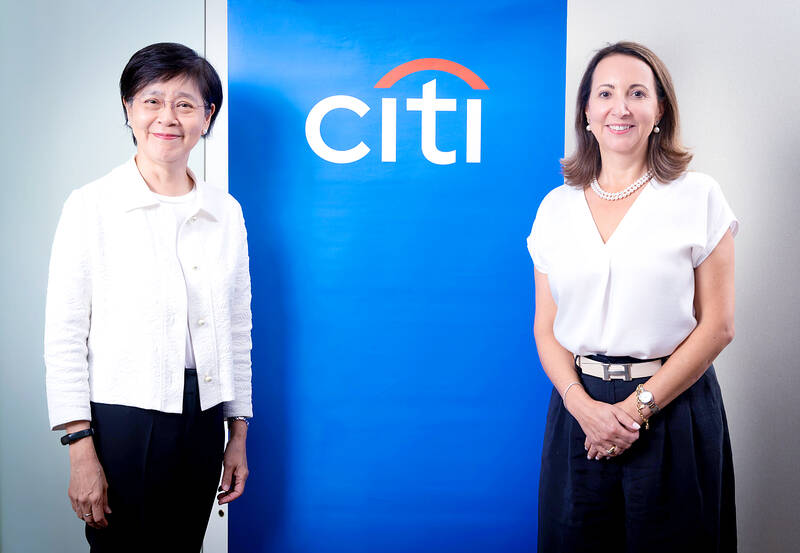
Citi Country Officer for Poland Elzbieta Czetwertynska, right, and Christie Chang, Citi Country Officer for Taiwan and Chairman of Citibank Taiwan Ltd pose in this picture in Taipei on Monday.
Photo on courtesy of Citi
A strategic gateway to Europe
The trend reflects the growing importance of “near-shoring” and “friend-shoring,” as companies seek to reduce exposure to geopolitical tensions and supply-chain disruptions by locating production closer to major markets or in countries regarded as strategic partners.
Poland is particularly well positioned because of its location between Western Europe and the wider Central and Eastern European region, Czetwertynska said. Poland’s economy is approaching the US$1 trillion milestone and progressing toward developed market status. GDP growth is projected at approximately 3.5-3.6 percent this year, around three times the EU average, she said.
Its established industrial base and skilled workforce could complement Taiwan’s strength in technology and hardware manufacturing.
Trade and investment ties deepen
The relationship is also being reinforced by rapidly growing trade. Bilateral trade exceeded US$2.5 billion in 2025, according to Taiwan’s Ministry of Economic Affairs, with integrated circuits, semiconductors and LCD panels accounting for about 60 percent of Poland’s imports from Taiwan.
Polish imports of computers, servers and electronic components from Taiwan surged about 500 percent in the first half of 2026 from a year earlier, underscoring the growing role of AI and data-center investment in the bilateral relationship.
Green energy transition, supply chain security and digitalization are among the key investment themes, Czetwertynska said.
AI infrastructure offers opportunities
AI infrastructure is likely to be one of the most promising areas. Taiwanese companies involved in AI servers, GPU systems, server racks, power supplies, liquid cooling, thermal management, networking and data-center power systems could use Poland as a production or service base for the European market.
The opportunity is not limited to final assembly. Taiwanese companies could also establish local operations in testing and packaging, equipment maintenance, precision machinery, automation, vacuum systems, factory infrastructure and semiconductor equipment components, Czetwertynska said.
Poland’s automotive industry offers another potential entry point, providing Taiwanese suppliers with a base from which to serve European automakers and parts manufacturers, she said.
Green energy transition could create opportunities in battery-management systems, power electronics, inverters and energy-management systems as Poland expands renewable power, energy storage and grid infrastructure.
Beyond manufacturing
Another emerging area is drones. Poland accounted for nearly 60 percent of Taiwan’s drone exports in 2025, making it Taiwan’s largest export market for the products. The two markets could deepen cooperation by combining Poland’s system-integration capabilities with Taiwan’s strengths in key drone components, Czetwertynska said.
Poland as a regional platform
The potential extends beyond Poland itself. Its position within the EU means companies establishing operations there can use the country as a base for serving customers across the bloc, while Poland’s proximity to Ukraine could also become strategically important when reconstruction begins.
The reconstruction of Ukraine could eventually generate more than US$500 billion in economic opportunities, with Poland expected to play an important role as a regional gateway.
For Taiwanese companies, however, establishing a European base also means navigating a more complex regulatory environment, Czetwertynska said. A factory in Poland is likely to serve customers across the EU, exposing companies to requirements involving carbon emissions, supply-chain transparency, sustainability and other regulations.
The longer-term opportunity, Czetwertynska said, is therefore not simply to use Poland as a lower-cost production location, but to build a deeper presence that connects Taiwanese technology supply chains with European industrial markets.
Taiwanese companies are increasingly moving beyond exports toward local manufacturing, research and development, industry partnerships and joint ventures.
Citi’s role
Citi has supported clients through changing market environments. With a presence in over 90 markets, Citi helps clients capture cross-border opportunities around the world, said Christie Chang, Citi Country Officer for Taiwan and Chairman of Citibank Taiwan Ltd.
Through close collaboration between its Taiwan and Poland teams, Citi helps companies expand into the European and Central and Eastern European (CEE) markets.
Citi provides insights on the local investment environment, macroeconomic developments, and geopolitical trends, while offering cross-border banking solutions including trade finance, supply chain finance, foreign exchange, cash management, and corporate financing.
Through the One Citi model, clients benefit from a consistent and seamless banking experience across different markets.
KioskNews shows a cleaned-up reading view extracted from the publisher’s page — the original always lives on their site, not ours.