Interview: NexCOBOT expects strong growth in AI controllers
By Meryl Kao / Staff Reporter


NexCOBOT Co (創博) expects robust growth in its artificial intelligence (AI) controller business this year and next year, as partnerships across a range of robotics applications begin to bear fruit, chairman Clement Lin (林茂昌) said in an interview with the Taipei Times on Monday last week.
NexCOBOT is a robotics subsidiary of industrial PC maker Nexcom International Co (新漢), where Lin also serves as chairman.
AI controller shipments are expected to exceed 1,000 units and account for about 20 percent of NexCOBOT’s controller sales next year, as the company has received orders for AI controllers for wheeled robots with humanoid upper bodies, he said, adding that the company plans to ship hundreds of units from the second half of this year through early next year.
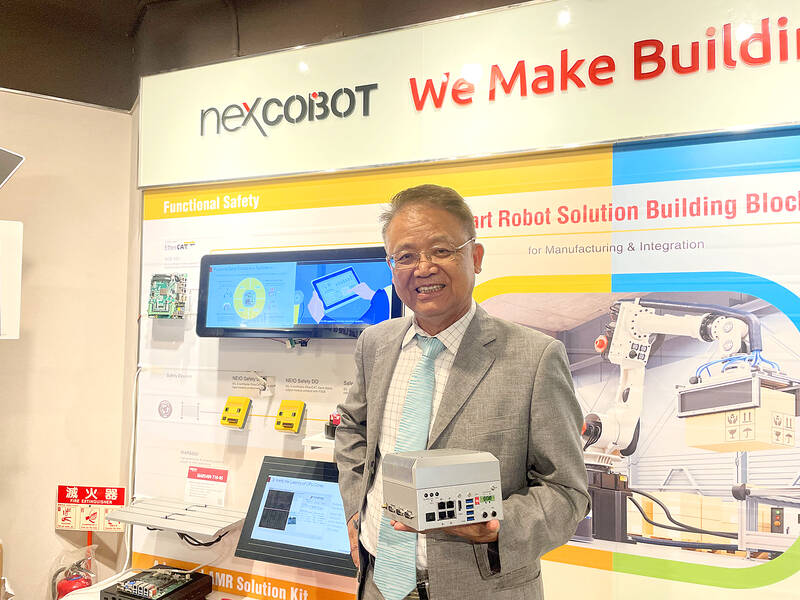
Nexcom International Co and NexCOBOT Co chairman Clement Lin poses for a photograph in Taipei on Monday last week.
Photo: Meryl Kao, Taipei Times
Controller sales — including those for computer numerical control equipment, industrial robotic arms, collaborative robots and AI robotics — are expected to account for more than 20 percent of NexCOBOT’s total revenue next year, he said.
The company’s AI controllers made with higher-end Nvidia Corp computing modules could cost US$5,000 to US$8,000 per unit, significantly higher than standard controllers, which are priced at about US$1,000 each, Lin said.
NexCOBOT expects to ship about 500 advanced AI controllers based on Nvidia’s IGX Thor platform next year, up from several hundred units this year, he said.
Quadruped robot dogs and wheeled robots with humanoid upper bodies are likely to begin volume production earlier than fully bipedal humanoid robots, Lin said.
Nexcom, the Industrial Technology Research Institute and Compal Electronics Inc (仁寶) demonstrated a robot dog solution in July, drawing the interest of firefighting agencies, while wheeled robots are generally more practical than bipedal humanoids in factories, he said.
Fully bipedal humanoid robots still require major advances in vision-language-action models and multimodal AI, Lin said, adding that meaningful progress was unlikely for at least another three years.
To address the complexity of humanoid robots’ more than 20 joints, as well as the demands that heat dissipation, wiring and real-time synchronization place on AI controllers, NexCOBOT earlier this year introduced a “four-in-one” AI control platform that combines motion control, functional safety, AI computing and cybersecurity, Lin said.
With the four-in-one platform, NexCOBOT adds its own I/O baseboards, communications, and control hardware and software to computing modules from Nvidia and Intel Corp, enabling components such as joints, vision modules, dexterous hands, thermal-imaging systems and predictive maintenance tools to be directly integrated and operated together, he said.
“While industrial PC suppliers typically provide only graphics cards or hardware baseboards, NexCOBOT aims to offer a more complete ‘last-mile’ solution to help system makers develop and deploy robots faster,” Lin said.
Last month, NexCOBOT unveiled its “RoboWIZ AI Robot Open Platform” to bring together dozens of robotics ecosystem partners and support the development of humanoid, quadruped and dual-arm robots, while allowing customers to focus on robot design, dynamic balancing, application development and commercialization, thereby shrinking the time to market, Lin said.
Taiwanese robotics partners mainly supply cameras, thermal-imaging and predictive maintenance technologies, while functional safety joints, complete 3D vision modules and advanced dexterous hands still require the support of European and US partners, he said.
NexCOBOT works with motion control supplier Synapticon GmbH on developing functional safety joints, he added.
Nexcom plans to establish RoboWiz hubs in Taipei, Taichung and at the Curiosity Lab in Atlanta, Georgia, to serve robot system makers and engage with local ecosystem partners, Lin said.
The company also aims to leverage Taiwan’s information and communications technology integration capabilities to expand AI robotics supply chain cooperation and position the country as a key partner for US robotics development and non-China supply chains, he said.
KioskNews shows a cleaned-up reading view extracted from the publisher’s page — the original always lives on their site, not ours.