Iron chest found during work at Indore's Lalbagh Palace, two claimants come forward
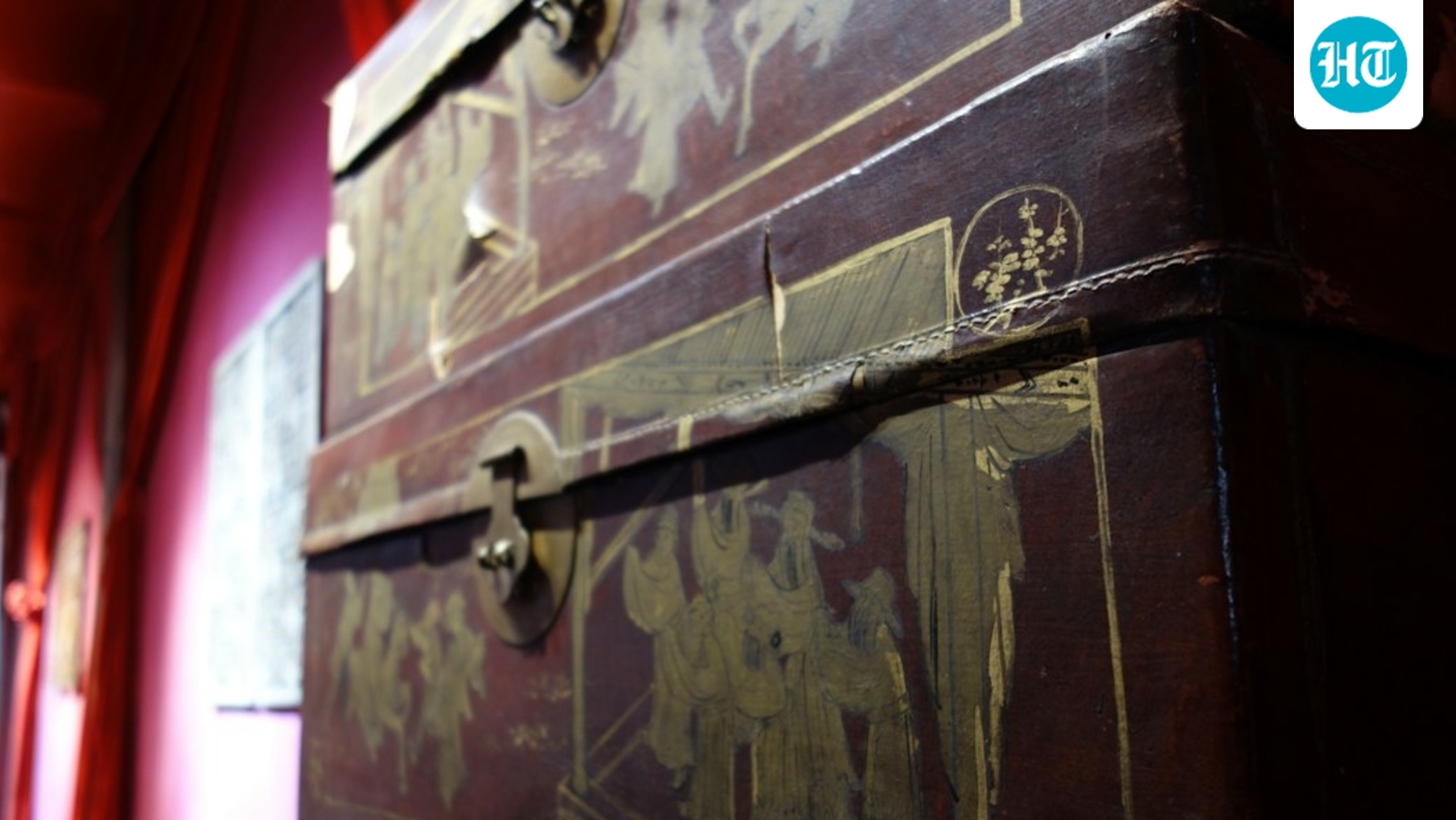
An old iron chest, discovered buried on the premises of Lalbagh Palace in Madhya Pradesh's Indore during pathway construction, has sparked curiosity and competing ownership claims, prompting the state Archaeology Department to begin verifying and opening it.
The chest was unearthed when labourers levelling the ground for a pathway struck a metal object with a spade last week. Further digging revealed a heavily rusted iron chest weighing more than 100 kg.
“Labourers were levelling the ground for a pathway when a spade hit an iron object. On digging, a rusted chest was found. The chest has no handle, its key is missing, and it weighs over 100 kg,” state archaeology department deputy director KL Dabi said.
The discovery has attracted public attention amid speculation that the chest could be linked to the Holkar royal family. However, officials said its age and origin are yet to be established.
Two claims made
Two claims have already been made over the chest. The Khasgi Trust, associated with the Holkar family, has written to the archaeology department seeking that the chest be opened in its presence.
A woman from Guna, Vandana Soni, has also staked a claim to the chest, alleging that it belonged to her mother, Manorama Soni. According to her, the chest was brought from their ancestral home in Guna to Indore and was abandoned at the palace years ago.
“I don’t possess ownership documents, but have evidence supporting her assertion," she told the media.
Dabi said the department has received representations from both claimants.
"Some reports have dated it to around 1900. We received letters from the Khasgi Trust and a woman, but claimants will have to visit the office and submit proof of ownership," he said.
HT reached out to the Khasgi Trust, and their response is awaited.
The State Archaeology Department said the chest does not figure in any government record.
Officials said the chest will first be chemically cleaned. Experts will then prepare a new key to open it in the presence of the claimants, with the entire process being videographed.
Under the Treasure Trove Act, 1878, any valuable object discovered during excavation must be reported in writing to the district collector, who then allows claimants four to six months to establish ownership.
The archaeology department plans to place the chest in the Rajwada gallery after examination. The gallery already houses 14 similar chests.
Built over 130 years ago by Tukojirao Holkar III, Lalbagh Palace spans 72 acres and is known for its European architecture, often compared to London's Buckingham Palace. The Holkar royal family resided there until 1978.
The palace was acquired by the Madhya Pradesh Archaeology Department from the Usharaje Trust in 1987 for ₹65 lakh and was opened to the public the following year by then chief minister Arjun Singh. Renovation work at the site is currently underway under the Indore Smart City project.
ABOUT THE AUTHOR
I have spent over a decade chronicling Madhya Pradesh’s political and social landscape, covering politics, investigative journalism, crime, human interest, and government policy, blending sharp insight with ground‑level depth. I have closely tracked three assembly elections, three Lok Sabha elections, leadership transitions in MP while exposing governance lapses, tender irregularities, and flawed policy rollouts. My reports have revealed gaps in the Cheetah project, irregularities in medical education, rigging in recruitment exams, and loopholes in policy implementation. In crime reporting, I have moved beyond FIRs to map systemic patterns — from organised crime networks and gender‑based violence to custodial accountability — balancing urgency with sensitivity. My journalism is defined by a commitment to human interest. I have profiled the marginalised Bancchda community, documented atrocities against tribal groups, and highlighted efforts to preserve their culture through heritage liquor and revival of spiritual practices. I have reported on farmers struggling with failed MSP promises, giving voice to those often reduced to statistics in policy files. Passionate about field reporting, I have reported on rampant sand mining in Chambal and Narmada, pharmaceutical companies supplying medicines under altered names, the dire condition of schools and colleges, the plight of commercial sex workers, and skewed sex ratios in specific districts. Beyond deadlines, and as HT’s state correspondent and assistant editor in Madhya Pradesh, I engage with ministers, farmers, students, and activists, believing the best policy stories begin with a single human voice. A postgraduate in Journalism and Mass Communication, I also hold a diploma in sports journalism.
KioskNews shows a cleaned-up reading view extracted from the publisher’s page — the original always lives on their site, not ours.