This Steamy Romance Trilogy Is Officially Launching a New Era for Verticals

Carly Lane is an Atlanta-based writer and critic who has been with Collider in some form or fashion since 2021. She considers herself a television nerd, diehard romance/sci-fi/fantasy reader, and nascent horror lover. Her fondness of books is only eclipsed by the towering TBR that her shelves can't possibly contain.
She is the author of A REGENCY GUIDE TO MODERN LIFE: 1800s ADVICE ON 21ST CENTURY LOVE, FRIENDS, FUN AND MORE, published through DK Books (an imprint of Penguin Random House) and currently available wherever books are sold.
Sierra Simone wasn't expecting to get a call from ReelShort.
Although the USA Today bestselling author had been independently publishing romance novels since the start of 2015, Hollywood hadn't come knocking to adapt them. Some of that, Simone tells me, likely had to do with the content of her books, which have earned a reputation for pushing boundaries within an already wide-ranging genre. "In film and TV, you have to have so much buy-in; you really have to have a proof of concept," she explains. "So to take a chance on something as taboo and as frankly erotic as the stuff that I normally write, you have to be like, 'Well, there's a huge audience for this. There's a huge appetite for this.' But I don't know," Simone adds, with a laugh. "Is there a huge appetite for priest effin’?"
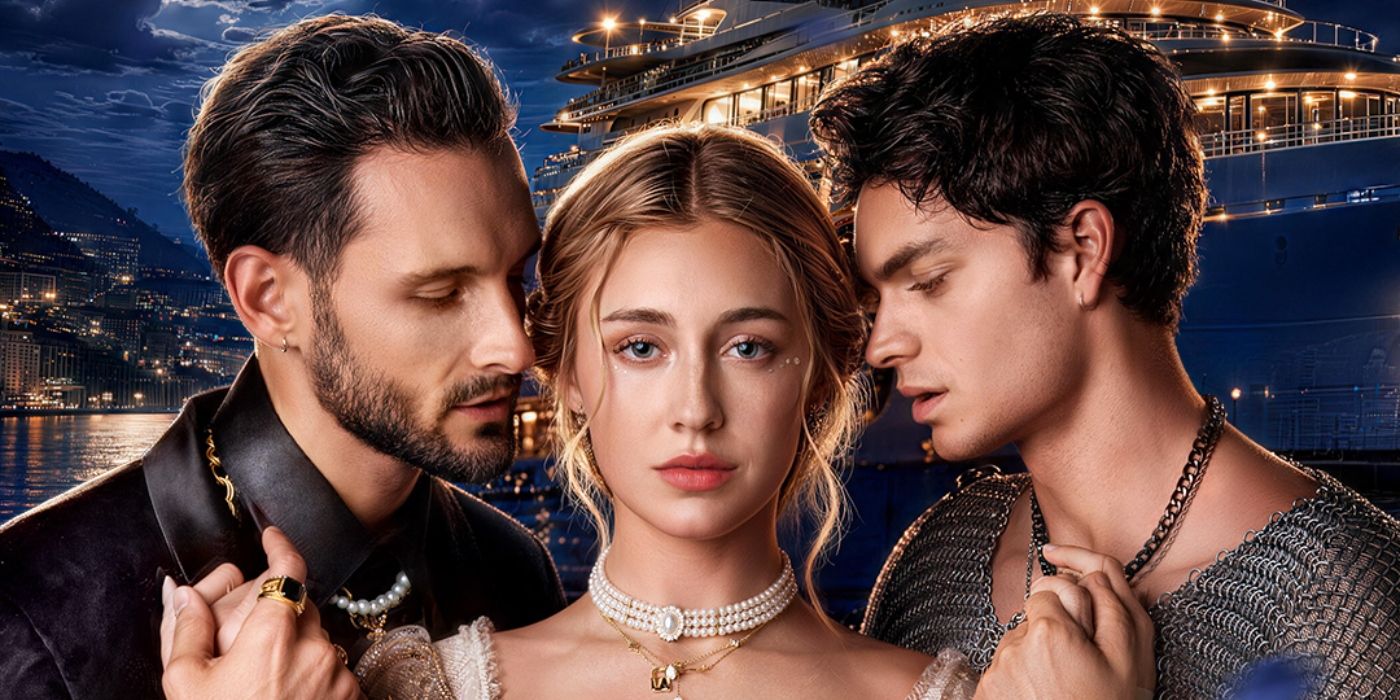
While the author's Lyonesse Trilogy may not feature priests — at least, not in the erotic sense — it's far from the first series she's written that delves into subjects that Hollywood is still catching up to depicting on a mainstream level. A queer, kinky contemporary retelling of the story of Tristan and Isolde, Simone takes the medieval legend and hauls it forward into the modern day, anchoring it in one significant diversion from the original tale: What if Tristan and Isolde both fell in love with Mark, the man Isolde has been promised to in marriage, while pursuing their own forbidden romance? It's a premise that seems to introduce a classic love-triangle conceit before throwing it out the window in favor of a true throuple situation. It's also the reason Simone expected ReelShort to balk at the idea of faithfully adapting her Lyonesse books when the conversation began last year.
"I had been upfront about Lyonesse as an unabashedly queer story," Simone admits. "Just because it's MMF, the F doesn't erase the MM part." After other potential studios had displayed some hesitation, or what the author describes as "anxiety about how carnal the stories are," Simone knew she had to go to bat for which aspects of her books needed to be preserved in adaptation — including an emphasis on sensuality. "It is a queer story, and it's a story that really only makes sense through the lens of desire. These three characters, the way that they interface with each other, the syntax of their language with each other, is physical.
Translating text for the screen has always been a tricky tightrope, particularly with a series like Lyonesse where you're not just privy to the characters' inner thoughts and feelings, Simone adds, but "what is happening inside of their nervous system." Yet she confesses to adopting a more laissez-faire approach to any adaptation of her work, emphasizing that any direct, 1:1 comparisons would be fruitless. "To me, the minute you start translating something, there's just no getting around the fact that there is going to be change and a gap between one medium and the other. I tend not to see that as a negative."
ReelShort's response to her requests, Simone says, was nothing short of enthusiastic. "The fact that there was not even a blink about the queer content, that there was not even a blink about the story being really kinky, was really attractive to me. I was expecting there to be hesitation, and instead, what I got was excitement." More yeses followed on other key details that Simone felt were important for the production — queer voices behind the lens, and, equally importantly, "casting actors who could carry a lot of what is unspoken inside the books."
From "Knife Wife" to "Lover Boy": Meet the Trio Behind ReelShort's Lyonesse Adaptation
With Simone's most important non-negotiables signed off on, the task then turned to finding the right actors to play the Lyonesse Trilogy's key trio. Katelyn Rose wasn't very familiar with vertical dramas — series typically made up of 60 episodes clocking in at a minute or two each — until her manager floated them as a possibility for her career. Like many, she didn't think all that highly of them at first. A relative newbie to acting, Rose had only had "one line in a feature film five years before," and had some apprehension about joining a corner of the industry that's still in its infancy in America but growing exponentially. After booking her first gig as a villain in a microdrama for the app Candyjar, she walked away from the experience, which marked the first time she'd ever been on a real set, forever changed. "This is what I want to do for the rest of my life."
When the opportunity came to audition for the role of Isolde Laurence, who finds herself being maneuvered into an arranged marriage with Mark Trevena as part of a larger political plot, Rose was "confident [she] wouldn't get it," as she later shared via her social media. Not only was the script intimidating, considering the admittedly kinky and emotionally heavy themes so prevalent in Simone's writing, but the filming schedule was going to be its own unique beast within the world of verticals. Since ReelShort had agreed to adapt the entire Lyonesse Trilogy, that meant Rose would be spending an entire month getting to explore and develop her character, rather than only having the typical 9 to 10 days for production. When she landed the part almost immediately, it left her with even more time to prepare, during which she read Simone's books so she had even more detail to pull from.
"She's intense!" Rose exclaims when the conversation turns to what first stood out to her about Isolde. "I mean, she's a nun, but that girl is a killer — they call her a 'knife wife.'" Getting to play a character with more intensity also marked a welcome change of pace from the roles that are so often written for women within this type of short-form content. "A lot of these characters tend to be very damsel-in-distress, just waiting for the man to come and save her. But Isolde, she will always fend for herself and fend for the people that she loves."
While Rose has about a year of vertical drama acting to her name, Jake Lively is practically a veteran by comparison. After moving to Los Angeles with the dream of becoming an actor, he started noticing an uptick in audition opportunities for verticals and decided to give it a shot one day. "I remember I went to my first one as a background [actor] about two years ago, not knowing what it was, and it was a ball," he laughs. "It was some werewolf alpha daddy thing. I had no idea what I was walking into." That adventure arguably kicked off a rapid ascent of Lively nabbing supporting parts in more verticals, which eventually became leading roles. As of our conversation, he says he's starred in about 30 different dramas — "don't quote me on that," he quickly adds. "I'm definitely [at] over 25."
Being cast as Tristan, a former soldier and loyal bodyguard to Isolde's betrothed Mark Trevena, whom Lively describes as an archetypal "lover boy," feels like the culmination of what the actor calls "leveling up in this little bubble," but the ability to embody the same character for a month is something Lively says he's still talking everyone's ear off about. "The longest I've been with a team, in a character, has been going on 10 days. To get to triple that... Tristan's forever going to hold such a near and dear place in my heart because of that, just because we're developing so much more of a story than just one series." Every vertical he's starred in so far has followed a clear-cut romantic formula from start to finish, but ReelShort's Lyonesse adaptation was an experience unlike anything he's appeared in before. "There was so much more up and down, and there was so much more turmoil throughout all three seasons, three books to play with. It’s so great. Everything is more nuanced. Everything is more complex."
The name that might surprise you most in this cast, however, is Nico Tortorella, best known to audiences outside the vertical drama space for his performances in Scream 4 and Younger. While the Illinois native has been working in film and television for "a really long time," he started noticing a shift after both the COVID-19 pandemic and 2023's SAG-AFTRA/WGA strikes significantly impacted opportunities for creatives. "The majority of my friends who are established actors haven't been working the last few years, and the only actors that I really saw that were consistently working were doing these things called verticals."
Knowing nothing about the landscape himself, Tortorella reached out to his former Walking Dead: World Beyond co-star Robert Palmer Watkins, who had found regular, reliable work with verticals; after an hour-long conversation in which Tortorella learned as much as he could, he started setting up meetings with casting directors and creatives over the next month, including Cameron West at ReelShort, who just so happened to have a role he thought Tortorella would be perfect for, in one of the app's first book adaptations. "I started reading [Salt Kiss]," the actor tells me, "and was blown away. These characters — Sierra does such an incredible job of painting these worlds and these relationships and these dynamics. I was pretty hooked on the story from the get, and we stayed in touch."
With Rose already cast, the process of finding the right actors to complement her was definitely more extensive — especially since Mark and Tristan have to forge their own intimate, surprisingly emotional bond before either of them lays eyes on Isolde. Multiple actors were reading for the trilogy's leading men, Tortorella admits, but after a few chemistry tests, he found himself in a "vertical room" in Los Angeles opposite Lively. Rather than simply throwing himself into the audition, Tortorella mentions that he asked Lively if they could run through the scene together in private first, which allowed them to establish an "immediate bond and camaraderie." It was one of the last opportunities he had to take a pause before being cast as Mark Trevena, the outwardly cruel, emotionally detached billionaire dom who owns Lyonesse, DC's premier adults-only club.
"The thing with verticals is the language is all there on the page, but everything moves so fast. There's no time to catch your breath," Tortorella explains. "So, you have to make bold choices very quickly and stick to them." A couple of weeks later, the three were in costume fittings, and then it was off to the races for what the actor describes as a production "marathon of 26 days — which is unheard of in the vertical space," but which gave Rose, Lively, and Tortorella more time to forge the kind of off-camera bonds that only helped their performances.
"Getting to be in such a long shoot for so long was really great, especially because of Nico and Katelyn, and getting to work with the team that we got to have really makes or breaks it on something as long as that. You can put up with anyone for a week, but for 26 days of 12-hour days?" Lively points out. "Gosh, I'm just glad that we got a real family here."
Tortorella is quick to agree: "We all got so close on this. I miss you both so much!"
"I miss you too!" Rose chimes in.
When Simone herself visited the set for the culmination of production with Bitter Burn, which is itself arguably the most pivotal installment of her trilogy, she left feeling newly inspired and reinvigorated about her own craft. "There's fighting, there's despair and fear, and all of the actors are just embodying so much of what you hope to feel at that point in the story — which is that these three people, however unlikely, have formed this connection that is actually stronger than any threat of violence or death.
"Just seeing this deep human-level bond that the three of them had formed and then were able to leverage for these incredibly emotional moments while they were being filmed, it just blew my hair back." Never mind the fact that the scene in question, which represented both a physical and emotional climax for the characters themselves, was what Tortorella describes as a "very intense day" — which is saying something, given that the 26-day shoot also included an emotionally draining boat scene while navigating rough waters and seasickness, multiple three-way kisses, several steamy scenes involving an X-cross, and more than one knife-fighting stunt.
"We were all battered and bloody, and Katelyn was gagged for most of the day," Lively recalls.
"Gagged and crying," Rose amends.
"And in between takes, we were like, 'Sierra, what do you think of this'?" Lively quips.
Romance Adaptations Are Giving Vertical Dramas a Different Kind of Boost
At a glance, it's easy to form a preconceived notion of verticals — especially for those of us who remember Quibi's brief run. Bite-sized serialized stories specifically shot and produced to be watched on your phone don't seem that premium when held up against other streaming offerings. Yet microdramas, which first exploded in China before making their way over to the U.S. to become a billion-dollar industry in their own right, are one of the few spaces Simone argues are predominantly focused on "trope-forward storytelling." Scroll through any app's library, including ReelShort, and you'll find titles that wouldn't necessarily look out of place on any Harlequin cover, from The Billionaire's Forbidden Nanny to The Alpha's Virgin Captive. Frank as that packaging may be, there's an honesty in verticals' approach to the romance genre that Simone says the rest of Hollywood is still struggling to meet.
"I find the way that sometimes standard and traditional film and TV treat romance to be a little dismissive — the idea that a romance on its own is not enough to hold the attention of an audience, that you need this romance plus another storyline to have enough structural support," the author tells me. "And it doesn't matter how many times that's proven not to be true. It doesn't matter how many times You've Got Mail is streamed 30 years later, or how successful Bridgerton is; there still seems to be this idea that it's not enough to draw people to it." In contrast, she says, verticals have ignored the apparently unwritten rule that an HEA (happily ever after) on its own can't sustain a narrative — and likens this rapidly evolving space to a similarly experimental era for romance authors.
"When I started indie publishing romance at the beginning of 2015, technology had all of a sudden unlocked this completely new frontier, and you just saw so much experimentation and iteration," Simone explains. "It was like we were all collectively in Iron Man's lab or something, blowing things up and smashing things together. It was so playful and so much fun because it was this place that hadn't been calcified by rules and expectations."
In many ways, Simone argues, verticals are now feeding the same appetite in audiences that romance novels — a booming industry all their own — have been satisfying for decades. The fact that studios are now looking for the next hit book series to adapt seems like the perfect marriage between two genres that are so often either dismissed or outright derided for the types of stories being told.
"I think what romance has proven is that there is no bottom of the well for the hunger for happiness, for human connection, for empathy. The need for that is eternal and ongoing, and that is a good thing. It's not like a romance reader reads a good romance and is like, 'Well, I’m done with reading for the year!' You read a good book, and you're like, 'I can't wait to find the next good book.' Verticals are very much the same way," Simone emphasizes. "They speak to this really beautiful hunger for connection on a scale that typically gets ignored."
It's a sentiment that Lively, arguably the most seasoned vertical actor in the Lyonesse cast, immediately echoes. "It's been great to see this new wave of book adaptations, because that was unheard of until a couple of months ago. Now, we're getting to dive into these scenes where the scripts have so much depth, because they're drawing from these wonderful authors who obviously know their way around a really great, gritty, interesting, twisted love story." He would know — at the time of our conversation, Lively's been playing Landon King in ReelShort's adaptation of author Rina Kent's dark mafia romance series, Legacy of Gods.
From a purely professional standpoint, however, verticals have allowed both above-the-line talent and below-the-line crew to keep working in an already tenuous industry — and it isn't just apps leading the charge, with channels like Lifetime, FOX, and Bravo also launching their own productions. It's the biggest sign so far that verticals aren't just a momentary fad or an attempt to capitalize on a new space within the entertainment business, but a realm that's only poised to keep expanding.
As for what's next, Simone's tight-lipped about whether any more of her books have been tapped for adaptation, but she's already hard at work on the second book in the Academic Affairs series she co-writes with Julie Murphy, as well as the final installment of her Priest series, titled Angel. Meanwhile, Lively and Rose reunited for another two-season vertical about a week after wrapping Bitter Burn, which couldn't be any more different from ReelShort's Lyonesse adaptation. "Jake becomes this bad boy rebel, and I'm this farm girl," Rose reveals. "It was such a 180 from what we'd been doing for the past month." Tortorella also confirms he's officially been bitten by the vertical bug after his first and very defining experience; now, he's in production on a new drama for Shortical — albeit with a very different kind of co-star.
"I left just really appreciative and grateful that this space exists — not only for actors in my position, but for new actors," Tortorella reflects. "I went in kind of thinking, 'Oh, is this going to replace modern television? Is anybody watching TV anymore?' And I left feeling like this was just a brand-new leg of the industry that didn't exist a few years ago. It's not taking away from what is already there; it's just adding more. We're living in a time in Hollywood where more is better for everyone, you know? The cast, the crew — everyone involved, really — is a veteran, in one way or another, from traditional film and television, who just wants to be working, and you feel that every step of the way."
The Lyonesse Trilogy — Salt Kiss, Honey Cut, and Bitter Burn — is now available to stream in full on the ReelShort app.
KioskNews shows a cleaned-up reading view extracted from the publisher’s page — the original always lives on their site, not ours.