The dawn of the age of the exoskeleton
One of the earliest known concepts was patented in 1890 by Nicholas Yagn, a self-taught Russian inventor, who designed a wearable apparatus for exercising. And in 1919, the American Leslie C. Kelley received a patent for a steam-powered device to support walking, one of the first powered exoskeleton concepts.
By the end of the 1960s, multiple actuated robotic exoskeletons incorporating electronic control systems had been developed. Since then, exoskeleton research and development has advanced rapidly, leading to the emergence of numerous devices with commercial and clinical applications.
How they work
Exoskeletons generate forces to make the wearer stronger, move faster, or fatigue slower.
Some devices also improve movement accuracy and dexterity or support overall posture. Some are designed to elevate human capabilities beyond what is typically possible. Others help patients with reduced physical capacity.
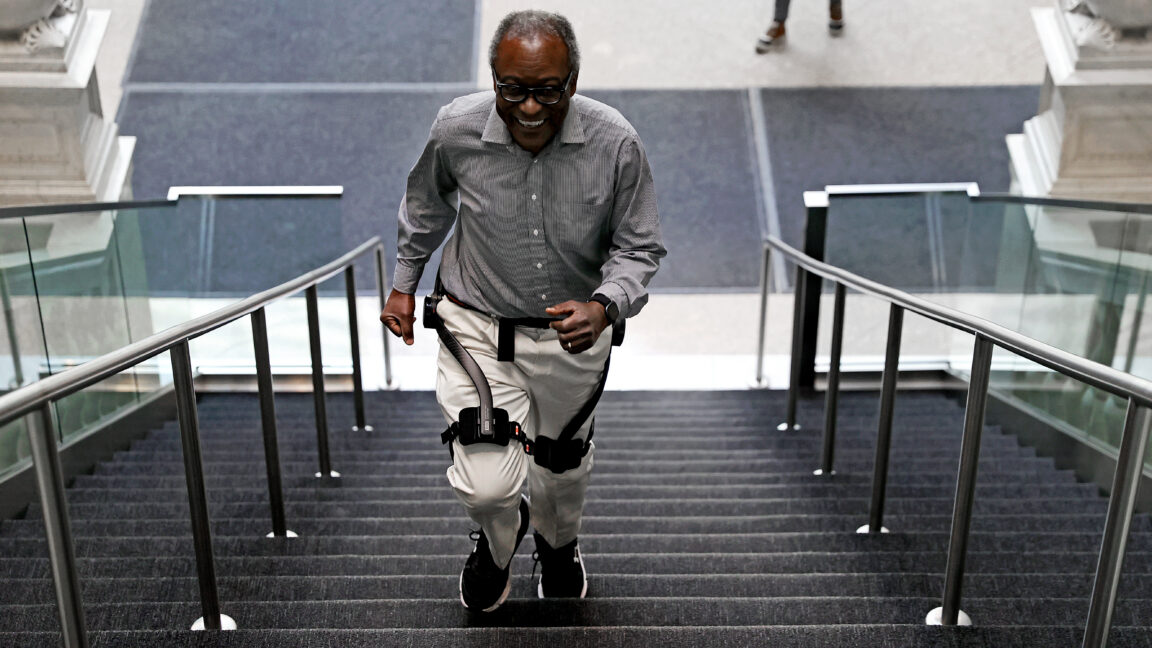
Modern, active robotic exoskeletons typically consist of a lightweight mechanical frame with ergonomic attachments to the human body. These are usually affixed at the trunk, waist and to upper or lower limbs.
For example, the Hypershell device seen in Ukraine attaches to the user’s waist and thighs, to assist with hip flexion and extension and strengthen lower-body movement. The SuitX device used by IKEA attaches to the torso and upper limbs, to support the back and shoulders.
In most powered exoskeletons, mechanical components called actuators convert electric power from batteries into mechanical movement, generating forces that support or enhance the body’s movement.
The actuators are coordinated by control units embedded in the exoskeleton. These define the trajectories of the exoskeleton’s movements and how much force it applies to the wearer’s body. Exactly how the device moves, and how forcefully, will depend on the task and the state of the user—with the device using sensors to determine what’s needed.
For instance, if a wearer starts running, an exoskeleton will speed up its supportive movements. If it senses they’re beginning to fatigue, it might increase its power output to compensate.
KioskNews shows a cleaned-up reading view extracted from the publisher’s page — the original always lives on their site, not ours.