Sara Duterte impeachment trial Day 26: 3 ex-SC chief justices say 16-vote threshold can be changed
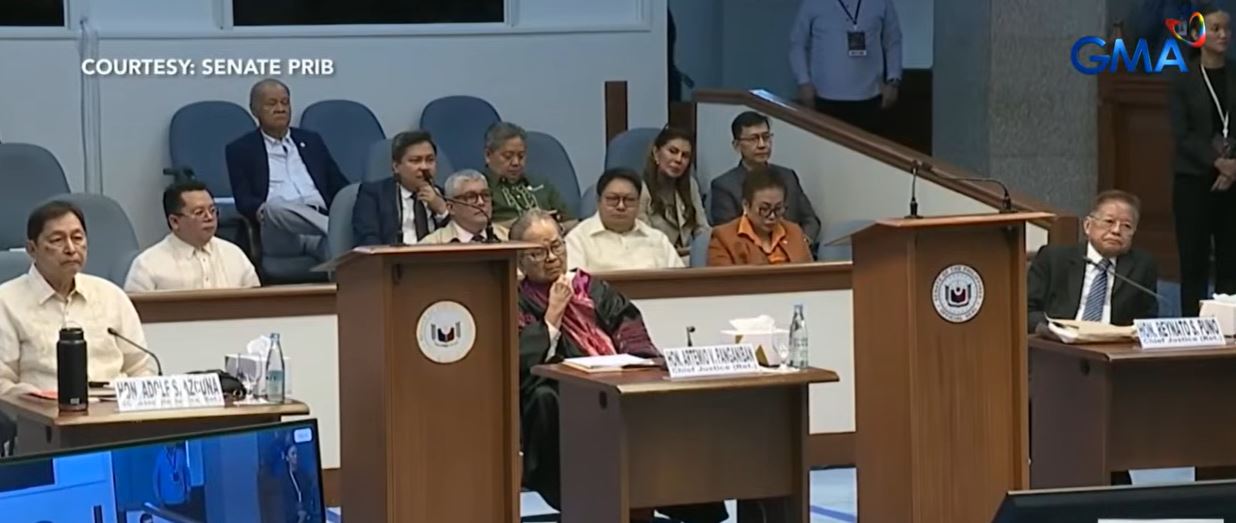
The amici curiae, or “friends of the court,” took center stage on the 26th day of Vice President Sara Duterte’s impeachment trial, with three of the four legal experts saying the Senate impeachment court can change the 16-vote threshold for conviction, citing the Senate’s authority to try and decide impeachment cases. Their position came amid the continued absence of at least four of the 24 senator-judges.
Former Chief Justice of the Supreme Court Hilario Davide, Jr., Artemio Panganiban and Reynato Puno all said that the Constitutional provision stating that two-thirds of all the members of the Senate are needed to secure a conviction must not be taken literally since the language used was not a number but a fraction.
“We have decisions of the Supreme Court which clearly decree that public officers facing criminal cases in court cannot, during the pendency of their cases, practice their profession nor hold office, elective or appointive, while in detention. Clearly then, the basis of computing the two-thirds must be the number of senators who are qualified to vote, not the 24 in the present Senate,” Davide said in a written submission.
“Meaningful adjudication requires active participation in the search for truth and fairness. It is only in this manner that a verdict that is fair to the parties, fair to the Senators, and ultimately fair to our sovereign people,” Panganiban added.
Puno, for his part, said, “by using two-thirds, the number of votes to convict will have to move depending on certain factors” because “a strict, standalone, literal interpretation of Article XI Section 3.6 may result in absurdities and may result in injustices which will defeat the purpose of the Constitution.”
It was only retired Supreme Court Associate Justice Adolf Azcuna who said every member of the Senate should be counted in determining the threshold for conviction.
"As long as he is a member of the Senate he has to be included in the two-thirds denominator. The only exception is if he dies, if he is removed from office, or if he resigns. No more," Azcuna said.
Panganiban and Puno, however, clarified that the decision to determine the threshold solely belongs to the Senate since the Constitution vests that power in them.
“That is why I explained the Senate impeachment court is not under the Supreme Court. If the Constitution wanted the Supreme Court to decide on impeachment cases, then the Senate impeachment court should have been listed under Article VIII of the Constitution on the Judiciary, not Article XI, which is Accountability of Public Officers,” Puno said.
“You (the Senate impeachment court) are an independent, free court. The Constitution said the Senate shall be the sole judge to try and decide impeachment cases. What the Constitution requires is for you, as elected representatives of the people, to make the decision. Not the Supreme Court,” Panganiban added.
Puno also said that the Senate impeachment court is not under the Supreme Court.
As to the invocation of the Avelino v. Cuenco Supreme Court decision, which excluded senators beyond the Senate's coercive jurisdiction from the official count for quorum, Panganiban, Puno and Davide all agreed that this does not directly apply to the impeachment trial of Vice President Sara Duterte because the case decided the quorum needs to pass legislation, not the threshold needed to convict and impeachable official.
Justice over legalism
But for Panganiban, justice should prevail over technicalities. As such, he was firm that allowing absent judges to vote or be included in the determination of the voting threshold will be unfair, if not an injustice, to the Filipino public who elected the Senators in the first place.
“I'm talking about justice for our people. What do our people expect from you [Senators]? It's not legalism, it's not judicial conduct. It is justice for our people,” Panganiban said.
“Kesyo dalawampu kayo, dalawampu’t apat kayo, dalawa lang kayo…ang hinahanap po ng ating bayan ay hustisya mula sa Senado. Hindi po pinakikialaman siguro ng mga tao kung sino ang nagbigay ng hustisya. Para sa kanila, meron ba silang hustisya na nakikita, na nararamdaman? I speak from the point of our people, Your Honors, not from the point of view of the judges,” Panganiban added.
(You may be 20, 24, two judges…what our people are asking from you is justice. They do not really dwell on who will give that justice. But for them, they want to see and feel that there is justice.)
Panganiban pushed the envelope further by calling for the inhibition of senator-judges who failed to participate in the ongoing impeachment trial proceedings.
“If I were in their position, because they are not in a position to render a truthful and fair judgment, I would even voluntarily inhibit from voting,” Panganiban said.
Before the proceedings ended, the Senate impeachment court also ordered Davao City Mayor Sebastian "Baste" Duterte to testify before the impeachment trial of his sister, Vice President Duterte.
The younger Duterte was among the individuals subpoenaed to appear on September 23, including Gerardo del Rosario, director of the company registration and monitoring department of the Securities and Exchange Commission (SEC).
House prosecution panel said the Davao City mayor could speak about Gencorp Industries, Inc., a firm linked to his sister.
"Ang gusto natin malaman dito, in his capacity as mayor of Davao, kung nagkaroon ba ng dealings itong company na ito with the city government of Davao. Kung ano 'yung details? Let's see when he is called to the stand," said private prosecutor Benjamin Tolosa Jr. said in a press briefing.—LDF, GMA News
KioskNews shows a cleaned-up reading view extracted from the publisher’s page — the original always lives on their site, not ours.