Democratic Congress to guard US’ Taiwan policy and press Trump on arms sales
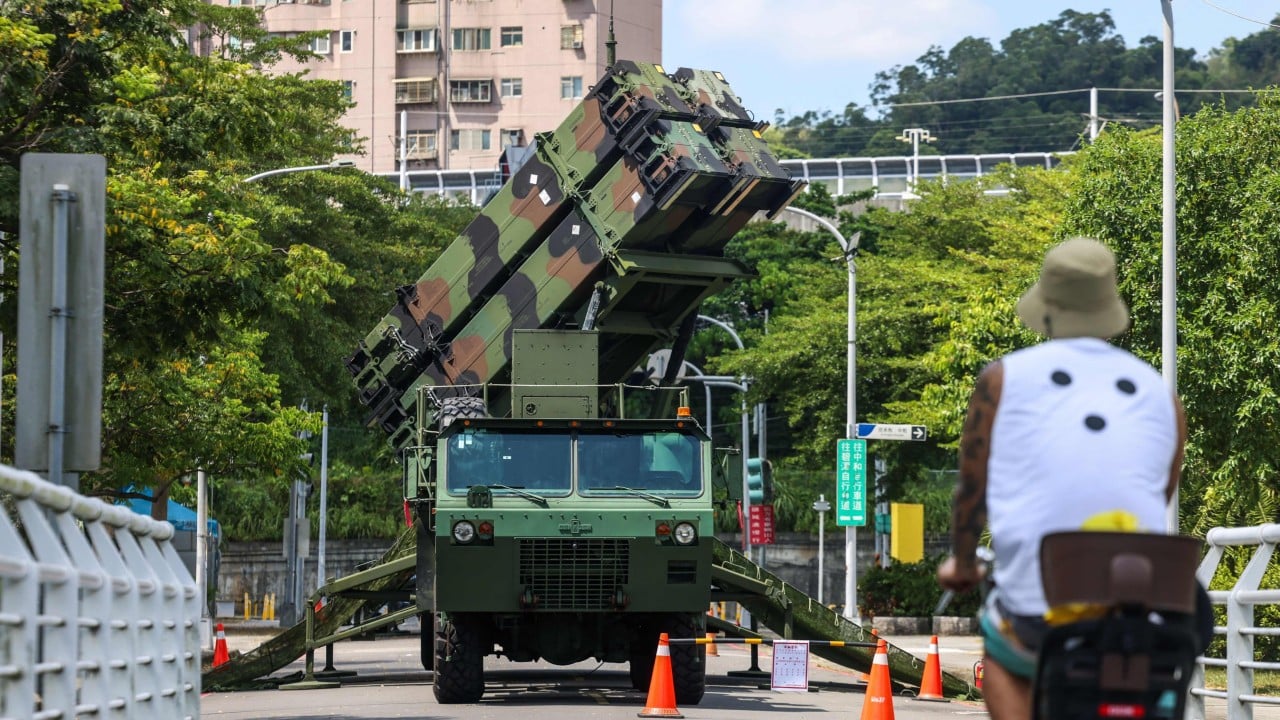
The Democratic US Congress may push for faster arms sales to Taiwan following the party’s resounding midterm election victories, but there will be no fundamental shifts in broader US policy towards the island, according to analysts.
And if the likely next House speaker, Hakeem Jeffries – a long-time supporter of Taiwan – “crosses the red line” on the issue, Beijing was expected to take strong countermeasures, one analyst said.
“A Democratic-controlled Congress will ramp up pressure on Trump to expedite the approval of the US$14 billion arms sale to Taiwan, while introducing various bills to demonstrate support for Taiwan and prevent Trump from ‘selling it out’,” said Shao Yuqun, director of the Institute for Taiwan, Hong Kong and Macau Studies and senior fellow at the Centre for American Studies at the Shanghai Institutes for International Studies.
US President Donald Trump had previously suggested that the US$14 billion package, which has been on hold for months, was a “good negotiation” chip in broader talks with Beijing, even as bipartisan lawmakers signed letters urging the administration to approve and formally notify the sale immediately.
The Democrats’ sweep of both the Senate and the House in the elections on Tuesday is widely seen as a stinging defeat for the Republicans and Trump, leaving him a lame-duck president to face aggressive checks on his policies during the final two years of his term.
Unlike the previous Biden administration, which repeatedly stated that US forces would defend Taiwan in the event of a military attack against the island, Trump cast doubt on that commitment.
Following his summit with Chinese President Xi Jinping in May, Trump remarked that he was not eager to have the US “travel 9,500 miles to fight a war” over the island.
However, according to Shao, “the US Congress has long been a stronghold of pro-Taiwan sentiment, and internal political shifts generally have limited impact on its Taiwan policy”.
International relations professor Shi Yinhong, of Renmin University in Beijing, said: “The likelihood of an escalation in US military support for Taiwan over the next two years is increasing. Congress is likely to advocate for stepping up military assistance to Taiwan, primarily reflected in arms sales.”
Both analysts agree that the incoming House speaker might bring new tensions in bilateral relations over the Taiwan issue.
“The Democrats’ military backing of Taiwan under the Biden administration has already been made very evident,” Shi said. “Regardless of who serves as the Democratic speaker of the House, they are likely to take such action.”
Congressional leadership visits and high-level engagements remain flashpoints for Beijing. In August 2022, former House speaker Nancy Pelosi visited Taipei, triggering unprecedented large-scale live-fire military exercises by the People’s Liberation Army around the island.
02:53
US midterm elections: What the results mean for mainland China, Taiwan and foreign policy
Jeffries has maintained close engagement with Taiwanese leaders. In March 2023, he met former leader Tsai Ing-wen during her transit in New York, and he held a phone call with leader William Lai Ching-te in December 2024 to discuss security and economic partnerships.
SCMP Plus is a new premium news platform that gives you an
all-inclusive edge to stay ahead on China news.
To access our exclusive content you’ll need to subscribe.
Already a subscriber?
LOG IN
“This will not be the first time the Chinese mainland has seen a pro-Taiwan US House speaker,” Shao said. “Should the new speaker push for any Taiwan-related legislation that crosses [Beijing’s] red lines and bottom line, Beijing will undoubtedly take resolute countermeasures.”
In Taiwan, analysts broadly agree that while strategic competition with Beijing has bipartisan backing, a Democrat-controlled Congress could be another check on any attempt by Trump to make concessions affecting the island.
Taipei’s foreign ministry said it would continue its long-standing policy of maintaining bipartisan engagement with Washington.
Shen Yu-chung, deputy minister of the island’s Mainland Affairs Council, said the council was particularly concerned about a possible meeting between Trump and Xi on the sidelines of coming international summits, including the Asia-Pacific Economic Cooperation (Apec) and Group of 20 gatherings.
Taipei would continue communicating with Washington to ensure that any Trump-Xi meeting did not undermine Taiwan’s interests, he said.
Huang Kwei-bo, a diplomacy professor at National Chengchi University in Taipei, said the congressional shift could make Trump more cautious about using Taiwan as leverage in negotiations with Beijing.
“If Trump were to sell out Taiwan, he would inevitably face resistance from Congress, potentially including legislation designed to counter such moves,” Huang said.
He said Beijing would probably adopt a wait-and-see approach to the change in congressional control while continuing to appeal directly to Trump and offer economic incentives to encourage a relatively friendly US policy towards mainland China.
But Huang said China hawks were influential within the Democratic Party and could complicate any attempt by Trump to improve relations with Beijing.
Huang expected Democrats to press for faster arms sales, although he cautioned that deliveries depended on US defence production capacity and export priorities, rather than political decisions alone.
Li Da-jung, a professor of international relations and strategic studies at Tamkang University in New Taipei City, said the Democrats’ victory had weakened Trump’s standing within the Republican Party and could affect his approach towards Beijing, noting that the US leader had changed course on mainland China policy during his first term.
“The key question is whether Democrats would use their congressional majorities to pressure Trump into taking additional considerations into account when handling Taiwan-related issues,” Li said.
02:20
US accuses mainland China of targeting Taiwan leader’s family in surveillance case
At the University of St Thomas in Houston, political science professor Yeh Yao-yuan was more confident that the election outcome would not fundamentally alter Washington’s approach to Beijing or Taipei.
He argued that strategic competition with Beijing had bipartisan consensus in Washington, while Taiwan’s strategic importance would remain unchanged regardless of which party controlled Congress.
Beijing sees Taiwan as part of China to be reunited by force if necessary. Most countries, including the US, do not recognise Taiwan as an independent state, but Washington is opposed to any attempt to take the self-governed island by force and is committed to supplying it with weapons.
KioskNews shows a cleaned-up reading view extracted from the publisher’s page — the original always lives on their site, not ours.