As Delhi chokes, patients crowd hospital, struggling to breathe
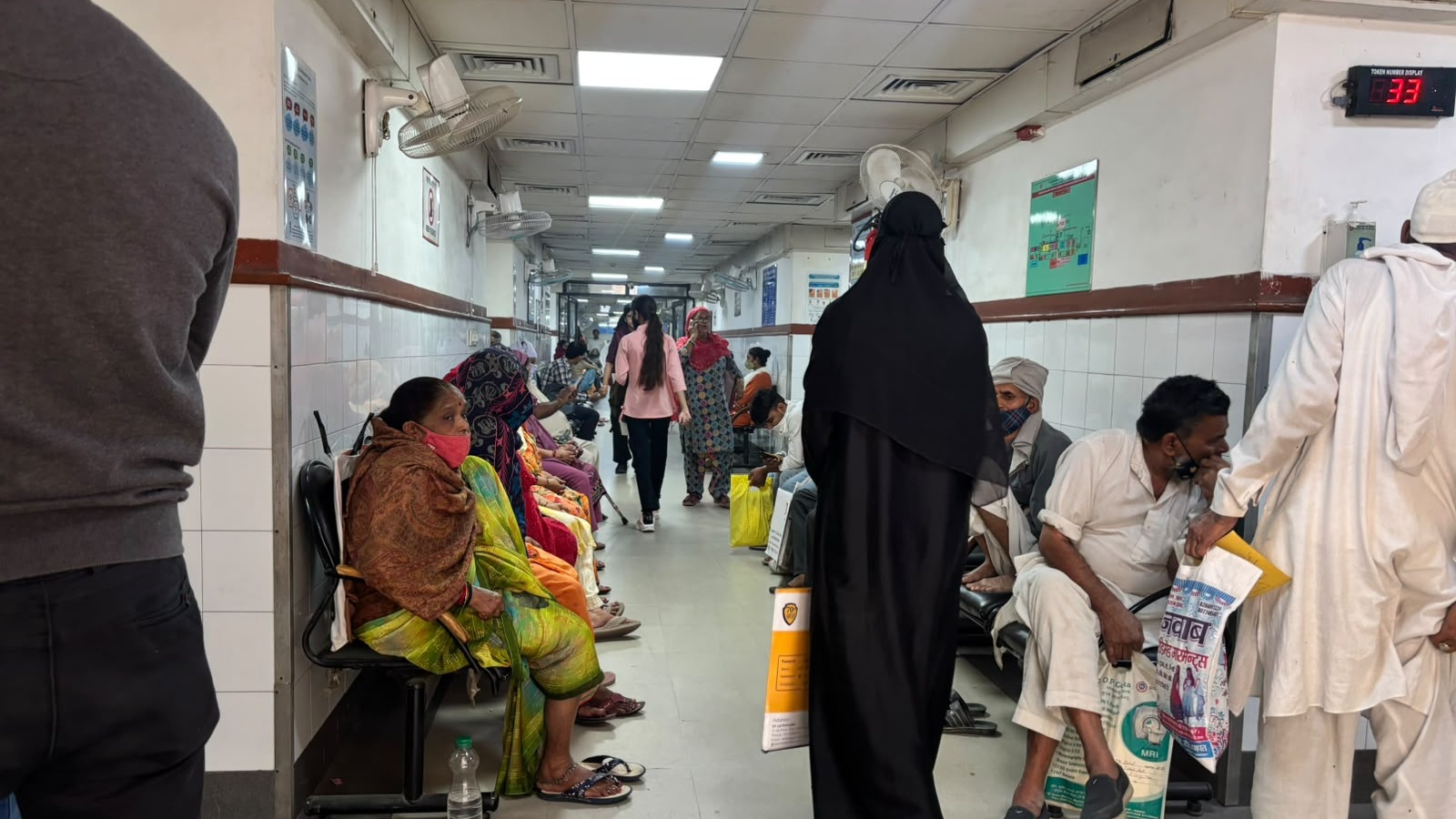
A cough breaks the silence every few seconds in the crowded OPD of Vallabhbhai Patel Chest Institute in North Delhi’s Vijay Nagar. Outside Room 13, patients sit clutching prescriptions, X-rays and medical files. Every two minutes, an attendant steps out from the room and calls a number. “29, next.” Then “30.”
Nearby, outside Emergency Room 17, another queue has formed. Inside the room, patients sit breathing through nebuliser masks. On a bed, one is receiving oxygen support.
As Delhi’s air turns toxic, the hospital is seeing a rise in the number of patients with respiratory illnesses, many of them elderly. For some, it is an ordeal that returns every winter.
Among those waiting is Ram Mohan (81), a retired BSES employee from Nirmal Vihar. With a black mask slipping off his nose, he coughs almost every 20 seconds.
“I don’t like coming here at all,” he says. “But every winter, for the last four or five years, I have to come when the pollution season starts. I don’t have asthma or TB. Nothing shows up in my X-rays. But my cough worsens every time.”
A senior resident doctor says hundreds of patients are arriving daily with respiratory complaints and the numbers are increasing every day. “Most are elderly people with pre-existing illnesses. Many need nebulisation, while some require hospitalisation,” the doctor adds.
Indra Devi (62) sits waiting for nebulisation. While a red dupatta covers her mouth, a black bag containing medical files and medicines rests on her lap.
Story continues below this ad
“For the last 10 days, my breathlessness has been getting worse,” she says, pausing for breath. “It started with a fever. Then I had trouble walking. Last night, I couldn’t stop coughing.”
A retired ASHA worker from Model Town, who left the job five years ago, she once earned Rs 2,500 a month. Now, she is dependant on her daughter and son-in-law, who accompanied her to the hospital.
Nearby, Paramjit Singh (62), slowly climbs the OPD ramp with a stick. A white handkerchief covers his mouth as he waits to undergo an X-ray.
“I have had TB for five years,” he says. “Pollution has worsened it. For the last three days, I have been coughing all day. It doesn’t stop… I was admitted here in December last year for a week and needed oxygen to survive last winter.”
Story continues below this ad
His son Anmol, who runs a business in Karol Bagh, says, “He has grown weaker. We are thinking of shifting back to our hometown in Ludhiana. I can’t see my father like this every year.”
Outside the OPD sits Prem Kumar (56) with a portable oxygen cylinder strapped to a trolley. A tailor until five years ago, he stopped working after his health deteriorated.
Diagnosed with chronic obstructive pulmonary disease (COPD), he requires oxygen, bronchodilators and steroids. “He used to earn Rs 15,000 a month. Now, our son supports us,” says his wife Nirmala, from Mangolpuri.
“His condition has worsened over last week. That is why we decided to come today,” she adds.
Story continues below this ad
Dr Nikhil Modi, pulmonologist at Indraprastha Apollo Hospital, says elderly people are particularly vulnerable along with children, pregnant women and those with existing respiratory illnesses.
“Some patients are also asymptomatic, especially in old age… Old age weakens the lungs and increases the risk of respiratory conditions such as COPD and asthma. As people age, lung elasticity gradually decreases, and the muscles involved in breathing become weaker, reducing lung capacity,” he adds.
“Children, pregnant women and people with pre-existing respiratory illnesses are also particularly vulnerable. Exposure to high pollution levels can aggravate their symptoms, leading to increased breathlessness, wheezing and respiratory distress. Even short periods of exposure can trigger complications in people with compromised lung function.”
He advises those with pre-existing conditions to minimise outdoor exposure during periods of high pollution, wear N95 masks and seek medical help if they experience breathlessness, persistent coughing or wheezing. “Whenever they do step outdoors, they should wear a N95 masks,” he adds.
KioskNews shows a cleaned-up reading view extracted from the publisher’s page — the original always lives on their site, not ours.