The 12 Best Movies About Video Games, Ranked

Ryan Heffernan is a Senior Writer at Collider. Storytelling has been one of his interests since an early age, with his appreciation for film and television becoming a particular interest of his during his teenage years.
This passion saw Ryan graduate from the University of Canberra in 2020 with an Honours Degree in Film Production. In the years since, he has found freelance work as a videographer and editor in the Canberra region while also becoming entrenched in the city's film-making community.
In addition to cinema and writing, Ryan's other major interest is sport, with him having a particular love for Australian Rules football, Formula 1, and cricket. He also has casual interests in reading, gaming, and history.
Sign in to your Collider account
Cinema has enjoyed—and occasionally bemoaned—a litany of video game adaptations over the recent decades, from painfully bad '90s movies like Super Mario Bros. and Street Fighter to more modern gems like the Sonic the Hedgehog movies and Resident Evil. This list is not about those movies. Instead, this list's purpose is to highlight the far rarer and much less discussed subset of movies that are about video games.
Gaming at large has become one of the biggest entertainment properties of the 21st century, a monumental cultural entity that has completely reconfigured the nature of media storytelling in the modern age, completely re-shaped the economic structure of the entertainment industry at large, and pioneered new avenues for social interaction and community engagement. While movies that focus specifically on this phenomenon—rather than merely try to capitalize on the ideas from it—are few and far between, they do exist, and they are slowly becoming increasingly common. From insightful documentaries that explore the process of game design to action adventures that grasp what it truly means to be a gamer, these are the best movies that are actually about gaming.
12 'Gamer' (2009)

Coming from the creative minds behind the maniacal Crank movies, Gamer excels as a bombastic, balls-to-the-wall action bonanza that runs a little like someone drank every flavor of Mountain Dew, read all of William Gibson's books while someone played Gears of War in the background, did 18 suicide sprints, and then pumped out a stream-of-consciousness screenplay in record time. Needless to say, it's frenetic. Taking place in 2034, where humanity has become addicted to a video game called "Slayers," it unfurls as a hotshot player creates Kable (Gerard Butler), an avatar of a human being who can win his freedom from the game by proving himself over and over again.
Subtlety is not Gamer's forte, but nor should it be. In lieu of nuance and sophistication, it flaunts outrageous action set pieces assembled in a manner that suggests co-directors Mark Neveldine and Brian Taylor are more attuned to our media-saturated society's ability to digest radically shifting information than many other, more renowned 2000s filmmakers. Additionally, Gamer also effectively predicted the rise of live-stream content and esports long before they became even niche interests in gaming. It would be a bridge-too-far to call it a masterpiece, but its mixture of thematic ideas and brilliant, bruising spectacle make its a hidden gem that is perhaps far more relevant today than it was upon release in 2009.
11 'Free Guy' (2021)

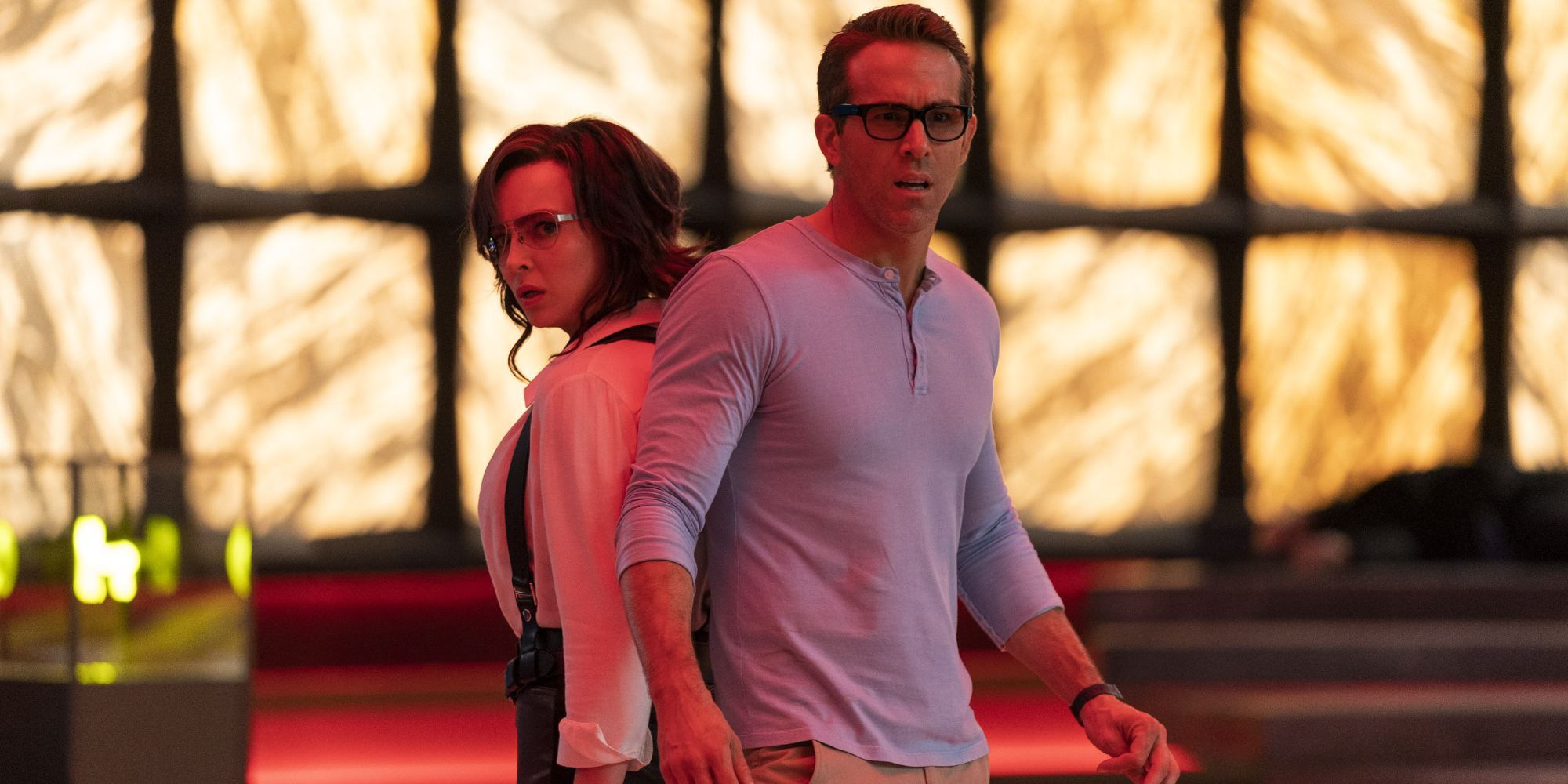
For better or worse, the past decade has seen a meteoric rise in video game adaptations, but one of the most intelligent spins on video game representation in film in recent years comes in the form of 2021's too hastily dismissed Free Guy. While it sometimes reduces its thematic focus to being the punchline of a joke, the colorful action-comedy largely excels as a cheerful send-up of popular video game designs, taking place in an open world game that resembles Grand Theft Auto with Fortnite's aesthetic style, it follows Guy (Ryan Reynolds), a bank teller who discovers he is an NPC (non-player character) and decides to take ownership of his life and responsibility for saving his world on his own terms.
The messaging of kindness, autonomy, and anti-violence as it counters the power fantasy many video games portray is, at times, tinged with hypocrisy and naivety, but Free Guy is sure to give gaming its time in the sun by incorporating everything from Twitch streamer cameos to clever conceptual ideas that implant viewers in the perspective of its most unlikely hero. Complimented by its self-aware humor, crafty premise, and the charm of its ensemble cast, Free Guy is easily enjoyed by gamers as a unique descent into the finer details of their world.
10 'The Wizard' (1989)

Could The Wizard be in the conversation of the best bad movie of all time? This isn't to say it's a case of so-bad-it's-good cinema, but rather a sloppily assembled artifact of late '80s nostalgia powered by product placement and running as a borderline advert for the Nintendo Entertainment System (NES). Within this work of commercialized adventure, it features an abundance of flaws, but the largely forgotten 1989 kids' comedy has some huge redeeming qualities as well that elevate it, especially for viewers whose childhood hovered around the late 1980s. As it luxuriates on the glory of the NES, it follows Corey (Fred Savage) as he breaks his little brother out of a mental institution and ventures with him to California, where the duo discovers young Jimmy's (Luke Edwards) talent for gaming and try to make money off it.
As a celebration of gaming, The Wizard aspires to be a fun-filled adventure of freedom and family that captures the perpetual awe gamers often feel towards new advancements in the industry while highlighting how the hobby can underline relationships. However, there is another quality The Wizard possesses that arguably makes it decades ahead of its time. While no specific mental illness is named, audiences can grasp that Jimmy likely has autism due to his difficulties communicating, emotional triggers, and the comfort he finds in set routines. It treats the social fun of gaming and the pattern-based level progression many games employ as being an invaluable resource gaming has to make inroads into the conversation of people living with mental health understanding themselves, particularly in conjunction with conditions like autism. It's goofy, video-game championing fun with plenty of heart and perhaps more merit than the filmmakers themselves initially recognized, and while it's far from perfect, The Wizard deserves its place among the more noteworthy movies about video games.
9 'Tron: Legacy' (2014)

Too hastily dismissed as "just another ordinary reboot," Tron: Legacy walks the line between modernization and legacy sequel with a confidence grounded in its stunning visual display. Against a palette of desaturated pale greys and light blues, interrupted by eruptions of neon splendor, it follows Sam (Garrett Hedlund) as he ventures into "The Grid, the virtual space his father designed, searching for answers concerning his missing dad's whereabouts. Once there, he works with his old man and the program, Quorra (Olivia Wilde), to prevent a malevolent and corrupt ruling program from invading the real world.
Bolstered by Claudio Miranda's pristine cinematography and Daft Punk's outstanding score, Tron: Legacy is able to thrive as a stylistic indulgence, but it has always been so much more than that. Not only does it cleverly incorporate fundamental rules of game design into its storytelling—using level progression as a means to propel the story, arena combat as a source of awe-inspiring action, and set programming rules as an outline for narrative parameters—but it also hits hard at an important note of human beings being in control of technological advancements rather than technological advancements being in control of human beings. Tron: Legacy thus plays as a particularly shiny, stylish reminder that at the end of the day, it’s people who play video games, not the other way around.
8 'Indie Game: The Movie' (2012)

There is no doubt that the gaming industry has evolved exponentially over the past 14 years, and yet 2012's Indie Game: The Movie still stands as arguably the best and most insightful documentary about the inner workings of game design and video game culture cinema has ever seen. Equal parts inspiring and excruciating, it follows the creative journeys of three acclaimed indie games and their eccentric developers, capturing the essence of an idea, the agony of bringing it to fruition, and the qualities of childlike wonder and ambition that drive the developers in their arduous endeavors.
What makes Indie Game: The Movie so compelling, however, is its ability to not shy away from the more confronting aspects of video game culture. While it grapples with the exhausting angst, debilitating self-doubt, and unrelenting anxiety of standing alone against an industry machine, it also touches on the unhealthiest elements of the medium, not only the social isolation, but the often blurred line between satirical edge and naive indulgence that sometimes permeates from gaming's darkest jokes, a point made even more complex by the fact that the developers—much like the majority of gamers—are young men. In this regard, Indie Game: The Movie acknowledges that creative ventures can be an outlet for hardship. It also acknowledges that using pain for art can be a double-edged sword, one that often swings hard and in every direction.
7 'WarGames' (1983)
.jpg?q=49&fit=crop&w=825&dpr=2)
Released in 1983, WarGames marks an interesting cultural point as the first movie released that acknowledges computers and video gaming as a widespread global phenomenon. This is to say it doesn't try to walk viewers through any step-by-step explanation as to what is happening as Matthew Broderick's cheeky teen, David Lightman, zooms through complicated programming systems with ease, inadvertently hacking his way into a military supercomputer where he mistakes a simulation of the Soviet Union's nuclear movements as being a video game and begins manipulating the possible outbreak of World War III. When he realizes what he has done, he races against time to alert authorities before it's too late.
Playful and exciting, WarGames is chiefly a fun techno-teen thriller that places a naive kid at the heart of nuclear disaster, but its commentary on video gaming has proven to be as fascinating as it is prescient. Looking at the movie in a vacuum of video game analysis, it predicts the morally intriguing intersection of violent war simulation and high-stakes entertainment gaming provides. Furthermore, it addresses timely modern issues pertaining to the gulf between A.I. and common sense. Achieving all this with a crackling sense of humor and a resolution that is both optimistic and nerve-wracking, WarGames excels as a spirited thriller movie that was decades ahead of its time and has aged superbly to be one of the best movies about video games of all time.
Collider Exclusive · Sci-Fi Personality Quiz Which Sci-Fi Hero Are You Most Like? Paul Atreides · Captain Kirk · Princess Leia · Ellen Ripley · Max Rockatansky
Five iconic heroes. Five completely different ways of facing an impossible universe. One of them shares your instincts, your values, and your particular way of refusing to back down. Eight questions will tell you which one.
🏜️Paul Atreides
🖖Capt. Kirk
✊Princess Leia
🔦Ellen Ripley
🔥Max Rockatansky
01
How do you lead when the stakes couldn't be higher? The way you lead under pressure is the most honest thing about you.
02
What is your greatest strength in a crisis? The quality that keeps you alive when everything else fails.
03
What is the thing you'd sacrifice everything else for? Your deepest motivation is your truest compass.
04
How do you relate to the people around you? Who you are to others under pressure is who you really are.
05
You're facing a threat that no one else believes is real. What do you do? How you respond when you're the only one who sees it defines everything.
06
What has your heroism cost you personally? Every hero pays. The question is what — and whether they'd pay it again.
07
How do you feel about the rules of the world you're in? Every hero has a relationship with the system. What's yours?
08
When everything is on the line, what keeps you going? The answer is the most honest thing about you.
Your Hero Has Been Identified Your Sci-Fi Hero Is…
Your answers point to the iconic sci-fi hero who shares your instincts, your values, and your particular way of facing the impossible.
Paul Atreides
You carry a weight most people would crumble under — the knowledge of what you're capable of, and the burden of what you might have to become.
- You see further ahead than others and you plan accordingly, even when the vision frightens you.
- You are driven by loyalty to your people and a sense of destiny you didn't ask for but can't escape.
- Paul Atreides is not simply a hero — he is someone who understands the cost of power and chooses to bear it anyway.
- That gravity, that willingness to carry what others won't, is exactly you.
Captain Kirk
You lead with instinct, warmth, and an absolute refusal to accept a no-win scenario — because you've always believed there's a third option nobody else has thought of yet.
- You take the mission seriously without ever taking yourself too seriously.
- Your crew would follow you anywhere, not because you demand it, but because you've earned it.
- Kirk's genius isn't tactical — it's human. He reads people, bends rules with purpose, and wills outcomes into existence through sheer conviction.
- That combination of warmth, audacity, and relentless optimism is unmistakably yours.
Princess Leia
You are the kind of person who holds the line when everyone else is losing faith — not because you're fearless, but because giving up simply isn't something you're capable of.
- You lead through conviction. Your voice carries because your belief is unshakeable.
- You gave up everything ordinary the moment you chose the cause, and you've never looked back.
- Leia is not a supporting character in her own story — she is the moral centre of the entire rebellion.
- That same fierce, principled, unbreakable core is what defines you.
Ellen Ripley
You are not reckless, not grandiose, and not particularly interested in being anyone's hero — you just refuse to stop when it matters.
- You see threats clearly, you document the truth even when no one listens, and when the time comes you handle it yourself.
- Ripley's heroism is earned, not performed. She doesn't have a speech — she has a flamethrower and a plan.
- You share her composure under the worst possible pressure, and her refusal to pretend the monster isn't there.
- When it counts, you don't flinch. That's everything.
Max Rockatansky
You have been through fire that would break most people — and what came out the other side is something the world underestimates at its peril.
- You don't ask for help, don't need validation, and don't wait for anyone to tell you the rules no longer apply.
- Your loyalty, when it finally arrives, is absolute — but it's earned in silence and tested in action, not in words.
- Max is not a nihilist. He is someone who lost everything and found, against his will, that he still has something worth protecting.
- That bruised, stubborn, ultimately human core is exactly yours.
6 'The King of Kong: A Fistful of Quarters' (2007)

The King of Kong: A Fistful of Quarters is a lot of things. It's a documentary, a suspense thriller, an exposé, a universally David-versus-Goliath story, and an exacting examination of one of the most specific subcultures in the world. Above all else, it’s incredibly entertaining. The tightly structured deep-dive into the world of arcade game high score competitions—specifically for Donkey Kong—as the good-natured, out-of-work engineer Steve Wiebe sets about claiming the game's high score record off its contemporary holder, Barry Mitchell, a love-to-hate antagonist who boasts a scorching mullet, an American flag tie, and an oppressively cocky, downright sleazy attitude.
On the surface, The King of Kong centers on ideas of gaming rivalries, but everything from toxic masculinity to the nature of power structures rears its head throughout the documentary, making it a surprisingly relevant watch almost 20 years on in the modern world of socio-political division, gaming hysteria, and YouTube streamer controversies. Furthermore, while the film’s ending may not provide the traditionally cathartic ending you’d desire in a story like this, the bonus features rewrote some of the film’s history. After all, it wouldn’t be a video game without DLC.
5 'Ready Player One' (2018)

Underappreciated as a directorial success from Steven Spielberg, Ready Player One strikes a clever balance between cautionary dystopian drama and immersive, action-propelled fun that is full of more thrills and thematic ideals than most gave it any credit for upon release. Based on Ernest Cline's novel, it unfolds in a miserable near-future where masses of humanity escape the monotony of their lives by entering the OASIS, a virtual reality of near-limitless possibilities. Teenager Wade Watts (Tye Sheridan) works with his friends to scour the video game world in search of an Easter Egg left by the OASIS' creator that would grant them total control over the virtual world, a prize corporate entities are desperate to attain so they can monetize it for their own benefit.
To some degree, Ready Player One comments on the isolation and potentially harmful escapism of gaming, but it is more at home as a triumphant celebration of friendship, adventure, and the many fun interactive experiences the medium can conjure. There is an all-encompassing might to its spectacle as well, not only because of the stunning detail of its frenetic animation, but the sheer number of pop-culture references that are glimpsed throughout. It captures the sense of camaraderie and community that defines the hobby in the eyes of so many gamers, making Ready Player One an underrated gem of modern action bombast as well as one of the better movies about video games in recent decades.
4 'Scott Pilgrim Vs. The World' (2010)

Scott Pilgrim Vs. The World, the Edgar Wright-directed cult classic based on the Bryan Lee O'Malley cult classic, is not explicitly about video games. It’s about love, the past, moving on from traumas, growing up, music, and self-actualization. But this thing is drenched in video game culture, from its narrative structure to its eccentric, over-the-top aesthetics, in ways both simply pleasing and complicatedly dissecting. The very first image we see is the Universal logo done in a chunky, pixelated style, with their iconic theme song rendered in 16-bit synthesizers. The very second image we see is a cascading establishing shot set to an immediately familiar The Legend of Zelda. Wright has always saturated his films with reverence to pop culture, and Scott Pilgrim’s nigh-upon idolization of the vibe of video games glows throughout, from Bill Hader’s “fighting game voiceover,” to the shifting visual language and aspect ratios of the film.
Even the plot itself feels coded directly from a video game, with Scott Pilgrim (Michael Cera) having to defeat the "Seven Evil Exes" of his new romantic interest, Ramona Flowers (Mary Elizabeth Winstead), in order to secure a first date. The progression through "boss"-like antagonists works wonderfully in concert with Pilgrim's own stunted, selfish design. The climax only heightens the presence of video game influence in the movie, with gimmicks like "Scott earned the power of self-respect!" highlighting the parallels between Wright's direction and video game culture, making it a perfect movie about video games despite not being remotely about video games.
3 'Edge of Tomorrow' (2014)
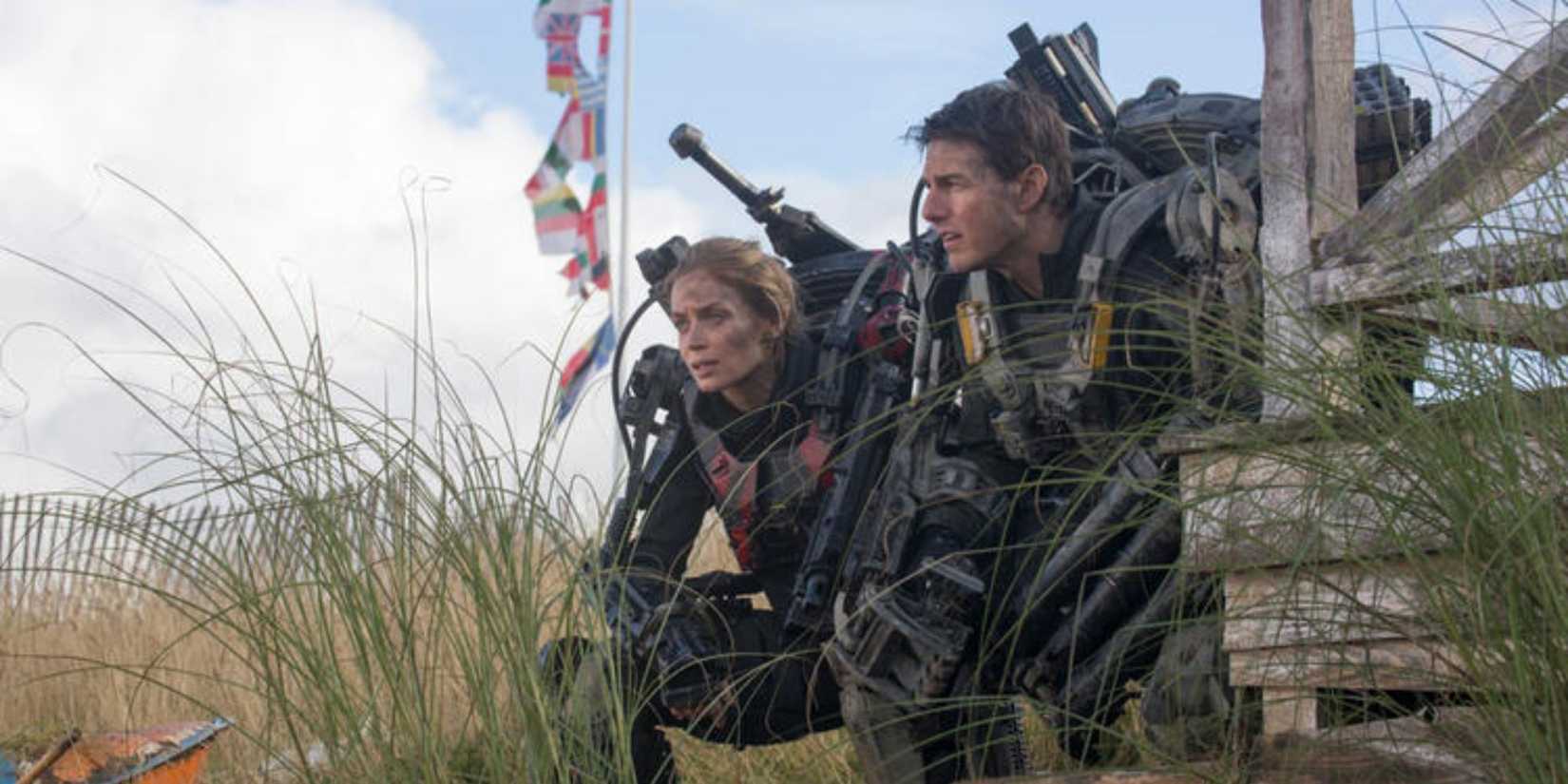
The original title of "Live Die Repeat" was certainly on the nose, but it couldn't be accused of being dishonest. Edge of Tomorrow thrives as a sci-fi action gem that stars Tom Cruise in an against-type performance as Major Cage, a cowardly public affairs officer sent against his will to take part in a full-scale assault on the Mimics, an alien race that has invaded Earth. When a mishap on the battlefield sees Cage plunged into a Groundhog Day-esque time loop that resets every time he dies, he uses his ability to re-live the same day over and over to embark on a trial-and-error mission to find a way to defeat the Mimics once and for all.
Edge of Tomorrow isn't about video games per se, but the parallels are impossible to overlook. A ton of shoot-em-up action? Check. Level-grinding noob-to-pro progression? Check. Respawn points? Check! Cage's journey from unwilling soldier to humanity's savior perfectly encapsulates what it feels like to be a sentient video game character combined with a player slowly learning the ropes. As the narrative gets more complicated and the stakes escalate, the gulf between "player" and "character" starts to collapse, capturing the feelings of frustration and repetition that many a gamer has experienced. If you’ve ever dreamed of flying into your favorite video game, Edge of Tomorrow might show you the mordantly funny nightmare that awaits should your desire come to fruition.
KioskNews shows a cleaned-up reading view extracted from the publisher’s page — the original always lives on their site, not ours.