Incentives offered to wean people off feeding tubes
By Lee I-chia / Staff reporter


The Ministry of Health and Welfare is offering incentives to encourage the removal of nasogastric tubes and help patients return to eating by mouth.
National Health Insurance (NHI) data showed that about 280,000 patients underwent nasogastric tube placement for medical reasons last year, including 90 percent who needed the tube temporarily to treat acute illnesses, Minister of Health and Welfare Shih Chung-liang (石崇良) said yesterday in Taipei.
About 9 percent of them had a long-term nasogastric tube placement for more than three months, most of whom were receiving care at home or in residential care facilities, Shih said.
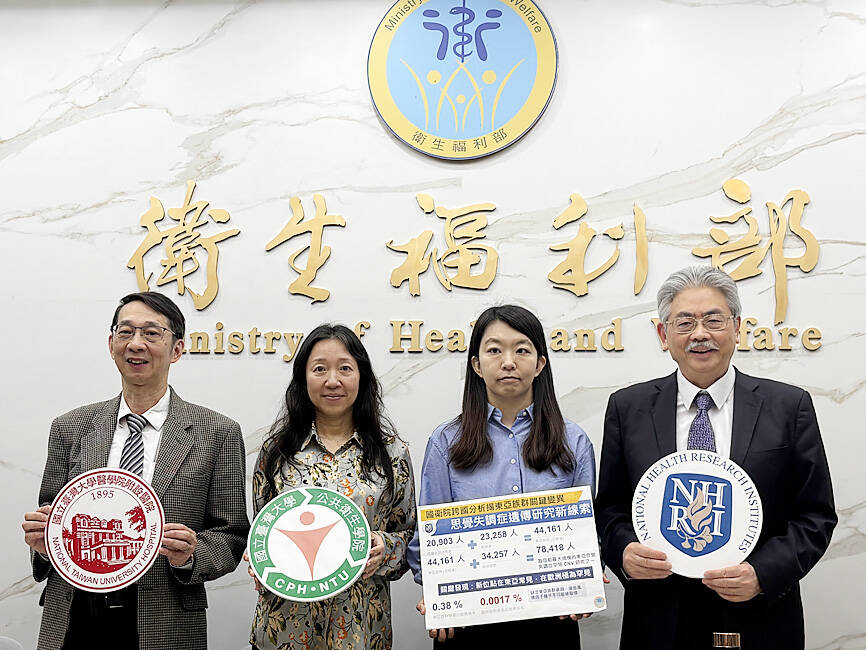
Researchers present findings from a genetic study on schizophrenia in Taipei yesterday.
Photo: Lin Chih-yi, Taipei Times
Long-term nasogastric tube feeding can increase the risk of aspiration pneumonia, acid reflux and other complications, so the ministry on Sept. 1 launched an incentive program with three types of rewards to encourage tube removal, he said.
The first is an incentive for healthcare providers to receive training, the second is a fee-for-service reward for every case of nasogastric tube removal, and the third is an additional team performance bonus for residential care facilities that keep the proportion of residents using nasogastric tubes below a certain threshold, he said.
The ministry hopes that through diverse incentive mechanisms, healthcare teams would be encouraged to proactively assess whether patients meet the criteria for tube removal, improving the quality of life and care for residents in residential care facilities, he said.
The NHI Administration (NHIA) yesterday said it has allocated NT$20.2 million (US$614,075) for the tube removal pilot program.
The program aims to encourage healthcare providers and long-term care facilities to collaborate in proactively conducting swallowing function assessments and training and helping residents remove nasogastric tubes earlier, to improve their quality of life, it said.
The agency expanded on the three types of rewards mentioned by Shih.
First is the start-up incentive: a NT$30,000 reward for the establishment of a joint interdisciplinary care team by medical institutions and residential care facilities, with members including physicians, dentists, nurses, speech therapists, dietitians, case managers and caregivers, it said.
Second is a care incentive for healthcare institutions that provide swallowing assessments and develop customized swallowing training plans for facility residents on nasogastric tube. The caregivers are required to follow the plan and provide residents with oral feeding training and nutrition-related care for at least four consecutive weeks, the NHIA said.
For each enrolled resident, the healthcare institution receives a reward of NT$8,000 and the residential care facility receives NT$10,000, it said.
The third is a quality incentive — each residential care facility receives an yearly bonus ranging from NT$50,000 to NT$60,000, based on the number of residents who successfully have their nasogastric tubes removed, the agency said.
KioskNews shows a cleaned-up reading view extracted from the publisher’s page — the original always lives on their site, not ours.