Killing the Pope review – the truth behind the attempted murder of John Paul II
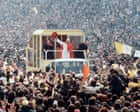
On the afternoon of Wednesday 13 May 1981, St Peter’s Square in Rome was packed with more than 10,000 pilgrims, excited to see the charismatic John Paul II, formerly Karol Wojtyla, archbishop of Kraków. Two and a half years earlier he had become the youngest cardinal to be elected pope in more than a century and the first non-Italian for 455 years.
At 5.17pm a man pulled out a concealed pistol and raised it with both hands above the heads of the crowd. He took aim at the pope, only a few metres away, and fired several shots. Then, as he backed away from the shocked bystanders, he tripped and fell, where he lay pinned to the ground by a Franciscan nun until handcuffed by uniformed police. Meanwhile the pope had been hit by two bullets, one in the arm and the other in the abdomen. He was losing blood rapidly. He was rushed to hospital and underwent an operation, before beginning a slow recovery. The would-be assassin was soon revealed to be Mehmet Ali Ağca, a member of the rightwing Turkish paramilitary group known as the Grey Wolves.
Almost immediately speculation began that Ağca had not been acting alone. In his new book, Serhii Plokhy weighs the claim, first made in an Italian court, that the assassin had been “only the visible point of a conspiracy”. Plokhy has previously written several highly praised works, including Chernobyl: History of a Tragedy, which won the 2018 Baillie Gifford prize. He has a deserved reputation for careful research and reasoned evaluation.
Of several competing theories, the one that gained most traction was that Ağca was a tool of Bulgarian state security, acting on behalf of their Soviet masters. This is what the CIA came to believe, despite their initial scepticism. Plokhy himself admits that he set out feeling more sympathetic towards the proponents of the “Bulgarian connection” than to their opponents. There was a strong case to be made: the pope was in the frontline of the cold war. He was a Pole, Poland was overwhelmingly Catholic, and the church represented a challenge to communist rule.
In 1979, only nine months after being elected, John Paul II had made a visit to his homeland and had celebrated mass in the centre of Warsaw, in front of an audience of 300,000 Soon the Catholic church was providing financial and moral support to the new unofficial trade union, Solidarity, which was rapidly becoming a focus of civil resistance to the regime. In January 1981 Solidarity’s leader, Lech Wałęsa, had visited Rome and enjoyed a private audience with the pope. There was no doubt that the pressure for change in Poland caused deep concern in Moscow; the Russians threatened to invade if the Polish authorities didn’t suppress the uprising themselves.
And if the Russians doubted the power of a religious leader to cause political upheaval, they only had to look to Iran, where the return of Ayatollah Khomeini in 1979 had brought about the overthrow of a western-backed regime previously assumed to be stable. As for the Bulgarians, they had form: in 1978 they had employed an agent to assassinate Georgi Markov, a Bulgarian dissident in London, using a poisoned umbrella to stab him as he waited for a bus on Waterloo Bridge.
Hardline anti-communist embraced the theory uncritically. Yet one might equally well argue that, far from wanting him out of the way, the Soviet leadership needed the pope as a restraining influence on the Polish insurgency. An article in the official Russian newspaper Izvestiia argued instead that the Americans were responsible for the assassination through their funding neo-fascist and terrorist groups in Turkey.
Plokhy, for his part, has found no evidence of an international conspiracy, and changed his mind about “the Bulgarian connection”. In that sense the book is an anticlimax: there was no smoking gun, except the Browning dropped by Ağca in St Peter’s Square. Plokhy’s downbeat conclusion is that Ağca, like most assassins, was probably just another deranged individual seeking notoriety.
Ağca’s testimony during his interrogation and trial was contradictory and sometimes palpably false. To the neutral observer it was obvious that he was bargaining for a reduced sentence. Some of his claims were so fantastic as to lead the Italian magistrates to doubt his sanity. “I am Jesus Christ!” he shouted from his steel cage in the courtroom to reporters and cameramen gathered for the trial of his alleged Bulgarian accomplices, who were acquitted. Nevertheless people believed what they wanted to believe. The pope himself was convinced from the start that the KGB was behind the assassination attempt. In an act of extraordinary forgiveness, John Paul visited Ağca in prison and spent 20 minutes in private conversation with him.
John Paul II died in 2005. Ağca issued a statement from prison mourning the death of his “spiritual brother”, the man whom he had tried to kill. He was released in 2010. On 27 December 2014, 31 years to the day after the pope had visited him in prison, Ağca stood in front of John Paul’s tomb in the Vatican, and after a few moments of apparent silent meditation, laid some white roses there. For this stunt he was accompanied by a television crew.
Plokhy writes in clear, straightforward prose. He has opted to use the present tense throughout and while this technique works well for the period immediately following the assassination, injecting an immediacy to the narrative, it is less effective and occasionally confusing when describing more recent events. Nevertheless, in telling this bizarre – at times even grotesque – story, he holds the reader’s attention to the end.
KioskNews shows a cleaned-up reading view extracted from the publisher’s page — the original always lives on their site, not ours.