[Just Saying] Chief Justice Rodil Zalameda and the question of respectability
Already have Rappler+?
to listen to groundbreaking journalism.
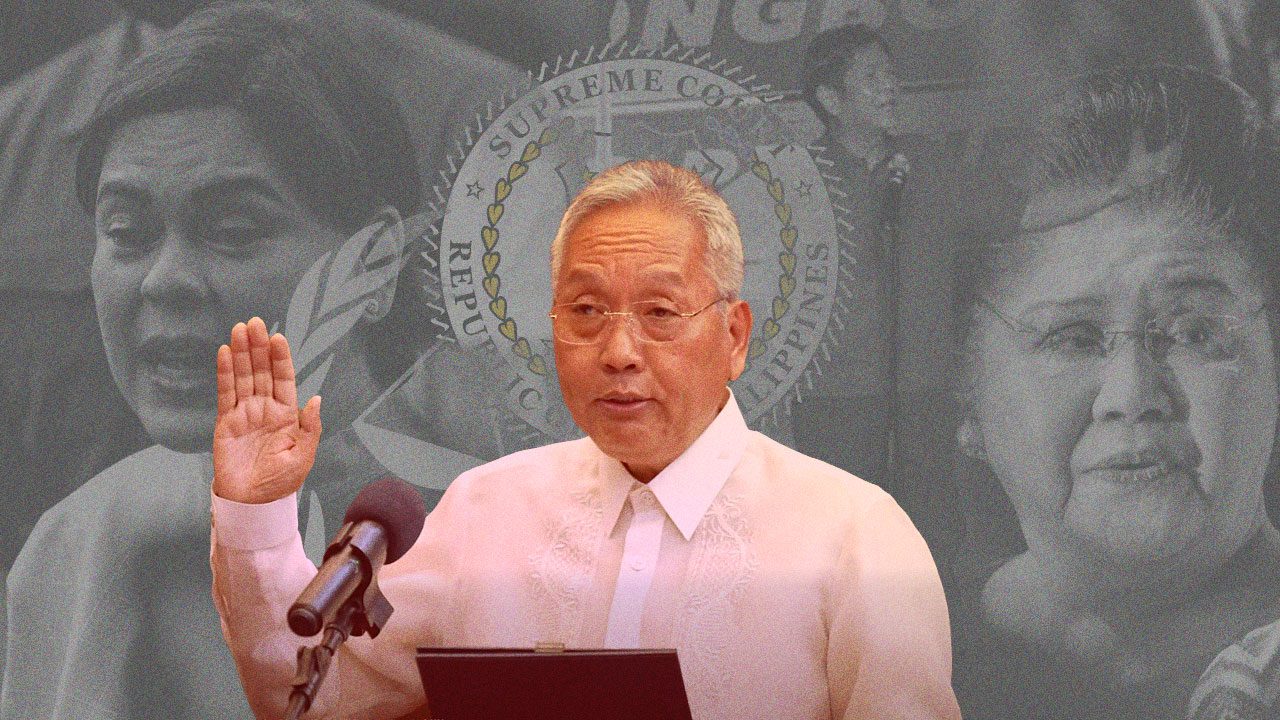
The legal burden of proof heavily rests entirely on Chief Justice Zalameda to demonstrate independence through every decision, vote, and dissent
AT A GLANCE
- Chief Justice Rodil V. Zalameda has been appointed to lead the Supreme Court, which is tasked with checking executive and legislative overreach, but faces public skepticism due to his past decisions perceived as accommodating political power.
- Zalameda's rulings in high-profile cases, such as reversing Imelda Marcos' graft conviction and interpreting constitutional mandates flexibly, have raised concerns about judicial independence and potential political alignment.
This is AI-generated. Read the article for full context. Report any errors.
Under Article VIII of the 1987 Philippine Constitution, the Supreme Court functions as a co-equal branch designed to check executive and legislative overreach. It also has review powers concerning criminal and civil cases. Its new leader has been appointed: Chief Justice Rodil V. Zalameda. His credentials are impeccable.
However, rightly or wrongly, many believe that he assumes the highest judicial seat carrying public skepticism coming from some critics not born of abstract baseless opinions, but rooted in specific overt actions and high-stakes jurisprudence.
First, he sided with the majority of the Supreme Court in People vs. Imelda Marcos (G.R. Numbers: G.R. Nos. 243402–08 June 10, 2026) which reversed the Sandiganbayan’s 2018 conviction of former first lady Imelda Marcos on seven counts of graft involving Swiss foundations. The decision — penned by Chief Justice Zalameda himself created — fairly or unfairly — a pervasive public perception of judicial accommodation toward established political power.
Second, in Generillo, Jr. v. Senate of the Philippines (G.R. No. 278311 April 22, 2026), the Supreme Court addressed the constitutional requirement for the House of Representatives to transmit articles of impeachment “forthwith.” The decision — again penned by Chief Justice Zalameda — interpreted “forthwith” to mean “within a reasonable time” — an interpretation which was perceived by a number of critics as stretching an explicit textual mandate into an elastic timeline to suit political convenience, a resolution which, to many, lacked scholarly discussion.
Third, in Lagman vs. Congress (G.R. No. G.R. Nos. 271059, 271347, E-02472, and E-04036 October 7, 2026) declaring unconstitutional portions concerning unprogrammed funds in the 2024 national budget, he dissented regarding the imposition of standards or guidelines restricting the legislature’s core power of the purse. When it came to the prerogative of the President, he concurred with the majority in holding that Congress violated Article VI, Section 25(1) of the 1987 Constitution when it increased the President’s total recommended budget by adding P449.5 billion to the 2024 unprogrammed appropriations, hence making it unconstitutional.
Fourth, even symbolic acts — such as posing in a photograph flaunting the highly politicized Duterte “fist-sign” — may be interpreted by the public — rightly or mistakenly — as a manifestation of a kindred spirit, deep companionship, mutual alignment, and shared values with no less than former President Rodrigo Duterte himself and his friends. It might further blur the line between judicial neutrality and partisan alignment. This attains great significance considering that dispensation of justice starts with perception.
In a political culture where “utang na loob” (debt of gratitude) may still hold sway, decisions and gestures that are perceived as accommodating political allies or those in power, or dilute constitutional text inevitably invite intense and legitimate scrutiny from many sectors, including legal scholars.
Being apolitical under these conditions cannot be assumed on faith; it demands concrete and super-credible proof. Consequently, the legal burden of proof — the onus probandi — heavily rests entirely on Chief Justice Zalameda to demonstrate independence through every decision, vote, and dissent. He cannot rely on institutional title alone to command respect and authority.
To grant Chief Justice Rodil Zalameda the “benefit of the doubt” fundamentally misunderstands democratic accountability. Under Article XI, Section 1 of the Constitution, public office remains a public trust.
And now let us go to the appointing power, President Ferdinand Marcos Jr. To view high judicial appointments as purely meritocratic rewards for objective credentials is naive.
Paper qualifications serve as baseline legal requirements and can function as standard cover for executive discretion. Unlike elective posts subject to public vetting, judicial selection is a unilateral exercise of presidential power.
It is primitive not to even think that appointing powers do not evaluate candidates based on political utility, institutional alignment, accommodation, pliable advocacy, backdoor-availability and/or long-term self-preservation rather than a commitment to act as a staunch constitutional watchdog.
Do you think that these matters did not factor in when the presidential choice was made? Or was the choice a foregone conclusion?
Having been appointed to such a high office, Chief Justice Zalameda must not feel secure behind formal credentials. The onus remains entirely on him to prove that his appointment was not a calculation of political convenience. Institutional authority alone will not restore public faith.
Neutralizing the perception of political debt requires affirmative, unequivocal acts of independence: invalidating unconstitutional executive actions, enforcing strict legal standards without political accommodation, convicting the “powers-that-be,” and authoring jurisprudence that withstands rigorous scholarly review.
Until such actions are taken, the sovereign public owes Chief Justice Zalameda no automatic reverence — only continuous, incessant scrutiny. For after all, he is still a public servant salaried by public money and fortunate to have so many other perks and benefits, also funded by the sovereign people.
Yet elevation to the chief justiceship presents a unique turning point. Backed by life tenure until age 70, a chief justice is supposed to be completely insulated from executive and legislative pressure and no longer requires political patronage for career advancement. History demonstrates that the weight of the office can transform jurists, compelling them to rise above the perceived political circumstances of their appointment.
Chief Justice Zalameda stands at a critical crossroad: he possesses the constitutional authority to forge an era of uncompromising judicial independence, or he can be a symbol of a weak, pliable, subservient, and suspect judiciary susceptible to outside pressure, accommodation, graft and corruption.
He must not squander this rare opportunity to lead the Supreme Court into a golden era of integrity and public trust — a legacy that can only be earned by defying expectations and holding power to account. – Rappler.com
Mel Sta. Maria is presently teaching law at the Ateneo de Manila School of Law, University of the Philippines College of Law, University of Sto. Tomas Faculty of Civil Law, and Far Eastern University Institute of Law.
KioskNews shows a cleaned-up reading view extracted from the publisher’s page — the original always lives on their site, not ours.