The trophies we hide: Artist Vinod Balak explores life’s uneasy truths
In many Indian homes, a glass cabinet holds a family’s prized possessions – trophies, souvenirs and mementoes that tell stories of achievement and pride. But what if, alongside these, there were trophies celebrating the things people would rather keep hidden?
A paunch-shaped trophy for the ‘Great Patriarch’. Or a black shield for the ‘Best Smoker’. Also, awards depicting narcissism and other less flattering human traits. All displayed with as much pride as any achievement.
Through his painting Traces of Glorious Days (2025), 44-year-old artist Vinod Balak imagines just such a showcase.
It is part of his ongoing exhibition Dis.em.bodied H.ours at Galerie Mirchandani Steinruecke in Delhi’s Defence Colony.
For Balak, the idea comes from the distance between the image people present to the world and the selves they reveal behind closed doors.
“When we are in the privacy of our homes or some other private space, we let go of our bad side. We hide them in our home, ironically the only place we reveal that side of us is our home,” he says.
“I took patriarchy, narcissism and other vices, and made them into a trophy,” he adds.
Story continues below this ad
Growing up at Malappuram in Keralam, Balak would eagerly look through books and magazines his father – a postal department employee – brought home from work.
“These books included art publications and Christian magazines with religious illustrations and reproductions of Raja Ravi Varma paintings… I was very much into them,” he says, recalling how these images stayed with him even before he understood their significance.
He also had access to Soviet magazines as well as Russian and Chinese revolutionary posters. His father’s political beliefs and Keralam’s communist culture further shaped his interest in revolution.
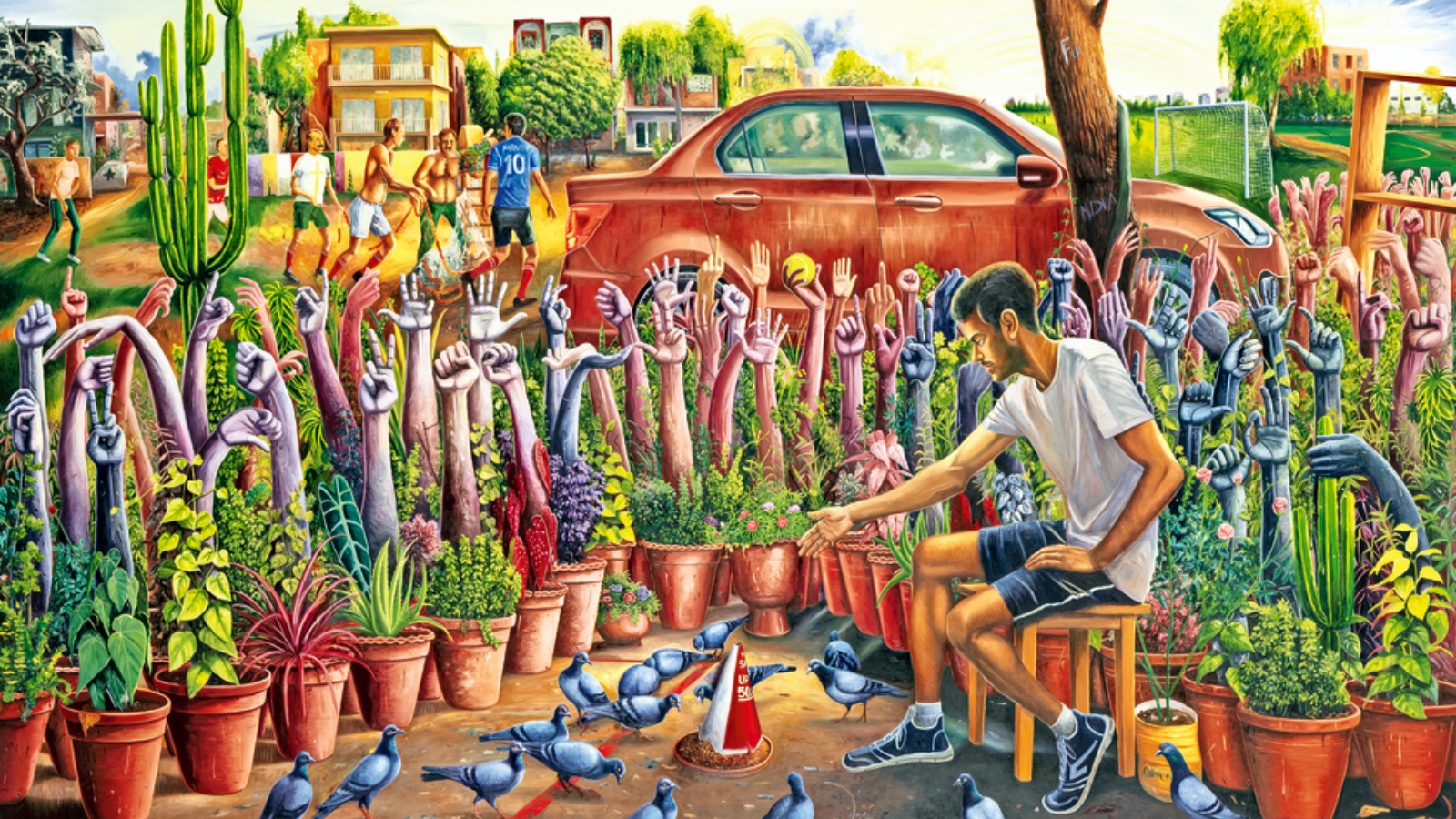
Decades later, those memories find their way into his work, Garden of the Rebellion, where hands point in different directions, recalling revolutionary posters. In the painting, he places these political references against a metropolitan setting – featuring pigeons and people playing football.
Story continues below this ad
The footballers take him back to Malappuram. “The Sevens football culture was part of everyday life there,” he says.
After spending six to seven years in Hyderabad, Balak moved to Delhi around 12 years ago. “I live in Noida now, and the area that I live in made me more conscious of the city’s social divisions and visible hierarchies and the lives of working class people,” he says.
In his artwork When We Last Touched Each Other (2023), people gather around a large ball, their bodies and skin tones bringing together different identities. Balak uses the scene to talk about caste and social hierarchy. “I have observed how a large crowd of people physically comes closer to one another during religious gatherings or disasters. Yet, this closeness does not necessarily erase the divisions that shape their everyday lives… When we are in a crowd, people don’t know each other. They float like a river,” he adds.
In his oil on canvas Dis.em.Bodied H.ours (2026), a trophy-like form represents the female body and how women are portrayed in commercial imagery. Other forms emerge from a childhood memory of collecting cigarette butts discarded by a neighbour and arranging them into different shapes with friends.
Story continues below this ad
Balak, who studied painting at the Government College of Fine Arts, Thrissur, and later at the S N School of Fine Arts in Hyderabad, has explored landscapes, religious satire, migration and social hierarchies over the years.
“It is a continuous process. It is a journey, actually, one episode to another episode,” he says.
KioskNews shows a cleaned-up reading view extracted from the publisher’s page — the original always lives on their site, not ours.