China lures global academic talent with high salaries, research funds and exclusive perks
China has built a network of nearly 200 national and provincial talent programs offering cash bonuses, research grants, tax breaks and other incentives to attract scientists from overseas.
While exhausted travelers queued for airport procedures, South Korean associate professor Shin Young-chul entered a VIP lounge through a red-carpeted passage in just five minutes, without document checks.
It was one of the perks Shin has enjoyed over the past five years since joining the Department of Biology and Chemistry at the Southern University of Science and Technology (SUSTech) in Shenzhen, according to The Korea Times.
Upon arriving in 2022, Shin was classified as a Class C talent under Shenzhen's Peacock Plan. Despite being the lowest tier of the city's talent-ranking system, he received an immediate bonus of 50 million won (US$37,000) and an annual after-tax salary of 240 million won.
He also has access to a $4.5 million cryo-electron microscope at the university and receives priority for research funding. Shin told The Korea Times that South Korea had only five such microscopes, requiring researchers to wait months for access, while SUSTech alone had six.
Shenzhen also helps him purchase a home, find employment for his wife and benefit from an income tax rate roughly one-third of that paid by ordinary high-income earners.
Lucrative offers for top scientists
 |
|
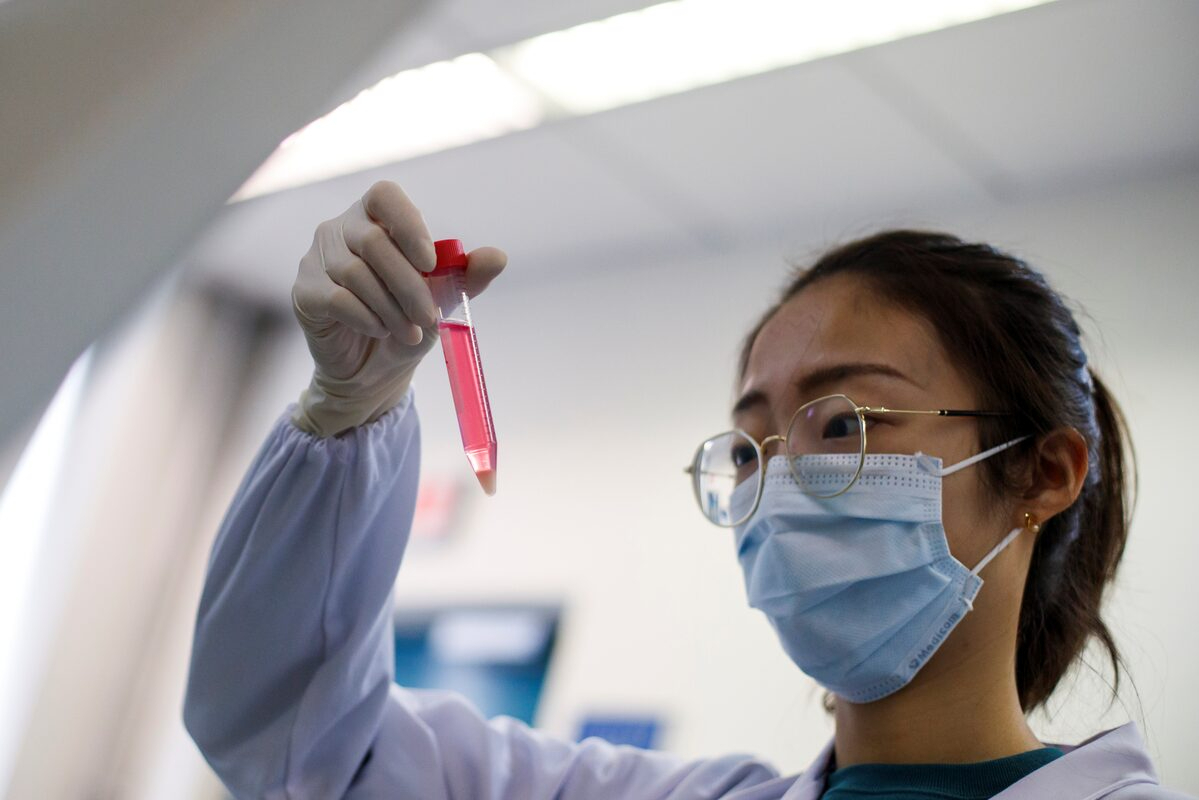
A scientist works in the lab of Linqi Zhang, researching antibodies for possible use in treatment of Covid-19, at Tsinghua University's Research Center for Public Health in Beijing on March 30, 2020. Photo by Reuters |
A report released in January by Shenzhen-based Dongbi Data found that China surpassed the United States in the number of leading science and technology experts for the first time, based on data from 2020 to 2024.
The number of top researchers in China rose from 18,805 in 2020 to 32,511 in 2024, increasing its share of global talent from 17% to 28%. The U.S. total fell from 36,599 to 31,781, with its global share declining from nearly 33% to 27%.
Dongbi Data defined high-level talent as researchers publishing influential work in leading journals. Its analysis covered author data from more than 40,000 highly cited papers published in 129 major international academic journals.
China's extensive recruitment and funding programs are central to this growth. A 2020 analysis by Georgetown University's Center for Security and Emerging Technology identified 43 national-level talent programs and more than 200 subnational initiatives.
National schemes such as the Thousand Talents Program, Young Thousand Talents Program and Changjiang Scholars Program are complemented by regional initiatives, including Shenzhen's Peacock Plan, Zhejiang's Kunpeng Initiative and Shanghai's Oriental Scholars program.
Candidates are typically assigned to A, B or C tiers to determine their benefits. In exchange for a service commitment of three to five years, successful recruits can receive signing bonuses, research grants and other financial incentives.
A Young Thousand Talents scholar joining the Chinese University of Hong Kong, Shenzhen, can receive more than $110,000 in government bonuses and $220,000 to $520,000 in startup research funding. Higher-tier recruits may receive double the signing bonus and subsidized housing, while some international scholars can secure $440,000 to $740,000 in initial research funding, in addition to local government support.
Universities also compete for leading researchers through their own salary and funding packages. Associate professors and tenured professors at Tsinghua University's Yau Mathematical Sciences Center earn between $74,000 and $518,000 annually. Comparable positions at Princeton University in the U.S. pay between $271,000 and $350,000, according to The Daily Princetonian.
Some institutions supplement government grants with matching funds. Shanghai Jiao Tong University, for instance, provides matching funding when young researchers secure government research grants of 1 million to 3 million yuan ($150,000 to $450,000), according to its website.
Universities are also accelerating academic appointments, with some offering tenure-track or tenured positions immediately and greater flexibility in recruiting doctoral students.
For energy scientist Chen Peipei, who recently moved from the University of Cambridge in the U.K. to City University of Hong Kong, access to funding and research teams was a major attraction.
" In Britain, a teaching position rarely comes with research start-up funds," she told the South China Morning Post. "New faculty members are mostly expected to teach, leaving little time to develop their own research."
Rising research investment and US uncertainty
China's recruitment drive is backed by rising investment in scientific research and a growing pool of researchers.
According to the China Fundamental Research Report, supported by the National Natural Science Foundation of China (NSFC), the country's spending on fundamental research nearly doubled from $16.5 billion in 2018 to $31.9 billion in 2023.
Research spending as a share of gross domestic product also increased from about 0.05% in 2000 to approximately 0.17% in 2023. China's full-time-equivalent research workforce expanded by 148%, from 1.21 million in 2010 to 3 million in 2023.
China's share of global fundamental research publications rose from 0.9% in 1985 to 32.6% in 2024. Over the same period, the U.S. share fell from 39.9% to 18.9%, while the European Union's declined from 25.8% to 22.3%.
Lizzi Lee, a fellow on the Chinese economy at the Asia Society Policy Institute's Center for China Analysis, told Times Higher Education that China's expanding research budgets and talent recruitment policies were making the country increasingly attractive to international researchers.
"AI, EVs, new energy, robotics, advanced manufacturing, biotech – talents genuinely see China as being at or near the technological frontier. And Chinese firms are increasingly global household names worldwide and peer competitors with Silicon Valley firms," she said.
Lee added that Chinese technology companies were advancing rapidly and offering compensation comparable to that of their U.S. counterparts.
"Fifteen years ago, a very ambitious Chinese scientist would much prefer doing frontier-tier work in America. Today, the innovation hubs in China also offer opportunities for cutting-edge work," she said.
At the same time, uncertainty surrounding U.S. research funding and heightened scrutiny of China have contributed to the movement of Chinese academics away from American institutions.
The departure of Chinese scholars from the U.S. accelerated in 2018, during Donald Trump's first presidential term, amid espionage allegations and the launch of the "China Initiative." The program triggered widespread investigations into U.S.-based academics of Chinese descent, according to Times Higher Education.
The second Trump administration has further intensified scrutiny of China and heightened uncertainty over research funding.
"Trump's science policy in his second term has accelerated the exodus of Chinese scholars out of U.S.," Yisu Zhou, a professor of public policy and sociology at Duke Kunshan University, told Times Higher Education, describing the trend as "almost unthinkable a decade ago."
KioskNews shows a cleaned-up reading view extracted from the publisher’s page — the original always lives on their site, not ours.