Communications Ministry signs MoUs with 11 universities for digital certifications
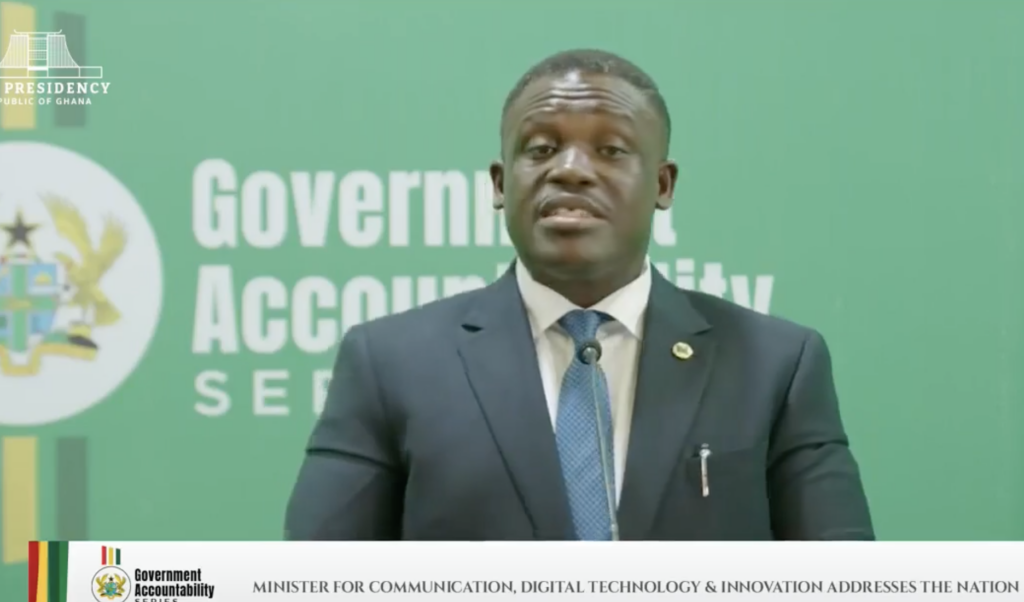
The government has signed Memoranda of Understanding (MoUs) with 11 of Ghana’s leading universities to embed digital certifications into degree and diploma programmes, Communications, Digital Technology, and Innovations Minister Samuel Nartey George has disclosed.
Speaking on Monday, September 7, 2026, at the Government Accountability Series at Jubilee House in Accra, Mr George said the initiative formed part of efforts to equip Ghanaians with relevant digital skills and prepare them for the demands of the digital economy.
He said the participating institutions included the University of Ghana, Kwame Nkrumah University of Science and Technology (KNUST), University of Energy and Natural Resources (UENR), Ghana Communication Technology University (GCTU) and the University of Cape Coast (UCC), among others.
“We have signed Memoranda of Understanding with eleven of Ghana’s leading universities, including the University of Ghana, KNUST, UENR, GCTU and UCC among others, to embed these certifications into degree and diploma programmes,” he said.
Mr George said the government was also working with the Ministry of Education and the Ghana Education Service to expand access to foundational digital skills for young people aged between 13 and 19.
“We are now working with the Ministry of Education and the Ghana Education Service to expand access to foundational digital skills for students aged 13 to 19,” he said.
Strong participation in digital skills programme
Mr George said participation in the digital skills programme had continued to grow, with centre-monitoring data recorded between June 1 and August 15 showing 11,683 cumulative attendances across 118 reporting centres.
He identified Twifo Praso, Daffiama, Sagnarigu, Yendi, and Wamanafo among the highest-performing centres, while the Northern, Greater Accra and Upper West regions recorded the highest participation nationwide.
He said the government was also taking steps to improve accessibility for persons with disabilities.
“In support of inclusion, the National Council on Persons with Disability has submitted a list of centres to be prioritised for accessibility onboarding,” he said.
Mr George said the focus for the remainder of the year would be to convert registrations into completed training while closing the gender gap in participation.
Ghana advances artificial intelligence agenda
On artificial intelligence, Mr George said Cabinet had approved Ghana’s National Artificial Intelligence Strategy 2025–2035 in April.
He said the strategy was built around eight strategic pillars and developed with GIZ FAIR Forward, the British High Commission, the KNUST Responsible AI Lab, the United Nations Development Programme (UNDP) and UNESCO.
This was followed in June by the publication, in partnership with UNESCO and the European Union, of Ghana’s AI Readiness Assessment Methodology report, he said.
Mr George said the government had already trained 240 civil servants in AI literacy.
He also disclosed that, in August, the government, in partnership with the National Communications Authority, Ghana International School and MakersPlace, organised a five-day AI and Robotics Summer Bootcamp for 100 basic school students, 40 per cent of whom were girls.
Between now and December, he said, the government would extend the capacity-building programme to 50 Digital Champions as well as Chief Directors and Directors across the Civil Service.
He said the initiative would be supported by UNDP, the Government of Japan and the UK Foreign, Commonwealth and Development Office.
Digital economy expands
Mr George said Ghana’s digital economy was also growing, with initiatives aimed at helping small businesses participate in e-commerce and digital markets.
He said the GI-KACE’s UNDP-funded MSME Gateway and eCommerce platform, now operated through the Ghana Enterprise Authority, had enrolled more than 350 small businesses.
The platform, he added, was supported by 110 trained Digital Champions from Business Advisory Centres across the country.
Mr George said the initiatives formed part of the government's broader efforts to expand digital skills, strengthen the country’s artificial intelligence capacity, and create greater opportunities for Ghanaians to participate in the digital economy.
DISCLAIMER: The Views, Comments, Opinions, Contributions and Statements made by Readers and Contributors on this platform do not necessarily represent the views or policy of Multimedia Group Limited.
Tags:
DISCLAIMER: The Views, Comments, Opinions, Contributions and Statements made by Readers and Contributors on this platform do not necessarily represent the views or policy of Multimedia Group Limited.
KioskNews shows a cleaned-up reading view extracted from the publisher’s page — the original always lives on their site, not ours.