Carney hails ‘real progress’ in China-Canada ties but suggests US has no need to worry
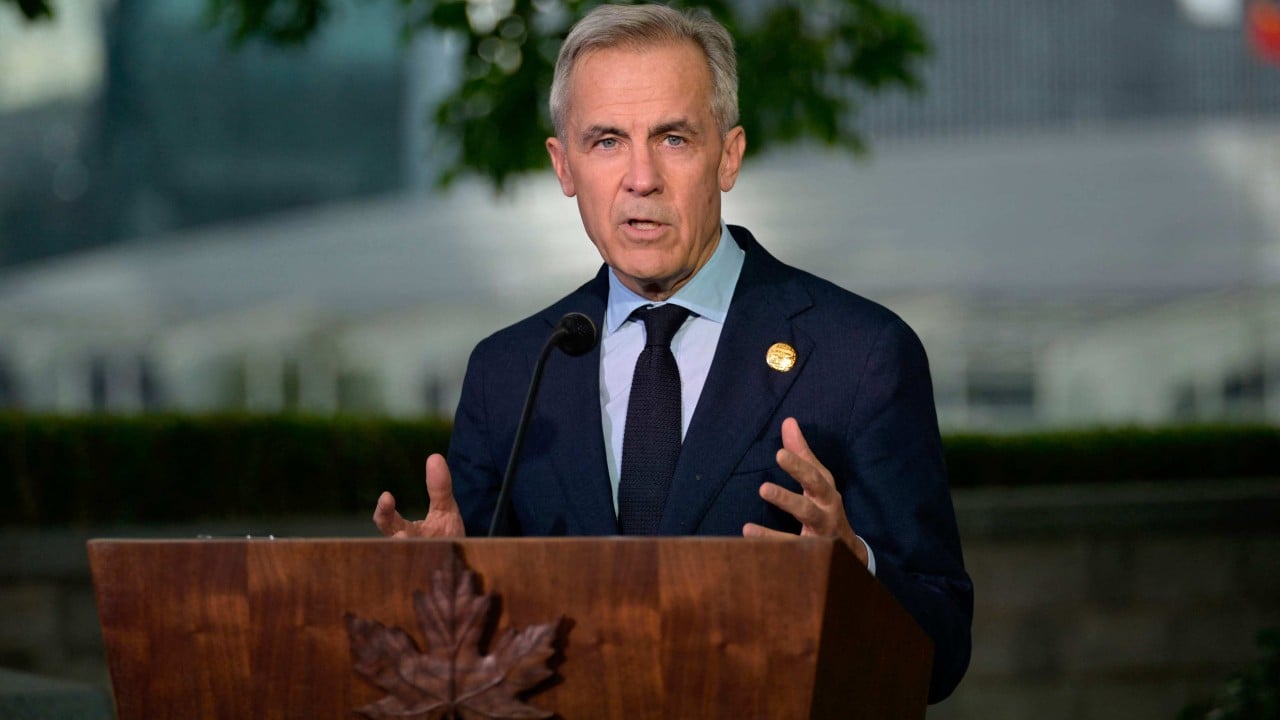
Canadian Prime Minister Mark Carney said on Wednesday that ties with China were “growing on every front” after the two countries agreed to ease trade restrictions, but brushed off suggestions that was a threat to the United States.
Carney also said he had raised the global governance of artificial intelligence when he met Chinese President Xi Jinping the previous day, setting out Canada’s “model for how this governance can be developed”.
After Carney’s meeting with Xi on Tuesday – held on the sidelines of the Asia-Pacific Economic Cooperation summit in Shenzhen – the two sides agreed to expand existing tariff reliefs, further opening the Chinese market to Canadian agricultural and seafood exports.
The agreement will cover around C$400 million (US$280 million) worth of Canadian goods, including frozen pork, fish and seafood. Canada will in return extend tariff exemptions on some Chinese steel and aluminium products for another two years.
The agreement follows Beijing’s pledge earlier this month not to raise tariffs on Canadian canola, peas, lobsters and crabs until the end of 2028.
In a press conference on Wednesday, the Canadian leader said: “There’s some real progress in the bilateral relationship in trade, travel, learning, cultural exchange … Our relationship is growing on every front.”
He added that easing trade curbs would bring “new orders … better prices … [and] greater certainty”, framing it as part of a push to build a “dense web of reliable partnerships” and reduce reliance on any one market.
Asked whether closer ties with China could be seen as a threat to the US, Carney replied: “We are exporting canola, we are exporting pork, we are exporting halibut.
“These are not cutting-edge semiconductors. These are not the types of trade relationship that the United States has with China.”
He added that, relative to the size of its economy, Canada’s trade with China was on a much smaller scale compared with the US.
Relations between the North American neighbours suffered another blow when trade talks collapsed in August and the US imposed 50 per cent tariffs on about US$20 billion of Canadian goods, triggering counter-tariffs from Ottawa.
Carney said the US had “fundamentally changed its trading objectives” but added that he would hold talks with US President Donald Trump later on Wednesday.
According to a statement from the Canadian prime minister’s office, Carney and Xi “agreed on the importance of strengthening cooperation on the global governance of artificial intelligence” and on the need to promote the safe and responsible development of AI use.
Xi calls for elimination of trade barriers in Apec summit speech
On Wednesday, Carney told reporters that there were “enormous risks” that come with AI, and it was “past time to develop global governance frameworks”.
He added: “I took the opportunity in the discussions with President Xi yesterday to share our views on a model for how this governance can be developed, and for us, with respect to China, that is that is the principal area of cooperation.”
Both China and the US are competing to dominate the technology and have been pushing other countries to cooperate with them.
Canada has not signed up to either Pax Silica, the Trump administration’s drive to China-proof AI and chip supply chains, or the World Artificial Intelligence Cooperation Organisation, Beijing’s rival attempt to shape global AI governance.
KioskNews shows a cleaned-up reading view extracted from the publisher’s page — the original always lives on their site, not ours.