Pope Leo diagnosed with cancer as doctors remove part of lung
Already have Rappler+?
to listen to groundbreaking journalism.
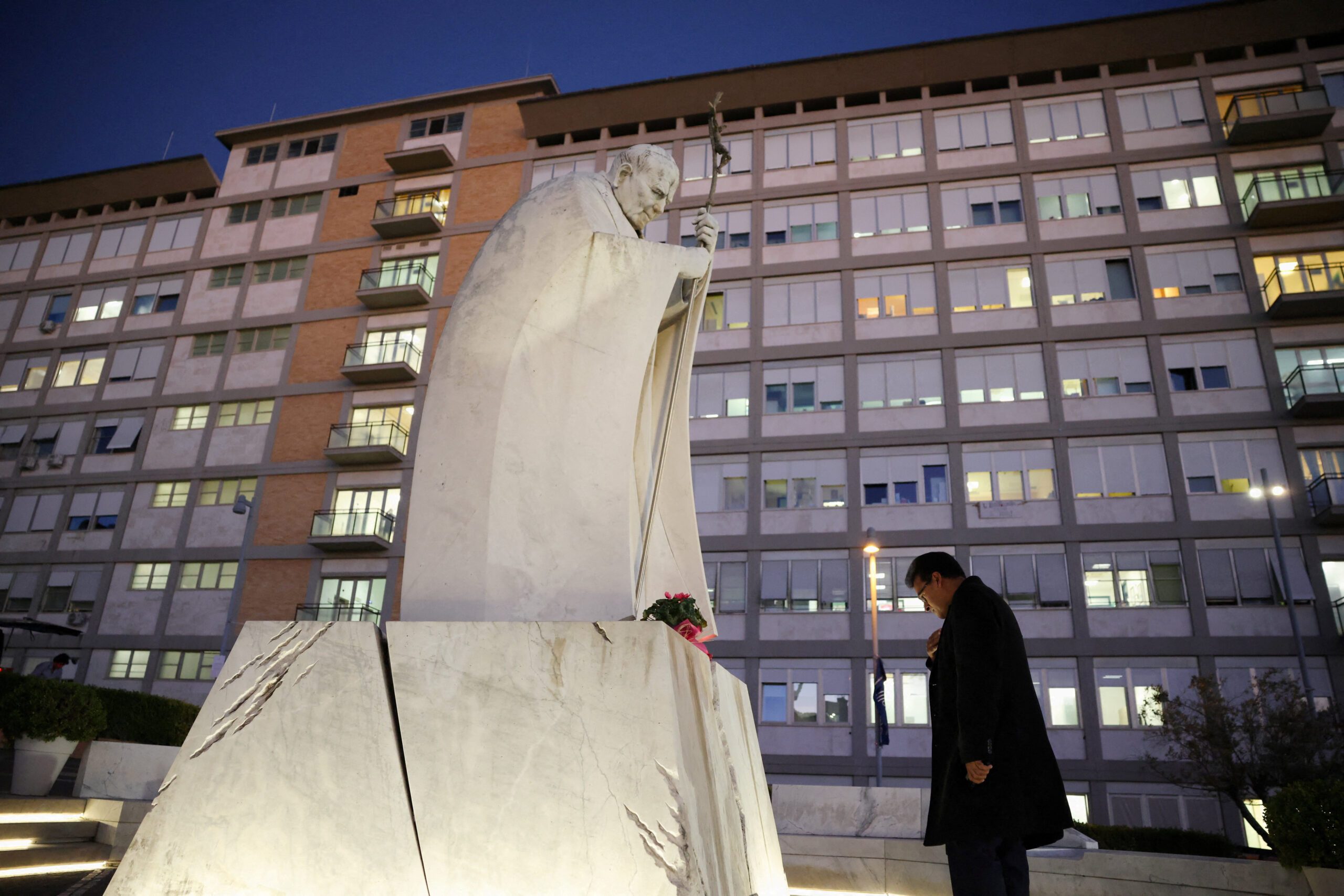
POPE'S HOSPITAL.A man prays before the statue of the late Pope John Paul II outside Gemelli Hospital, where Pope Leo is hospitalized in Rome, Italy, October 13, 2026.
REUTERS
Experts emphasize the need for more information regarding the tumor's size and potential spread to lymph nodes to assess the prognosis and treatment options
AT A GLANCE
- Pope Leo was diagnosed with lung adenocarcinoma after surgery to remove the lower lobe of his right lung, with the operation being successful and no complications reported.
- The Vatican announced that the pope's recovery is expected to take about a week, during which all public events have been canceled until October 20.
This is AI-generated. Read the article for full context. Report any errors.
VATICAN – Pope Leo was diagnosed with lung cancer after surgeons removed the lower lobe of his right lung during surgery on Tuesday, October 13, the Vatican said in a medical bulletin.
The 71-year-old pontiff has lung adenocarcinoma, a common form of lung cancer, with tissue tests conducted during the operation confirming what doctors had suspected from preparatory examinations, the bulletin said.
The surgery to remove a small growth discovered during a recent routine health check lasted about 90 minutes and was successful, with no complications, according to Leo’s lead surgeon, Dr. Stefano Margaritora, and personal physician, Dr. Luigi Carbone.
“In order to make the procedure curative, the lower lobe of the right lung was removed using a video-assisted technique,” they said, indicating that the aim was to eliminate all cancerous tissue.
The pope was admitted to Rome’s Gemelli hospital earlier on Tuesday for the procedure. The Vatican had said his recovery was expected to take about a week.
Leo regained consciousness normally after the operation and returned to his hospital room, where he was resting, the medical bulletin said.
The Vatican said earlier this week that the pope was expected to remain in hospital for about a week. All his public events have been cancelled until October 20.
A medical expert said more information was needed to assess the pope’s condition, including the size of the tumor and whether the cancer had spread to his lymph nodes, details the Vatican did not immediately provide.
“While we have the diagnosis, we do not yet have the stage. This is critical to prognosis and treatment,” said Dr. Stephen Liu, a lung cancer expert at Georgetown University in Washington and division chief of hematology-oncology at MedStar Georgetown University Hospital.
“If this is a small lung cancer with no lymph nodes involved, surgery itself is likely to be curative,” Liu said. “But if final analysis reveals a greater extent of cancer involvement, this indicates a poorer prognosis.”
Leo left the Vatican shortly before 1 pm (1100 GMT) on Tuesday and was seen waving from the back of a black SUV as his convoy traveled about 9 km north to the hospital.
Upon arrival, Leo shook hands with several officials and walked past a crowd of well-wishers, some of whom shouted “Auguri” (best wishes), before entering through the main entrance.
Elected by the world’s cardinals in May 2025, Leo is relatively young for a Church leader. He enjoys sports, including tennis, and is not known to be a smoker or to have had recent health issues.
The late Pope Francis, Leo’s predecessor, was hospitalised several times as he grew frail in his later years. He died aged 88 in April 2025.
Leo, who spoke in a firm, clear voice at his only public event on Monday, October 12, maintains a busy schedule. He is due to make an 11-day tour of Uruguay, Argentina and Peru from November 6 to 17, though it was unclear whether the trip would still go ahead.
The pope is the ultimate earthly authority for the world’s 1.4 billion Catholics and has no deputy who steps in when he is sick. When a pope is incapacitated, the Vatican’s bureaucracy continues its work, holding off on decisions that require papal approval.
Born in Chicago in 1955 as Robert Prevost, Leo served for decades as a missionary and bishop in Peru before becoming pope. In 1985, when he was a young priest, he contracted typhoid fever in Chulucanas, Peru, and was hospitalized.
He recounted the experience in his only major interview as pope, published in a book by Penguin Peru. Leo said the pain was so severe that he asked God to let him die rather than continue suffering. He took his survival as a sign from God that “We need you here (on Earth),” he said.
KioskNews shows a cleaned-up reading view extracted from the publisher’s page — the original always lives on their site, not ours.