Year after Vadodara bridge collapse killed 22, new link on Mahi River opens today
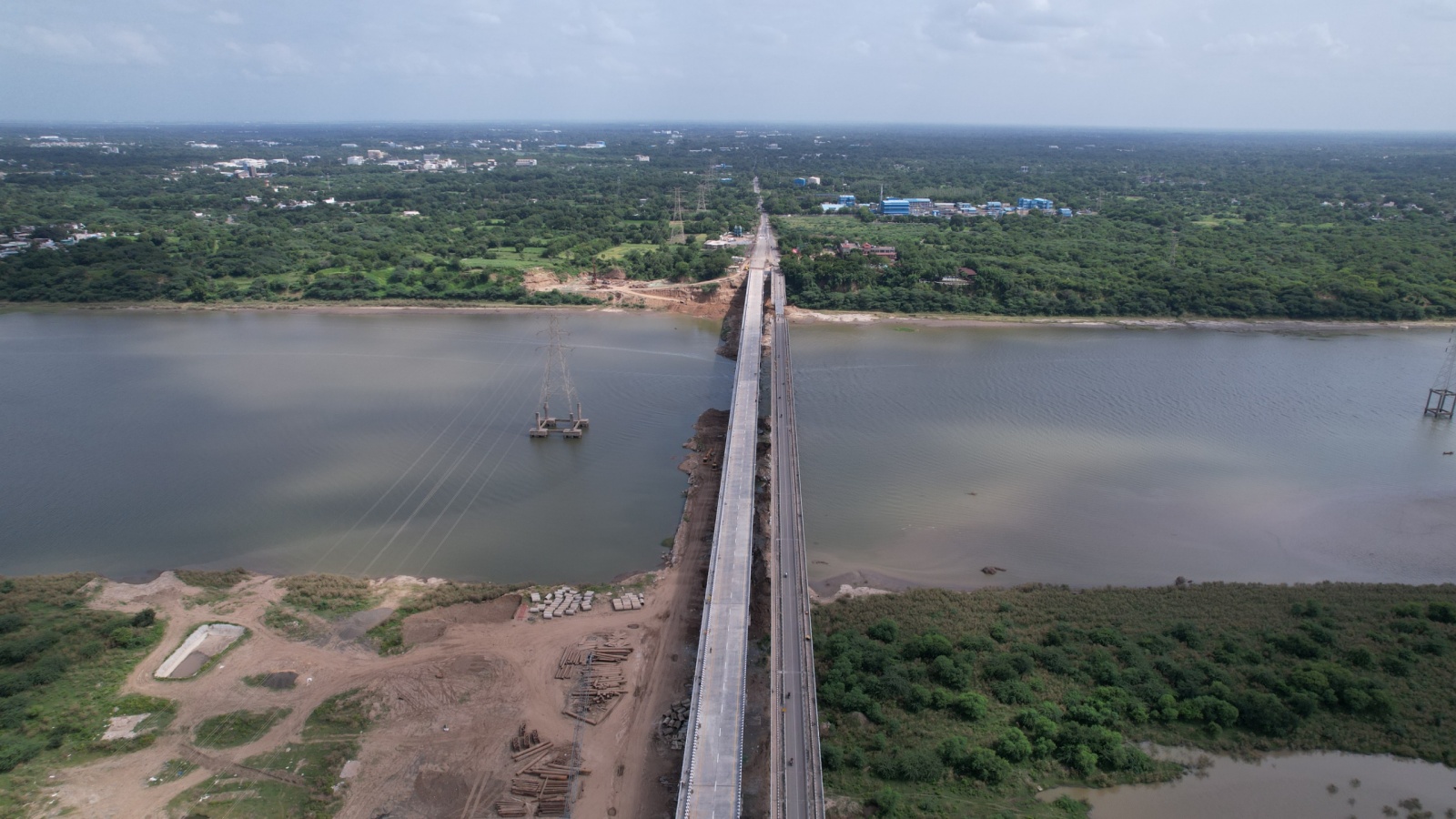
The new Gambhira-Mujpur bridge stands alongside the old structure on the Mahi River in Vadodara district. (Gujarat Government)
Over a year after the Gambhira-Mujpur bridge collapse that killed 22 people in Vadodara district, a new bridge alongside the remains of the broken structure is ready for launch. Chief Minister Bhupendra Patel is expected to inaugurate the new 868.75-metre bridge, which has epoxy-coated steel for better durability, on Sunday, officials said.
Built in 12 months with 23 spans and 21 piers, the new bridge will restore a direct route between Vadodara’s Padra taluka and Anklav in Anand district, an official of the Roads and Buildings Department (R&B) told The Indian Express. As per the R&B department, the bridge construction began on August 14, 2025, and was completed on August 13, 2026 — making it the “fastest” river bridge to be constructed in the state.
Alongside the new bridge, the steel-girder span of the old structure, which was built in 1985, still stands on the Mahi River, also called Mahisagar locally. On July 9 last year, a slab between two piers of the concrete bridge gave way during peak morning traffic hours, plunging vehicles into the river. The bridge would see an average of one lakh vehicles, mostly heavy-duty ones, plying it daily.
The new bridge has been constructed at an estimated overall expenditure of Rs 278 crore, as per the project details shared by the R&B department. Although the project had an “administrative sanction” of Rs 212 crore and a “technical sanction” of Rs 244.16 crore. The construction tender was awarded to the Patan-based Shree Manglam Buildcon Pvt Ltd for Rs 173.56 crore.
The state government attributed the pace of the project partly to “close monitoring by the CMO”, in a statement on Saturday. The note stated that the CM reviewed the progress of the bridge with the R&B Department secretary every fortnight over the past year, sought progress reports and intervened to prevent delays, after granting “administrative approval” to the new bridge within a fortnight of the July 2025 collapse.
The collapse also left students and employees travelling between Padra and Anklav reeling. As an interim measure, the government sanctioned Rs 9 crore for a steel structure on the old bridge to allow two-wheelers to cross. After the temporary arrangement, the old bridge was opened in April this year.
The R&B officials said the new bridge presented its own construction challenges, particularly fluctuations in Mahisagar’s water level and flow. Despite these conditions, the 23 piers were erected, and the structure was completed within the prescribed period. They said that 300 workers were deployed on the project round the clock. The bridge incorporates epoxy-coated steel to reduce the risk of corrosion and improve durability. Officials said precast elements were used to accelerate construction. Inspection platforms have been provided at each pier to facilitate checks of the structure.
Story continues below this ad
“Given the circumstances in which the previous bridge collapsed, safety testing was a significant part of the final stage of the project. Each of the 23 spans was subjected to a 280-tonne load test to assess its capacity. Vibration monitoring and pull-out tests were also conducted, while officials and consultants carried out physical inspections of the bridge’s components,” an R&B official said.
The pull-out test was carried out to assess the strength of the concrete and the grip of reinforcement steel and anchor bolts, while vibration monitoring used sensors to measure the bridge’s response to movement and controlled loads. Officials from the R&B department’s Design Circle, along with a deputy executive engineer and consultants, carried out the physical inspection before Sunday’s opening. “There was no compromise on the construction. This will ensure that commuters using the bridge feel safe,” the official said.
Once opened, the new bridge will restore a direct link for commuters travelling between Vadodara, Padra and Anand, ending the 45-km detour that has been a mandatory consequence of the bridge collapse last year.

Aditi Raja is an Assistant Editor with The Indian Express, stationed in Vadodara, Gujarat, with over 20 years in the field. She has been reporting from the region of Central Gujarat and Narmada district for this newspaper since 2013, which establishes her as a highly Authoritative and Trustworthy source on regional politics, administration, and critical socio-economic and environmental issues. Expertise: Core Authority & Specialization: Her reporting is characterized by a comprehensive grasp of the complex factors shaping Central Gujarat, which comprises a vast tribal population, including: Politics and Administration: In-depth analysis of dynamics within factions of political parties and how it affects the affairs in the region, visits of national leaders making prominent statements, and government policy decisions impacting the population on ground. Crucial Regional Projects: She consistently reports on the socio-economic and political impact of infrastructure projects in the region, especially the Statue of Unity, the Sardar Sarovar Project on the Narmada River, the Mumbai-Ahmedabad High Speed Rail bullet train project as well as the National Highway infrastructure. Social Justice and Human Rights: Her reporting offers deep coverage of sensitive human-interest topics, including gender, crime, and tribal issues. Her reports cover legal proceedings from various district courts as well as the Gujarat High Court (e.g., the Bilkis Bano case remission, POCSO court orders, Public Interest Litigations), the plight of tribal communities, and broader social conflicts (e.g., Kheda flogging case). Local Impact & Disaster Reporting: Excels in documenting the immediate impact of events on communities, such as the political and civic fallout of the Vadodara floods, the subsequent public anger, and the long-delayed river redevelopment projects, Harni Boat Tragedy, Air India crash, bringing out a blend of stories from the investigations as well as human emotions. Special Interest Beat: She tracks incidents concerning Non-Resident Gujaratis (NRIs) including crime and legal battles abroad, issues of illegal immigration and deportations, as well as social events connecting the local Gujarati experience to the global diaspora. ... Read More
Stay updated with the latest - Click here to follow us on Instagram
KioskNews shows a cleaned-up reading view extracted from the publisher’s page — the original always lives on their site, not ours.