NASA’s newest space telescope launches on a quest to explore the hidden universe NASA最新太空望遠鏡升空 探索宇宙奧祕
NASA’s new flagship astronomical observatory was launched into space from Florida on Aug. 10 on a mission to probe some of the biggest mysteries in astrophysics and cosmology.
The Nancy Grace Roman Space Telescope, a roughly US$4 billion project, was carried aloft from NASA’s Kennedy Space Center aboard a SpaceX Falcon Heavy rocket through blue skies just after sunrise, embarking on a potentially decade-long observation mission.
The telescope, which will park itself beyond the moon, is designed to investigate cosmic enigmas such as dark energy and dark matter, while also testing gravity at vast scales and searching for exoplanets — planets beyond our solar system.
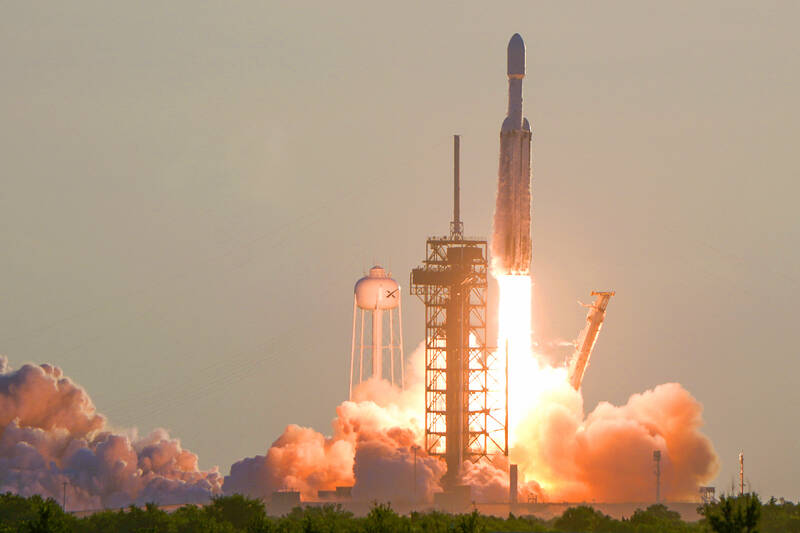
A SpaceX Falcon Heavy rocket with the space observatory Roman Telescope lifts off from launch complex 39A at the Kennedy Space Center in Cape Canaveral, Fla., US on Aug. 30. SpaceX 「獵鷹重型」火箭搭載羅曼太空望遠鏡,8月30日由美國佛羅里達州卡納維爾角甘迺迪太空中心 39A 號發射台升空。
Photo: AP 照片:美聯社
Roman will travel through space toward an orbital location called Lagrange Point 2, situated about 1.6 million km from Earth. Its mission is planned for five years, though the US space agency said the telescope may have enough fuel for five additional years.
Mission scientists will spend the next 90 days commissioning the spacecraft and preparing the observatory for its science operations. It is expected to beam back its first high-resolution images “before the winter holidays,” Roman telescope project manager Jackie Townsend told reporters.
Roman will build on the capabilities of other orbiting observatories such as the James Webb Space Telescope, launched in 2021, and the Hubble Space Telescope, launched in 1990.
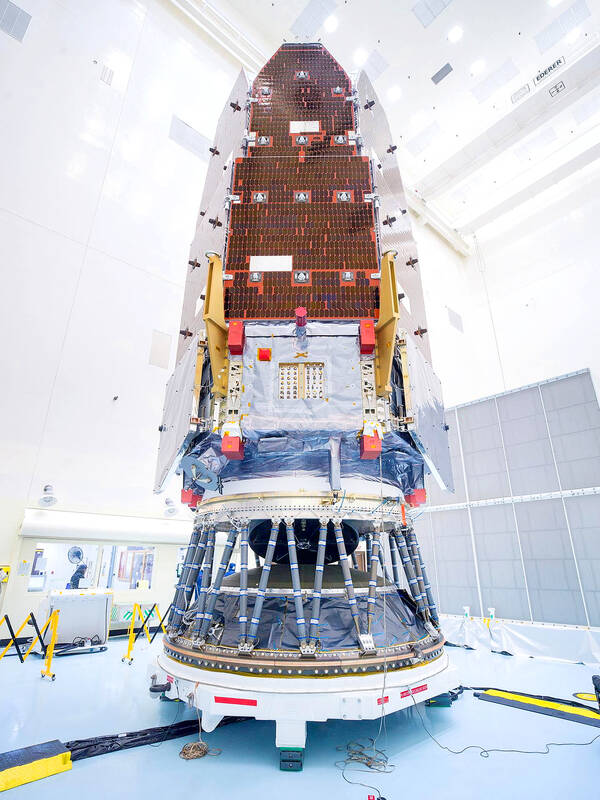
NASA’s Nancy Grace Roman Space Telescope stands inside the Payload Hazardous Servicing Facility at NASA’s Kennedy Space Center in Cape, Canaveral, Florida, US on Aug. 7. NASA 的羅曼太空望遠鏡矗立於甘迺迪太空中心的酬載危險維修設施內。8月7日攝於美國佛羅里達州卡納維爾角。
Photo: Reuters 照片:路透
“It will be as if Hubble and James Webb kind of peered through a keyhole at the universe, while Nancy Grace Roman will kick the door down,” Nicola Fox, chief of NASA’s Science Mission Directorate, told reporters on Aug. 29.
“Roman has broadly the same sensitivity and sharpness of vision as Hubble, but we survey the sky much faster,” Julie McEnery, Roman’s senior project scientist at NASA’s Goddard Space Flight Center in Maryland, told reporters at a briefing in July.
McEnery said one month of Roman observations can survey our entire home galaxy.
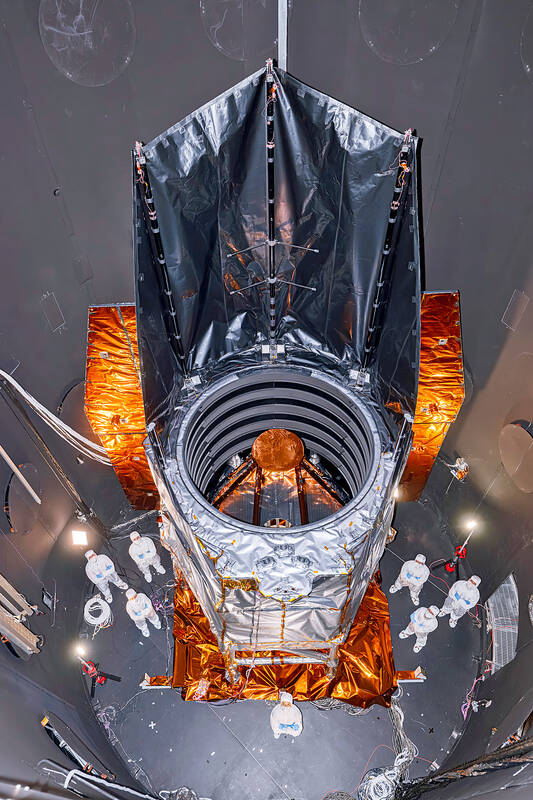
This photo provided by NASA shows one half of NASA’s nearly complete Nancy Grace Roman Space Telescope after it passed a lengthy test to en6sure it will function properly in the space environment, April 1 last year. NASA 羅曼太空望遠鏡接近完工的一半機體。這座太空望遠鏡去年4月1日通過一項耗時甚久的測試,以確保它能在太空環境中正常運作。NASA新聞照。
Photo: AP 照片:美聯社
“One month of observations to survey our Milky Way galaxy would take about a century with Hubble,” McEnery said.
WIDE ANGLE AND ZOOM LENSES
Webb has provided a new understanding of the early history of the universe, finding among other things that primordial galaxies formed sooner and were bigger than previously known. Webb is capable of looking across vast distances and back into deep time, because of the time it takes light to travel.
Roman instead is able to take panoramic views. NASA likens Roman to a camera’s wide-angle lens and Webb to a zoom lens.
Roman will help in the understanding of two mysterious cosmic components — dark energy and dark matter — by creating the most comprehensive 3D map of the universe to date. Its main survey, to take more than a year to complete, will cover more than two billion galaxies.
The Big Bang event roughly 13.8 billion years ago initiated the universe, which has been expanding ever since. Scientists in 1998 disclosed that this expansion was actually accelerating, with an invisible force called dark energy as the hypothesized reason.
The universe’s contents include ordinary matter — stars, planets, gas, dust and all the familiar stuff on Earth — as well as dark matter and dark energy. Ordinary matter represents perhaps 5 percent of the contents. Dark matter, known through its gravitational influences on galaxies and stars, may represent about 27 percent. Dark energy may represent about 68 percent.
Using Roman to gauge dark matter’s pull and dark energy’s push across the universe will bring scientists closer than ever before to solving both mysteries, according to NASA.
Roman also will conduct one of the most comprehensive searches ever for exoplanets. It is expected to discover thousands of new ones and provide the first statistical census of planetary systems similar to our own.
(Reuters)
美國太空總署(NASA)最新一代旗艦級天文觀測器 8月30日於美國佛羅里達州發射升空,其任務是探索天體物理學及宇宙學最大的一些謎團。
這項耗資約40億美元的「南希.格蕾絲.羅曼太空望遠鏡」(Nancy Grace Roman Space Telescope)計畫,由SpaceX的「獵鷹重型」(Falcon Heavy)火箭搭載,在當天日出後不久,從NASA甘迺迪太空中心升空進入藍天,展開這項可能長達10年的觀測任務。
羅曼太空望遠鏡將進入比月球更遠的太空,主要研究暗能量與暗物質等宇宙謎團,同時測試大尺度下的重力作用,並搜尋系外行星,也就是太陽系以外的行星。
羅曼望遠鏡將前往稱為「拉格朗日點2」(Lagrange Point 2)的軌道位置,距離地球約160萬公里。任務原定執行5年,但NASA表示,望遠鏡所攜帶的燃料可能足以再延長5年。
科學家將利用接下來90天進行太空船啟用與測試,並為天文觀測任務做準備。羅曼太空望遠鏡計畫經理傑姬.湯森告訴記者,預計望遠鏡將在「冬季假期前」傳回第一批高解析度影像。
羅曼太空望遠鏡將延續其他太空天文台的能力,例如2021年發射的詹姆斯.韋伯太空望遠鏡(James Webb Telescope),以及1990年發射的哈伯太空望遠鏡(Hubble Space Telescope)。
NASA科學任務理事會主管妮可拉.福克斯8月29日對記者表示:「這就好比,哈伯望遠鏡與韋伯望遠鏡只是透過一個鑰匙孔窺探宇宙,而羅曼望遠鏡則會直接把門踹開」。
位於馬里蘭州的NASA戈達德太空飛行中心(Goddard Space Flight Center)羅曼望遠鏡計畫資深科學家茱莉.麥肯納里7月在簡報會中表示:「羅曼望遠鏡的靈敏度與視覺解析度大致與哈伯望遠鏡相當,但羅曼望遠鏡觀測天空的速度要快得多」。
麥肯納里表示,羅曼望遠鏡只需一個月的觀測,就能掃描我們所處的整個銀河系。
她說:「要完成對銀河系的觀測,哈伯望遠鏡需費時約一個世紀;羅曼望遠鏡只需要一個月」。
廣角與變焦鏡頭
韋伯望遠鏡已讓我們對宇宙早期歷史有新的理解,包括發現原始星系形成的時間,比過去所認為的更早,規模也更大。由於光線傳播需要時間,韋伯望遠鏡能夠觀測極其遙遠的距離,也就等於回望宇宙遙遠的過去。
羅曼望遠鏡則能夠拍攝宇宙的全景影像。NASA將羅曼望遠鏡比喻為相機的廣角鏡頭,而韋伯則像是變焦鏡頭。
羅曼望遠鏡將繪製迄今最完整的宇宙三維地圖,以協助科學家了解兩種神秘的宇宙成分——暗能量與暗物質。這項主要巡天觀測任務預計耗時一年以上,將涵蓋超過20億個星系。
約138億年前發生的大爆炸(Big Bang)開啟了宇宙,而宇宙此後便持續膨脹。科學家在1998年公布的研究指出,宇宙膨脹其實正在加速,而假設中的一種無形力量——暗能量——可能就是造成加速膨脹的原因。
宇宙的組成包括普通物質——恆星、行星、氣體、塵埃,以及地球上所有我們熟悉的物質——還有暗物質與暗能量。普通物質可能只占宇宙總成分約5%。暗物質可透過其對星系與恆星產生的重力作用被觀測到,可能約占27%;暗能量則可能約占68%。
NASA表示,利用羅曼望遠鏡測量暗物質在宇宙中的引力,以及暗能量推動宇宙膨脹的力量,將使科學家比過去更可能解開這兩大謎團。
羅曼望遠鏡也將進行有史以來最全面的系外行星搜尋行動之一。預計將新發現數千顆太陽系以外的行星,尋找類似我們太陽系的行星系統,並建立首次統計普查。
KioskNews shows a cleaned-up reading view extracted from the publisher’s page — the original always lives on their site, not ours.