COP31 extended as countries unable to reach an agreement
The COP31 climate talks yesterday spilled into extra-time as countries were scrambling for a deal after a proposal dropped all mention of fossil fuels, exposing deep divisions over how to tackle global warming.
Negotiators worked through the night in Antalya, Turkey, to try and unblock an impasse over energy, finance and science as the summit sailed past Friday’s scheduled closing time without a deal in sight. Australia, which is presiding over the formal talks, raced against the clock to produce a revised draft deal, with many delegates due to catch flights home after two weeks of exhaustive negotiations.
The EU has warned the existing version “risks turning this climate COP into a fossil summit.”
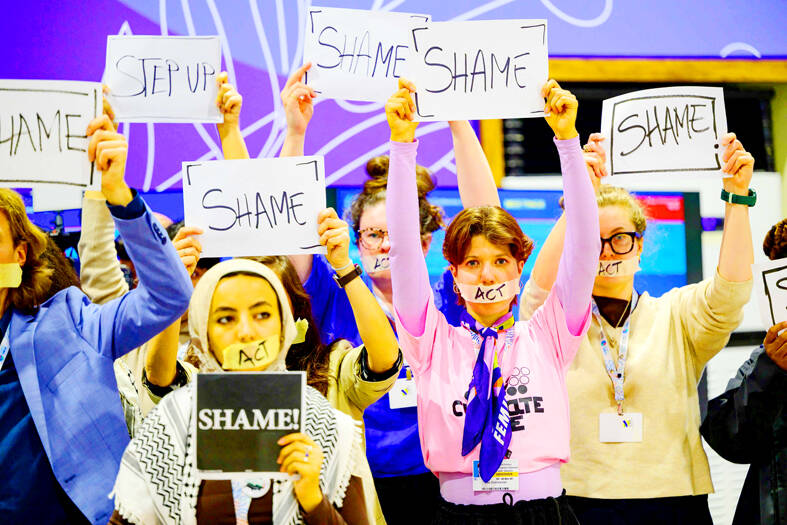
Activists hold a silent protest outside the plenary hall where delegates met during the COP31 meeting in Antalya, Turkey, on Friday.
Photo: AFP
“We are not going to give up easily,” European Commissioner for Climate, Net Zero and Clean Growth Wopke Hoekstra said yesterday after huddling with ministers from across the 27-nation bloc. “And at the same time, if we don’t meet the bar, well then the bar is not met, and there is no deal. That’s the reality of where we are.”
Expectations of a major breakthrough in Antalya were low as countries grapple with an oil price shock and geopolitical tensions stemming from the war in Iran.
The summit follows a string of climate-linked disasters from Europe to Nepal and Indonesia, and unfolds as a super El Nino pattern amplifies the risk of further extreme weather.
A draft deal unveiled earlier this week called for a faster phase-out of fossil fuels, a flashpoint at UN climate talks where producers such as Saudi Arabia have fiercely resisted such calls.
A second, pared-down draft released on Thursday stripped away all mentions of fossil fuels — sending negotiators rushing back to the bargaining table.
A dozen European and developing countries — from France to Panama and the Solomon Islands — on Friday released a letter insisting that the deal include “a clear transition away from fossil fuels.”
Panama, which also signed the letter, threatened to walk away from the talks. Panamanian Minister of Environment Juan Carlos Navarro is a vocal critic of the climate negotiations, accusing a “petroleum mafia” of blocking progress.
Meanwhile, the OPEC oil cartel wrote on social media that its secretary-general Haitham al-Ghais met Russian presidential climate envoy Ruslan Edelgeriev at COP31 to discuss “the importance of inclusive and balanced approaches across all multilateral environmental fora.”
The latest draft “cover decision” proposed a target to electrify the global economy — a push to replace technologies that burn fossil fuels directly, like diesel cars and gas heating, with electric alternatives.
The goal is championed by COP31 hosts Turkey and Australia, who tout “electrification” as integral to tackling concerns over energy security and sluggish global progress in cutting heat-trapping emissions.
“Electrification is the key to transitioning away from fossil fuels,” said Australian Minister for Climate Change and Energy Chris Bowen, who is chairing COP31 negotiations.
The proposal calls for countries to boost the global share of final energy demand met by electricity to 35 percent by 2035.
However, it does not specify that the additional electricity must come from renewables rather than coal or gas, spurring some countries to demand an explicitly “clean” target.
Some countries also rejected a proposal to ramp up carbon capture, dismissing it as a costly, unproven technology that could allow polluters to keep burning fossil fuels.
KioskNews shows a cleaned-up reading view extracted from the publisher’s page — the original always lives on their site, not ours.